'For us, mobile is a very dear thing, but what will happen if we get addicted to it? The story of the film 'Jhilko' is yours.
We use Google Cloud Translation Services. Google requires we provide the following disclaimer relating to use of this service:
This service may contain translations powered by Google. Google disclaims all warranties related to the translations, expressed or implied, including any warranties of accuracy, reliability, and any implied warranties of merchantability, fitness for a particular purpose, and noninfringement.
Mobile while eating, even in bed before sleeping. Mobile as soon as you come home from school, mobile when you open your eyes in the morning. While mobile in the toilet. 'Jhola' director Yadav Bhattarai has made a new film 'Jhilko: The Spark' covering the story of people who cannot run their daily lives without mobile phones. In this film, which will be screened from April 19, director Bhattarai has picked up the story of a middle-class family to show how the virtual world is ruining the human world.
In Jhilko there are responsible parents, and innocent children . How can children be pushed towards the virtual world by the carelessness of parents? The story of the film revolves around the circumstances that lead to it. 'Suddenly mobile came in our life. We continue to consume it without understanding what its special utility is. We also trapped ourselves, we also kept trapping our children,' said Bhattarai, 'just as drug use is dangerous for society and family, the same kind of problem happened in digital addiction . Alcohol, cigarettes are accepted as drugs. However, we did not understand that the mobile phone will have the same effect. Mobile has become an all-acceptable drug.' By creating a
research group, Bhattarai studied children and mobile phones - how are children leaving social interaction and enjoying the virtual world? Bhattarai's group has studied this subject thinking how mobile is making people lonely who should participate in social interaction and live in society. 'There is no world beyond mobile . Going beyond this started to make people panic and afraid. It caused problems. We made the film keeping that in mind,' he said.
According to , Bhattarai says that the film has been made to raise awareness about the use of mobile phones as they affect all four aspects like physical, mental, emotional and psychological. 'For us, mobile is a very dear thing . But, what happens if you fall under the influence of it? Jhilko's story is yours," said Bhattarai. Is
only a mobile problem? Of course not . The only problem is carelessness in its use. It can be used wisely, it makes life easier. But, if it is not used wisely, it affects life. This For this reason, the director named the film 'Jhilko'. According to director Bhattarai, the Internet is a spark of fire. Used in the right way, it makes work easy . However, if you fall into its intoxication, life becomes chaotic. Director Bhattarai thought of making a film on this aspect of the Internet 3 years ago.
'The spark of fire can also be used correctly by humans . It is dangerous for all other creatures. However, it has been useful for us in a controlled, judicious manner . If we don't pay attention, it will affect us,' said Bhattarai. Bhattarai initially thought of making a short film on the subject. However, after understanding the depth of 'digital addiction', he decided to make a film.
'Now digital addiction has increased crime . However, the state has not been able to understand that this is a problem. It has not come from any related body. Its misuse can be dangerous,' Bhattarai said, 'We have to accept that this is a problem.'
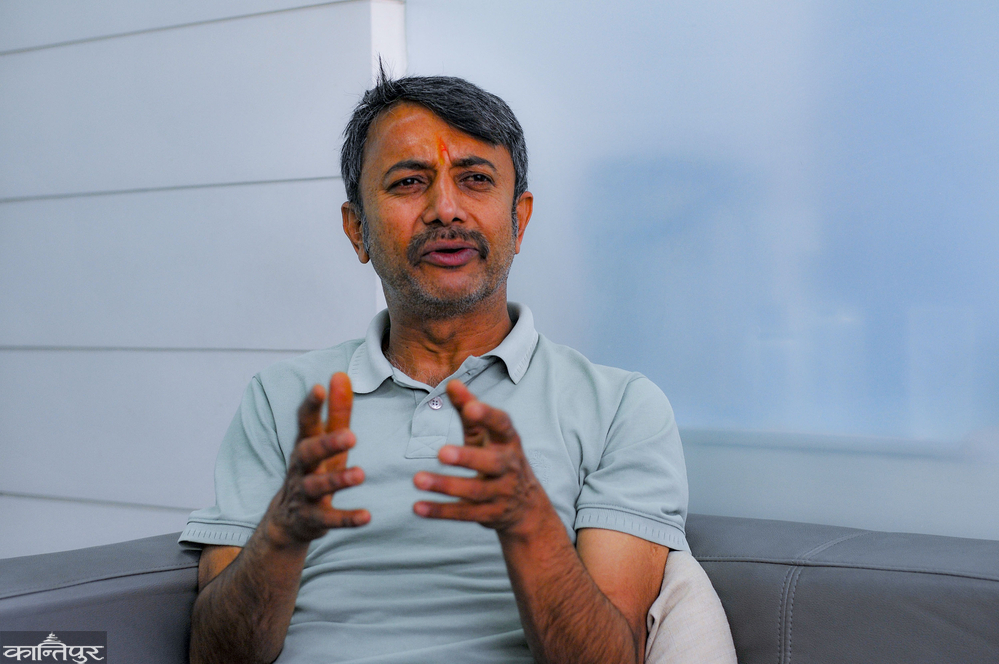
The story of 'Jhilko' is taken by director Bhattarai from the life of his close friend. That friend's child pronounces only three words well, but does not speak to anyone. After that, Bhattarai got closer to the problem. Both the child's parents are busy with work, and the elder daughter is also at school. After they stopped hearing their child's speech, the couple reached the hospital in panic. After reaching the hospital, it was found that the child has 'virtual autism'.
That's why the child used to sing the songs he heard on the mobile phone and used to dance. But, when someone tried to speak, he could not even answer it. After the child's condition, the mother had to leave work and take care of the child . 'In 3 years the child improved but he again reached another world . A lot of talking happened. Especially when the parents try to avoid their responsibility, they hand over the mobile phone to the child . But children are heading towards digital autism . I made it clear that their families should understand that,' Bhattarai said, 'What a material impact it has had on our lives, especially since we don't have a mobile phone! Life went on without mobiles, didn't it? When we don't use it the way we should use it, it is controlling us.' Director Bhattarai, who gained fame from
'Jhola', entered the film industry to become a hero. After his school play 'Zindagi' garnered praise, he became a hero. When he came to Kathmandu from Jhapa in 2047, he worked as an assistant director in a video film called 'Manmandir'. In order to become a hero, he turned to assistant direction. The film ran, he also acted in it. However, after not seeing a future in films, he turned to journalism. While doing journalism for 6 years, the dream of film did not leave .
Then worked with Deepak Alok in 'Padeshi'. Worked in 'Faisla', 'Silsila'. Rekha became Thapa's father in 'Silsila'. Meanwhile, Krishna read 'Jhola' written by Dharavasi. As soon as he read it, he dreamed that a film should be made on that story. While carrying the story for 7 years, some people suggested putting songs in the film . Some asked to keep the action scenes . However, Yadav was confident that the film would run without songs and action. 'I was confident that I could present that story vividly,' said Bhattarai. After running the bag, Yadav made 'Bhor'.
When he came to the film industry with the dream of becoming a hero, the aesthetic consciousness of that time was different . To be a hero, you have to be good, but he is weak . After doing 'Jhola', Yadav found out that he is more suitable for directing than acting. 'The director gets to act as much as the actor behind the scenes in the film. Why did it have to be done behind the scenes? So at that time I thought, I have to direct the film now,' said Bhattarai. It is the practice of
journalism that made Bhattarai make films on social themes. Now he is enjoying directing .

