'Vasant' not only inter-caste love, but also the ranks of the revolution, the pain of foreign employment, the Dalit issue and the politicization of it. But in the absence of a solid screenplay, the echoes of the community oppressed by the caste system do not resonate.
We use Google Cloud Translation Services. Google requires we provide the following disclaimer relating to use of this service:
This service may contain translations powered by Google. Google disclaims all warranties related to the translations, expressed or implied, including any warranties of accuracy, reliability, and any implied warranties of merchantability, fitness for a particular purpose, and noninfringement.
It is said that, wherever it flows, it flows! The same is the case with stories. Not only the plot and plot but also the story can be flowed wherever you want. For that, the director had to be skilled in story-craft. Otherwise, the story will lose its way. There is not much interest in a story without a destination, the ups and downs in it do not even attract attention.
Director Prakash Saput's film 'Vasant', who made his directorial debut with a lyrical story, shows the lack of this skill. 'Basant' has failed to rise above Bollywood films with weak screenplay, exaggerated dialogues and messages. As the world that the film is trying to create is not established in a credible manner, the issue of caste discrimination that 'Vasant' tries to raise has become superficial.
The story of the film is Vasant Vick (Prakash Saput). He wants to be a writer . He wants to remove discrimination from the society through his poems and writings and raises his voice against injustice. He has the courage to speak to the teacher against evil. However, when it comes to love, there is no clear speech. Despite being a progressive thinker, Vasant feels that falling in love with the supposedly upper caste Shanti Sharma (Swastima Khadka) is like 'flying a heavy stone as a balloon'. So he is gentle in love, or let's say his love is weak . On the other hand, Vasant seems to be insolent to help nurture the inter-caste love between friend Prem Chhetri and sister Sapna Vishwakarma. But will the inter-caste love of these couples spark rebellion in the society?
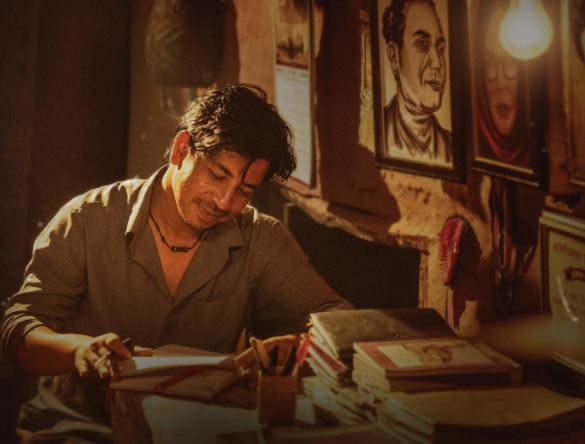
'Vasant', not only inter-caste love, but also connected many topics from the rank of revolution, the pain of foreign employment, the Dalit issue and the politicization of this issue . However, if these themes are not woven into the screenplay in a tight manner, the voices of those who are oppressed, oppressed and oppressed by the caste system will not resonate as loudly as they could through the film. As a result, the film covers all the topics it tries to touch on. As the
film leans more towards the narrative style of Bollywood, most of the scenes are entangled in exaggeration. As such, a long time has been spent establishing the Vasant character in the film. While the character of Vasant is being established as a 'hero', Shanti (Swastima Khadka), another major character of the film, studies in the same school with him for a long time. Or it is not obvious that they don't read . Most of the scenes in the film are longer than necessary. There is no colloquial language used in the dialogue. Literary journey started in the spring, it is the same thing to spread the literature. However, when other characters also speak in the same speed and style in a literary dialogue, it does not sound believable . In most of the scenes in the film, the message is imposed only . Especially when making a film on a serious issue like caste discrimination, the film could spread the message artistically through the story. However, in most of the scenes, when the slogans of big speeches are repeated, they are imposed in the dialogue. While in the film, there are many elements that can be conveyed in a symbolic style through the story.
Due to weak screenplay, the story of the film is losing its rhythm . Yes, Vasant wants to become an author by writing the book 'Society vs Society'. But, what kind of struggle does he struggle to become a writer? The director has not paid much attention to this aspect. In the film, the main character is not shown to struggle much for his purpose . The problems that come in his life are solved. In this way, the character who continues to advance the story easily fights with the problem, and the line of reading the story becomes weak . And, the attention of the audience begins to wander. Until the midway point, the story revolves around inter-caste love, friendship and a society that discriminates against Dalits. But, when the main character is detained for some incident . Then the destination of the story disappears . One after the other incident is forced rather than according to the demand of the story, the establishment of that aspect is done hastily . When a couple commits suicide due to interracial love, then politics gets involved in the incident. Since the rhythm of reading the story before that cannot be grasped, it seems that politics has been forced here . Then human rights activists join again. And foreign employment is added, a changed society is shown. In particular, these topics are shown only to show, but it is not strong enough to be raised in the story.
This is the most disturbing part of the film, background sound . The film has tried to create a unique sound for the lead characters. A special sound is played in the background to introduce the friend when he comes to the screen. However, the rhythm of this sound is not simple. Therefore, in some scenes, the use of sound has disturbed the sense of the story. Sound in particular creates the 'mood' of the story, character and situation. It binds the audience to the story. But, when the scene changes from one to another, the sound that needs to continue the feeling has become an obstacle. The film could have been tightened even in the editing . No matter how many songs were removed, the story of the film would flow smoothly.
The story of caste discrimination that 'Vasant' tries to raise is very strong . This movie has interracial love . There are friends who protect friendship by crossing the caste wall, there is a society that keeps protecting that wall . And within that society, there is the pain and sorrow of Dalits who are oppressed. In the film, there is a campaign against discrimination, there is a movement, there is a revolution. There are leaders who do politics by hiding the issue of Dalits. Especially in this film, the face of Nepali society is reflected. For years, there is a group that does not consider a section of society as human, there is a culture and there is superstition . There are also some memories. For example, it is believed that money will be found by inoculating butterflies. A beautiful way to add name to favorite person by writing 'plus' is shown . There is a love dialogue through the pages of a book. He has the courage to stand against the caste system, he has the courage to fight caste discrimination. There is a dream of ending caste-based untouchability. An inclusive and equitable society is envisioned . As a
, few have made a film on this issue that has become a problem in Nepali society. And, as many as the issue was brought up, they had to face the same question – were they worthy of telling the story? Especially when there is a community in the world, a sensitive issue is being raised, the storyteller must face the same question - are you the right person to tell this story? Recently, when the director and writer of the alleged upper caste made a film on the Dalit issue, those filmmakers also faced the same question in Nepal. The director and writer of the same community was waiting to tell the story of the Dalit, as Khukuri did not know. In that sense, Saput was perfect for storytelling. However, due to the lack of story-telling experience, he has failed in the form in which this story could have an impact on the society. After all, movies are not just entertainment. It creates a debate, warns the society . And the idea about a subject becomes clear, it makes the society sensitive and responsible. The practice of 'Vasant' was insufficient to make the society aware of such an important issue.
This film has a scene with actor Rajesh Hamal . Before Hamal appears, a character says, - The hero is yet to come. As Hamal enters the story, it satirizes that this film is stuck in the narrative style of Hamal's era.
Only the heavy dialogues and speeches spoken in the films of Hamal's era have been imposed on 'Vasant'. However, the finer side of fighting against discrimination and injustice has not been shown. Only in dialogue, it is not enough to say ``remove differences''. The film has the ability to make people aware and sensitive to the extreme trauma of discrimination. Let's hope that Saput, who could not come close to that strength, will correct these weaknesses in the 'sequel'!

