The resolution of the Kalapani-Limpiyadhura dispute depends on the confidence of the leadership and serious diplomatic skills rather than cheap sloganeering for momentary popularity. Local sensitivities should also be taken into account.
We use Google Cloud Translation Services. Google requires we provide the following disclaimer relating to use of this service:
This service may contain translations powered by Google. Google disclaims all warranties related to the translations, expressed or implied, including any warranties of accuracy, reliability, and any implied warranties of merchantability, fitness for a particular purpose, and noninfringement.
Tinkar in Darchula district is the last village in far north-west Nepal and also the farthest settlement from Kathmandu. This small and beautiful village with about seventy households is inhabited by people from the Shauka (Vyasi) community. After the implementation of the new constitution, the Byas Rural Municipality has been restructured by merging the previous Byas, Rapla, Sunsera, Dhaulakot and Huti Village Development Committees (Gavis). Byas gavis (Changru, Tinkar) of the past is now ward no. 1 have been.
In the first week of May (1st-7th) I was visiting the northern border areas including Changru, Tinkar in Darchula district. The process of reaching Tinker was the same. Tinker and Changru residents migrate with their livestock for 6 months a year to avoid snowfall. They have separate places in Khalanga, the headquarters of Darchula, to live in winter and do business. Ward office, school, health center will also move there. When I arrived, they had just reached the village and were plowing the fields. They were getting ready to plant seasonal vegetables such as potato, phapar, barley, napal (bote wheat) in the high Himalayan region.
After seeing a new face in a small village, it is natural to ask who came and why. Similarly, when I reached Tinkar, they were wondering why an elderly person had come so far from Kathmandu. In the course of the conversation, their main concerns are two things — firstly, whether the border with China will open or not and secondly, when the road will reach Tinker. For years they have been asking everyone who comes to Tinker. Tinkar is not only a small remote village but also a place of strategic importance linked to Nepal's national security. After the Indian capture of Kalapani, Lipulek, Tinkar is the only option available to us to connect the north-west border with China. From here you can reach Taklakot and Mansarovar in China. The people of this area including Tinkar, Changru, and other people of this area can go to Taklakot to do business. On top of that, if the road is also connected, their life will be easier.
Firstly, reaching Darchula is difficult. Tinker is very difficult! The road distance from Kathmandu to Darchula headquarters is about one thousand kilometers, traveling by bus takes more than 36 hours. A grand national plan for the construction of the 425 km long Mahakali Corridor from Brahmadev in Kanchanpur to Tinkar in Darchula is under implementation. About ten kilometers below the headquarters Khalanga, the construction of a motorized bridge over the Mahakali river is nearing completion. After the bridge is opened, that place will be the center of Nepal-India trade and business. About 113 km of road construction is going on in Darchula to Tinkar section. About 26 km unpaved road has been prepared till Sunsera, the center of Byas rural municipality, jeeps have started running. The remaining 87 km road is being constructed by the army. After the completion of these roads, the face of Tinkar, Changru is certain to change. But it is not possible to say how long it will be completed, it is not possible to predict that the traffic will run on that road for a decade.
Even after reaching Darchula, I knew that it would not be easy to reach Tinker, moreover, I was the only ordinary traveler. If possible, the idea was to go through Nepal's one-way route. I also went to Huti village in the year 2034 during that Panchayat period. At that time, a student studying at the postgraduate level in Tribhuvan University had to go to a village school for a year and do social work as well as teaching. I was there to supervise them. Huti is now a ward of Byas Rural Municipality. Tinker could not be reached based on my old travel experience. I thought that this trip would be easier if I could contact the armed police, they are also working in the border area. The armed forces officer stationed at Darchula facilitated my journey.
It is almost impossible to go to Tinker through Nepal. Due to lack of maintenance, the old roads have been destroyed, some have been taken away by landslides. There is no place to take it. Earlier, when the road to India was not built, the Indians of that region used to come and go through Nepal. But now, sometimes the army goes through what is called 'Himali Yatra'. Helicopters are used by high-ranking government officials including army, armed forces, police. The big bosses are also inspecting the progress of road construction from a helicopter. Local residents, employees and other Nepali travelers cross the Mahakali from Jholunge Bridge or Tuin via India. No matter how loud the announcement is from Kathmandu to free Tuin from Nepal, the daily life of the people in the remote villages is still connected with Tuin. Local residents of Vyas Rural Municipality Ward No. 2 and 5 cross the Mahakali River across Tuin. In this process, some have even lost their lives.
Ward No. 1 Changru and Tinkar have to cross the Mahakali river from a place called Sitapul through Bundi, India. That area has been declared a 'controlled area' by the Government of India. Indian citizens should also take permission to travel that way. After the District Coordination Committee (JESUS) Dharchula proved that the applicant is a Nepali citizen "living in the Nepali area within ten kilometers of the Nepal-India border", the District Magistrate Office of India, Dharchula, gives a "multiple travel permit" to Bundi, Garbag and Sitapul for 6 months. I was disappointed after looking at the form, I am not a resident of Darchula, nor do I hold any public or government post. There was no place to complain when I was not allowed. I had to use the Indian route to visit Tinkar. But there was no problem, Jesus proved it and the Dharchula administration gave permission.
Tinkarvasi's desire to go to Taklakot and do business seems to be fulfilled this year. The Nepal-China border, which was closed due to the outbreak of the Covid epidemic, has started to open since last year. Other checkpoints are opening this year. Tiptala, Kimathanka crossings in the east have been opened. The local administration has indicated that the Tinker crossing will also be opened in the second week of June. Tatopani-Khasa and Rasuwa-Kerung crossings are of national importance for Nepal-China trade. Most of the bilateral trade by road takes place from these places. But for the Nepalese who live in the difficult Himalayan region from Taplejung in the east to Darchula in the west, the local border crossings are very important. Not only commercial transactions are connected with these checkpoints, but also their history, culture, society and daily life. They carry the same civilization and culture for thousands of years. When these checkpoints are closed, the local residents become agitated and squeamish. Some have migrated. I have experienced it firsthand during my visits to these places.
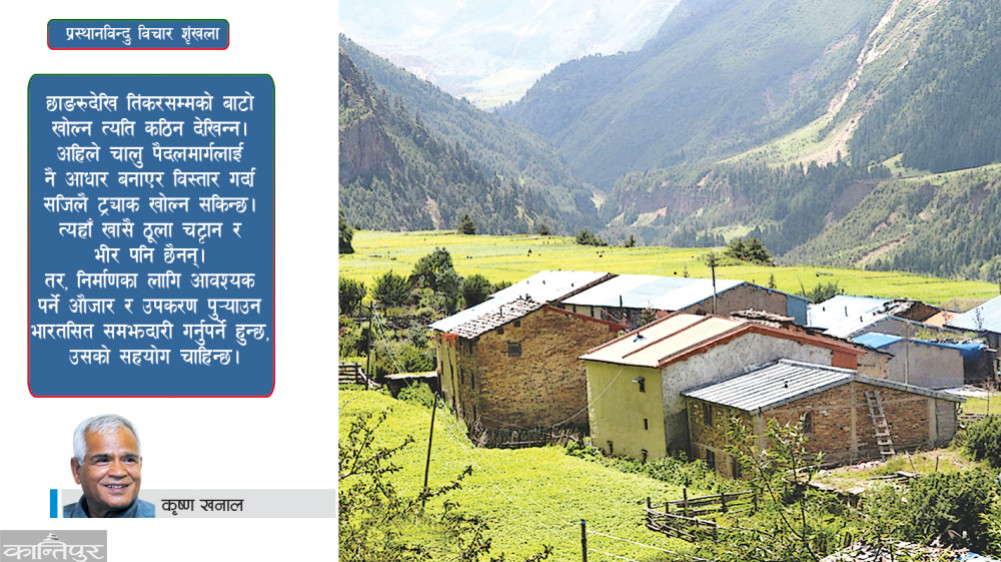
As far as the road is concerned, the residents of Tinkar say - 'It will take a long time for the road to reach Tinkar from Nepal's road through Chattani Bhir. The importance of the road being built through Nepal's land is its own, let that work continue.' Now they travel from Dharchula to Sitapul via the Indian route. They bring their daily necessities. There is an Indian border post at Sitapul, where records are kept along with the visitor's permit, goods are checked. There does not seem to be much disruption at the border for local residents to bring their essential goods. At Sitapul, the locals cross the Mahakali from Kathepul. This is also the way to enter Changru, Tinkar from India. Changru-Tinkar Valley begins from there. The lower part is called Changru Gaga, there are only eight to ten houses. Changru village with about 160 households is a little higher. Tinkar village is reached at a distance of about 13-14 km from Gaga. If there is a road in this section, the life of the local people would be a little easier, and it is the wish of the local people that consumer goods would be cheap and easy to get.
It doesn't look that difficult to open the road from Changru to Tinkar. Expanding the existing footpath as a base can easily open up the track. There aren't too many big rocks and cliffs. Yes, an agreement should be made with India to supply the tools and equipment required for construction, its support is necessary. The work of opening the track can be done in six months. Another thing, Changru is also an important place in terms of security in that area. There is a Gulm of Armed Police, Nepal Police and Customs Office as well. Tinkar is located in the north from Changru, while in the south-west, along the banks of the Mahakali river, one can reach the side of Gunji, which is being occupied by India, and from there to the north-west side of Kalapani. Gunjiwari is under the control of Nepal, Lower Kauwa, Upper Kauwa has Farakila Tars. Until a few years ago, there was a sense that there was a demand. The broken sheds are still there. If BOP is kept there, the border and forest can be protected. A road can be easily built from Changru to there. Nationality is also a bond with the country. The road network enhances that trust.
Before the Indian army settled in Kalapani, the Vyasi people of this region used to travel to Taklakot, Mansarovar through Lipulek road even though they lived anywhere in Nepal or India. After going north along the banks of Lipulek river, Lipu Bhanjang is reached through Kalapani. Lipupas is considered to be the easiest and Hocho Bhanjang to reach Taklakot, Mansarovar from that area. Except for the two months of November and January, this crossing can be kept open throughout the year. Dobs of wide paths can still be seen.
The Beas Himalayan region in the high Himalayan region of the Mahakali River was divided into two countries, Nepal and India, after the Sugauli Treaty. Part of Mahakalivari became Nepal, across India. Despite being separated by the borders of the country, the behavior, social and cultural relations and mutual harmony of the Shoka community remain intact. Bihawari, a cultural festival is still going on in the locals. But neither Nepal could protect its territory of Gunji, Nabi, Kuti and Kalapani in that region, nor did India leave it since the British era. The relationship of the people there with the state of Nepal also went away.
After Nepal officially released the Chukche map, this area has become more sensitive. According to the text of the Sugauli Treaty, the territory from Mahakali River to Wari is Nepal. The map establishes the claim that that part belongs to Nepal. But the kind of diplomatic initiative and skill required to implement it does not seem to have happened. Political propaganda is not diplomacy. Nepal has been lagging behind in its enjoyment for two hundred years. China has also accepted India's presence as far as Lipulekh. In 1954, China and India signed an agreement on cultural and trade exchange through Lipulekh. Both countries have been repeating its continuation until the visit of Indian Prime Minister Narendra Modi in 2015. Even in the border treaty between Nepal and China in 1961, the fact that the western limit of the Nepal-China border is not mentioned and that the Nepal-China joint border pillar was started from Tinkar Bhanjang, much higher than Limpiyadhura and Lipulek, has also weakened our claim.
The resolution of the Kalapani-Limpiyadhura dispute depends on the confidence and serious diplomatic skill of the leader rather than cheap sloganeering for momentary popularity. Local sensitivities should also be taken into account. Locals are suspicious and worried about the cheap publicity campaigns in Kathmandu. They say - the nation is also ours. If you make noise in Kathmandu, you will be considered nationalist, but our daily life here will be ruined. Talk about a nationality that is equal to everyone.'