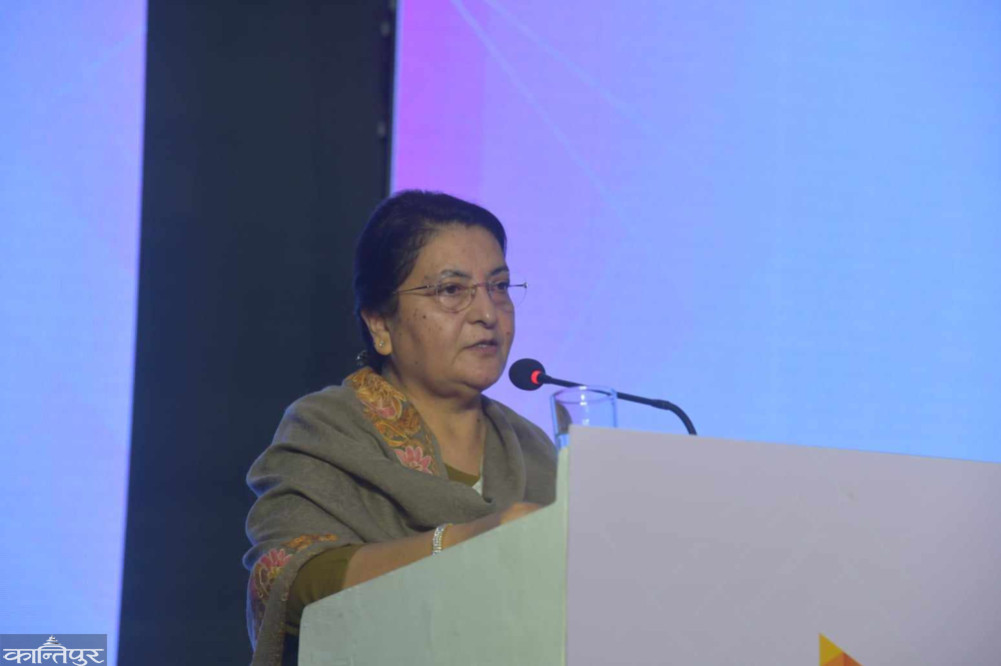
”In order to implement the constitutional and legal provisions for gender equality, it is necessary to have the same concept and understanding in both men and women.”
We use Google Cloud Translation Services. Google requires we provide the following disclaimer relating to use of this service:
This service may contain translations powered by Google. Google disclaims all warranties related to the translations, expressed or implied, including any warranties of accuracy, reliability, and any implied warranties of merchantability, fitness for a particular purpose, and noninfringement.
Former President Bidya Devi Bhandari has said that the system of one-third participation should not be considered as a complete achievement for women who make up half of the society. Speaking as the keynote speaker at the program on 'Nirbhik Nari' organized by Nari Monthly Magazine, co-published by Kantipur Publications Limited, former President Bhandari said that even if the participation of women is only one-third, it should not be considered a complete achievement.
He said that due to the constitutional, political, legal and structural arrangements, the representation of one-third of women in the important bodies of the state and representative structures of the union, state and local levels has been ensured. She said that efforts should be continued for full proportional representation while protecting the achievements.
'Since gender equality is a common concern of both men and women, equal and active roles of both are necessary for this,' she said. For the continuation of the human race, she said that nature has made men and women interdependent on each other with some biologically different roles. She said that during development, social, emotional and economic interdependence between women and men has also been maintained.
He says that the human race itself has dug the gap between men and women from the primitive age to the modern age. "In order to institutionalize this type of unnatural discrimination created by society between men and women, religious, social, cultural and legal recognition was also given to many misogynistic customs and traditions," she said. There are many uprisings and protests around the world in opposition to this," she said.
She said that these kinds of campaigns and movements for gender equality continue even today. He believes that he has seen many big changes in the political, social and economic system of Nepal in a long period of seven decades. Bhandari said that there has been an increase in indicators such as education, health, employment, property ownership, labor participation, etc., and the overall gender development index of Nepal has also improved. She said that there are still challenges in the practical implementation of the rights provided by the constitution and laws due to the ancient patriarchal thinking, poverty, illiteracy, superstition and some bad practices in the society.
Child marriage, polygamy, dowry and tilak system, chaupadi, witch accusations like misogynist bad traditions still persist, he says. He said that women's empowerment, representation and participation will be considered as the main means of achieving gender equality. He said that the intention of gender equality is to create an environment where both women and men have equal rights as well as responsibilities towards the family, society and nation.
For the practical implementation of the constitutional and legal provisions for gender equality, it is necessary for both women and men to have the same concept and understanding on this issue. She claimed that both women and men should be targeted when conducting awareness and empowerment campaigns for women's rights and gender equality.
For the benefit and welfare of women, children, senior citizens as well as the marginalized communities of the society, the state needs to increase its investment in the field of social security. He said that without a strong and strong national economy, the state cannot increase investment in this sector. She said that the main challenge now is to develop a self-sufficient national economy by increasing domestic production and productivity through the sustainable use of natural resources and cultural assets available in the country and the mobilization of young manpower.
She informed that due to global phenomena like climate change, internal and external migration and foreign employment, challenges have been added to the country's development efforts. He says that women are more affected by such incidents.