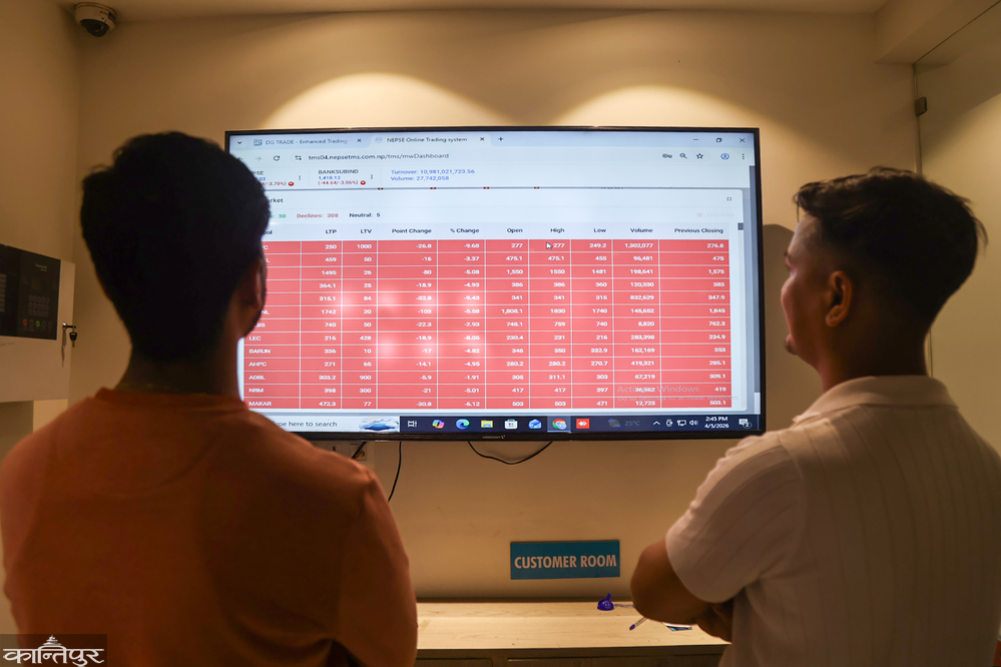
By Sunday, more than 8 million beneficiary accounts (demat accounts) have been opened, which shows that investor attraction in the market has increased. However, in areas such as information flow, investor protection fund, market stability, regulation and supervision, and sectoral representation of the economy, the market still lags far behind.
We use Google Cloud Translation Services. Google requires we provide the following disclaimer relating to use of this service:
This service may contain translations powered by Google. Google disclaims all warranties related to the translations, expressed or implied, including any warranties of accuracy, reliability, and any implied warranties of merchantability, fitness for a particular purpose, and noninfringement.
Even though a quarter of the country’s total population is now involved, the stock market has yet to mature in terms of investment, investor protection, and returns. As of Sunday, more than 8 million beneficiary accounts (demat accounts) have been opened for investment in the stock market (primary and secondary).
This shows that investor attraction to the market has increased. However, the market still lags far behind in areas such as information flow, investor protection fund, market stability, regulation and supervision, and sectoral representation of the economy.
A decade ago, banks, financial institutions, and insurance companies accounted for more than 80 percent of total market capitalization; now, this has dropped to around 50 percent. During this period, many hydropower companies, a few cement companies, and a limited number of companies from other sectors have entered the stock market. Experts say that sectors contributing the most to the economy, such as agriculture, manufacturing, and industry, are still not represented.
Although Nepal’s stock market is highly attractive in terms of citizen participation, its development has not kept pace, says Niranjan Phuyal, Chief Executive Officer of NRN Infrastructure and Development Limited. “Even after three and a half decades since its establishment and with a quarter of citizens involved, only equity is traded in our market. There has been no significant improvement in the development of other instruments, investor protection, or financial literacy,” he said. “Even if we could not move into derivatives, options, or swaps, we could have developed the bond market. Government bonds could have been brought into trading. Much could have been done to expand financial literacy.”
 Although some companies from sectors like hydropower and cement are listed on the secondary market for speculative trading, Phuyal says companies from other sectors and non-resident citizens have not been brought in. “For these reasons, the stock market has not become a suitable area for investment or a foundation for national capital formation,” he said. “Although it is not time to be satisfied with the development of the stock market, investor attraction remains very encouraging.”
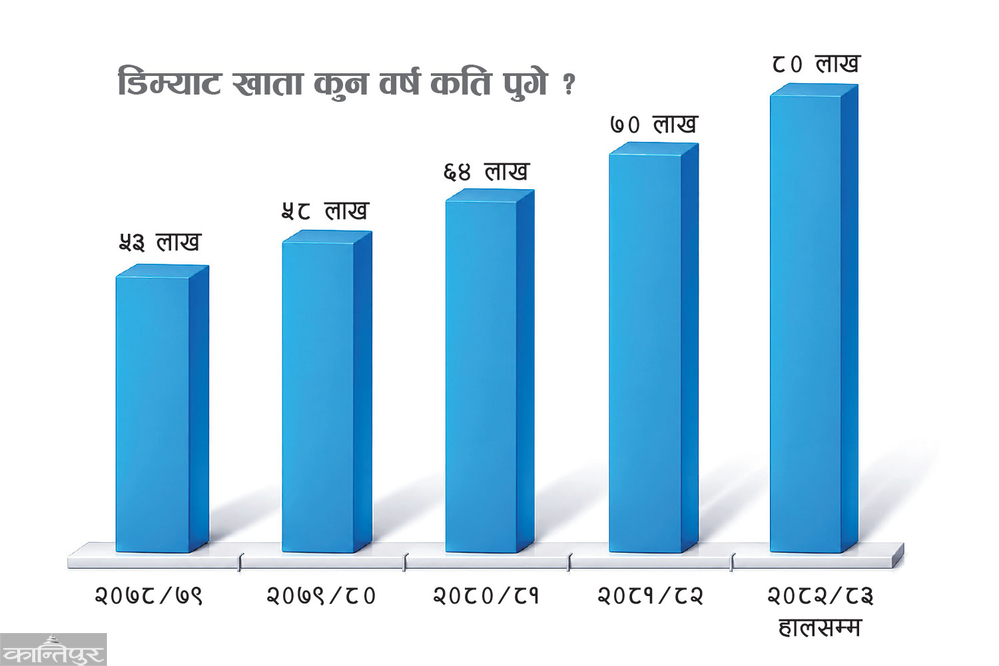
According to the Central Depository System (CDS and Clearing—CDSC), as of Sunday, 8,096,623 demat accounts (accounts for holding shares converted to the electronic system) have been opened. Currently, a demat account is mandatory to apply for primary share issuance (IPO) and
to buy and sell shares in the secondary market. Therefore, the number of demat accounts opened so far is analyzed as the number of investors in the stock market.
An individual can open more than one demat account. Based on this, the number of accounts does not directly equate to the number of investors. However, according to CDSC sources, out of the approximately 8 million accounts opened so far, only 500,000 to 600,000 are duplicates. Among these, many accounts are used only for IPO applications, and about 2 to 3 million accounts have no shares, according to the source.
According to CDSC, the number of demat accounts has increased by 2,663,000 in five years.
The “Mero Share” app, which holds personal details about share transactions, currently has 7,096,083 users. Of these, 5,148,893 are active users, according to CDSC data. Five years ago, in fiscal year 2078/79, there were 4,395,000 users of the Mero Share app; in 2079/80, this rose to 4,826,000, and in the following two fiscal years, it reached 5,369,000 and 5,976,000, respectively.
Currently, 1,927,648,698 shares are listed on the secondary market, of which 1,860,295,872 shares have been dematerialized (converted from physical to electronic shares), according to CDSC.
Although there has been a significant leap in citizen participation in the stock market in terms of numbers, expected development has not occurred in trading activity, regulation and supervision, or financial literacy, argues former Nepal Investors Forum president Ambika Paudel. “Our biggest weakness is that we are promoting the 10-unit policy. For the past 7–8 years, instead of encouraging institutional investors, it’s as if we have restricted them from buying and selling shares,” he said. “In terms of population ratio, participation in the stock market is an extraordinary achievement internationally. But in terms of trading, regulation, and supervision, we are the weakest in the international market.”
He says institutional investors should be encouraged for the sustainable development of the market. “Let’s encourage institutional investors in the market. Let’s bring in quality institutional investors,” he added. “Let’s not promote the 10-unit policy in IPOs. Let’s make the market clean, transparent, and predictable.”
About 4.7 million people have opened accounts in the Trading Management System (TMS) for online trading in the secondary market. Of these, only about 400,000 are active investors. Generally, Nepal Stock Exchange (NEPSE) defines active investors as those who have bought or sold shares at least once a year. The number of active investors also depends on the direction of the stock market. Typically, when the market rises, the number of active investors increases, and when it falls, the number decreases. In recent days, as the market has been on a slight upward trend, the number of active investors has also gradually started to increase.
As of last Jestha, 297 companies were listed in the capital market. Equity accounts for 99.4 percent of secondary market trading. Although there is a provision for listing government bonds in the capital market, secondary market trading has not yet started. Until Asar 2073, total market capitalization was 72.5 percent of gross domestic product (GDP). Currently, this ratio stands at 71 percent. In Falgun, this ratio was 77.7 percent. As NEPSE declined, company share prices fell, resulting in a decrease in total market capitalization.
The share of banks, financial institutions, and insurance companies in securities market capitalization was over 85 percent in Asar 2073. By last Jestha, this share had dropped to 50.9 percent. Before the current government was formed (11 Chaitra 2082), the NEPSE index was at 2,950.16 points. By Friday, NEPSE closed at 2,734.60 points.
Although there has been a significant leap in citizen participation in the stock market in terms of numbers, expected development has not occurred in trading activity, regulation and supervision, or financial literacy, argues former Nepal Investors Forum president Ambika Paudel.Experts suggest that immediate legal reforms are needed to expand the scope of the capital market by encouraging productive companies to enter, attracting investment from non-resident Nepalis, and developing the market for government bonds and similar instruments. They also say it is equally necessary to bring transparency, reliability, and stability to secondary market trading.
Former Executive Director of the Securities Board, Niraj Giri, says that although the number of investors has increased, the market has not developed as expected. He claims that the 10-unit policy implemented in IPOs in the past is the reason for the increased access to the stock market. However, he argues that it is now time to revise that policy. “That was the situation at the time, ASBA had just been implemented. The 10-unit policy was introduced because there was a need to increase access to shares,” he said. “At that time, the policy was supposed to change every five years. But it still hasn’t changed. Now it’s time to revise that policy.” He says that since there is risk in the stock market, it is not possible to distribute shares to everyone as in socialism.
Although it is now possible to apply for IPOs from anywhere, Giri said that it is not possible to sell from the same location, causing problems for citizens who receive IPO shares. “Investors were only taught how to apply for IPOs; we could not make many people understand that the value of those shares can fall and losses can occur,” Giri added. “Even after adding more brokers, expected decentralization of services has not happened.”
Compared to two decades ago (fiscal year 2060/61), there has been significant improvement in the secondary market index as of Asar in fiscal year 2081/82. In fiscal year 2060/61, the overall NEPSE index was at 222 points. By Asar 2081/82, it had reached 2,794.79 points. Data shows significant improvement in indicators such as total market capitalization, the state of market capitalization relative to GDP, trading volume, and the ratio of trading volume to GDP.
In fiscal year 2060/61, NEPSE’s total annual trading volume was Rs 2.14 billion, and the government received Rs 3.1 million in capital gains tax. Twenty-one years later, in fiscal year 2081/82, NEPSE’s trading volume exceeded Rs 2.1 trillion, and the Nepal government received more than Rs 18 billion in taxes from the market, according to NEPSE.
According to NRN Infrastructure and Development Limited CEO Phuyal, Nepal’s stock market participation, in terms of population ratio, is better than that of countries with emerging economies and higher per capita income than ours. According to him, until a decade ago, only banks, financial institutions, and insurance companies, as required by law, could make primary issuances. “The secondary market was mainly concentrated in banks and financial institutions, but now hydropower, productive companies, hospitality-related companies, and others are in the process of entering the market,” he said.
The history of the capital market in Nepal is not very long. The history of companies issuing shares in Nepal began with Biratnagar Jute Mills in 1993 BS. This company, established in partnership between then Prime Minister Juddha Shumsher Rana and Indian businessman Radhakishan Chamaria, had a capital of Rs 160,000. According to Sardar Bhim Bahadur Pandey’s book “Tyas Bakharko Nepal,” the company achieved good success in a short time. As a result, many companies were established in Kathmandu. However, due to political and business reasons, most could not continue.
The organized securities market in Nepal began with the establishment of the Securities Exchange Center in 2033 BS to trade government bonds. Later, the Securities Transactions Act was issued in 2040 BS, and secondary market trading of shares began through the center in 2041 BS. The capital market is considered to have started regular trading from 2050 BS, with the formal establishment of the Stock Exchange and the Securities Board of Nepal.
From 2050 to 2064 BS, share trading was conducted through the “open outcry” method. From 2064 BS, the electronic trading system was introduced, which helped securities trading move beyond the confines of Kathmandu. In 2072 BS, full dematerialization (demat) of shares began. In 2075 BS, fully online trading was launched.
As of the end of last Jestha, among companies listed on NEPSE, there were 133 banks, financial institutions, and insurance companies; 105 hydropower companies; 29 production and processing companies; 9 hotels; 7 investment companies; 4 trading companies; and 10 companies from other subgroups. In Jestha 2082, the number of listed companies was 272.
Based on market capitalization, banks, financial institutions, and insurance companies still hold a 50.9 percent share. Hydropower companies hold 17.5 percent, investment companies 6.8 percent, production and processing 8.7 percent, trading companies 4.1 percent, hotels 3.3 percent, and companies from other subgroups 8.6 percent.
In the first 11 months (Shrawan to Jestha) of fiscal year 2082/83, NEPSE data shows that additional securities worth Rs 147.15 billion were listed, including ordinary shares worth Rs 48.27 billion, bonus shares worth Rs 40.44 billion, rights shares worth Rs 9.64 billion, mutual funds worth Rs 27.5 billion, bonds worth Rs 3.45 billion, FPOs worth Rs 971.7 million, and others worth Rs 223 million.
In the past eleven months, the Securities Board of Nepal has approved public issuance of securities worth Rs 53.73 billion, including mutual funds worth Rs 37.03 billion, ordinary shares worth Rs 9.12 billion, rights shares worth Rs 4.94 billion, bonds worth Rs 2.6 billion, and FPOs worth Rs 467 million.