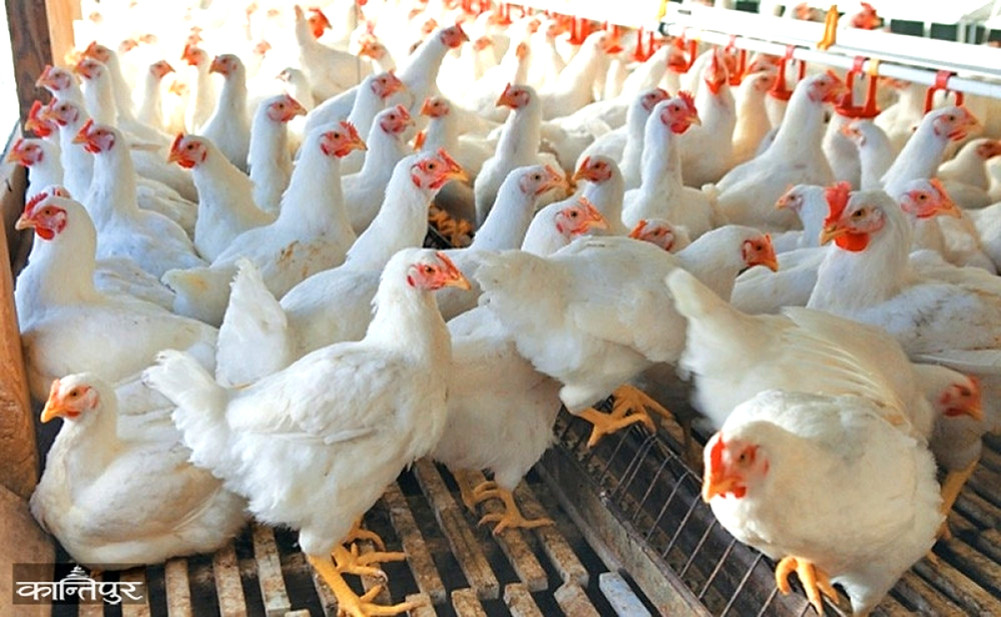
More than 600,000 chickens from farms where the infection was confirmed have been culled, along with millions of eggs and a large amount of chicken feed.
We use Google Cloud Translation Services. Google requires we provide the following disclaimer relating to use of this service:
This service may contain translations powered by Google. Google disclaims all warranties related to the translations, expressed or implied, including any warranties of accuracy, reliability, and any implied warranties of merchantability, fitness for a particular purpose, and noninfringement.
Officials have said that it is difficult to control the spread of bird flu in several places in all three districts of Kathmandu Valley - Kathmandu, Bhaktapur and Lalitpur. The Animal Services Department said that it has mobilized four teams of animal technicians on Monday and destroyed chickens and ducks in farms where bird flu (H5N1) was confirmed.
'So far, bird flu has spread in more than 50 places in the valley, this is a huge number,' said Dr. Mukul Upadhyay, senior veterinarian and head of the department's avian influenza control program and disease surveillance program, 'We are trying to control it.' According to Upadhyay, bird flu has also been seen in many small farms in the valley.
Avian influenza viruses A (H5N1), A (H9N2), A (H9N1x) etc., which are also known as bird flu viruses. This is a very deadly virus, which mainly affects domestic chickens and ducks. The department said that the outbreak that started in eastern Nepal in Falgun has now spread to various places in all three districts, including the Sadar Zoo in the valley. Dozens of birds, including rare vultures, shrike, swans, and storks, have died from the infection. The administration has closed the zoo indefinitely since Friday after the virus was confirmed in some animals, including wild cats and civets. The zoo, which used to attract four to five thousand visitors on holidays, used to receive about two thousand visitors on other days. According to officials, this is the first time that the disease has spread on such a large scale in the Sadar Zoo. 'We are not in a position to say when the zoo will open,' said zoo spokesperson Ganesh Koirala. 'We are closely monitoring the situation and are taking measures to prevent the infection from spreading further.'
Bird flu in Jawalakhel zoo animals, closed indefinitely
Officials suspect that the infection spread from crows and other wild birds entering the zoo. Officials of the Animal Services Department suspect that the bird flu spread in the zoo due to negligence in biosecurity. There were allegations that the officials tried to hide the incident even after dozens of wild birds died. 'The zoo officials made the incident public only after many birds started dying at once,' an official of the department said, 'Laboratory tests have confirmed the virus. Detailed details will come only after the investigation team formed by the government submits its report.'
Bird flu spreading in Kathmandu Valley, infection also seen in local chickens
According to department officials, outbreak reports have been received from at least 10 districts of the country so far. The infection in Koshi Province was caused by the A (H9N2) virus. Which caused huge economic losses to the poultry industry, while the virus seen in Kathmandu Valley is A (H5N1). According to them, bird flu infection has spread to most local chickens in the valley. According to the protocol for bird flu control, after destroying the chickens, eggs, feed and chicken droppings of the infected farm, human movement should be stopped for 423 days. But the current outbreak is in densely populated areas. Neither disinfection has been done properly nor has the movement of people been stopped.
After Kirtipur, 15 dead crows were also found in Toudaha area
Bird flu infection was first seen in Nepal in 2009. Since then, such outbreaks have been seen almost every year. Millions of birds and a large amount of poultry products have been destroyed. Many farmers have given up poultry farming due to lack of compensation, while some are still struggling to get relief.
One person died in Nepal from bird flu in 2019. He was a 21-year-old truck driver from Kavrepalanchowk. His death was later confirmed to be due to bird flu.
Infectious disease specialist Dr. Sher Bahadur Pun said that bird flu cannot be spread if chicken meat and eggs are cooked properly. He said that people working on poultry farms, those involved in transportation, meat cutters and those working in meat shops are at higher risk of bird flu infection. He said, 'There's no need to be afraid if you cook it well and eat it.'