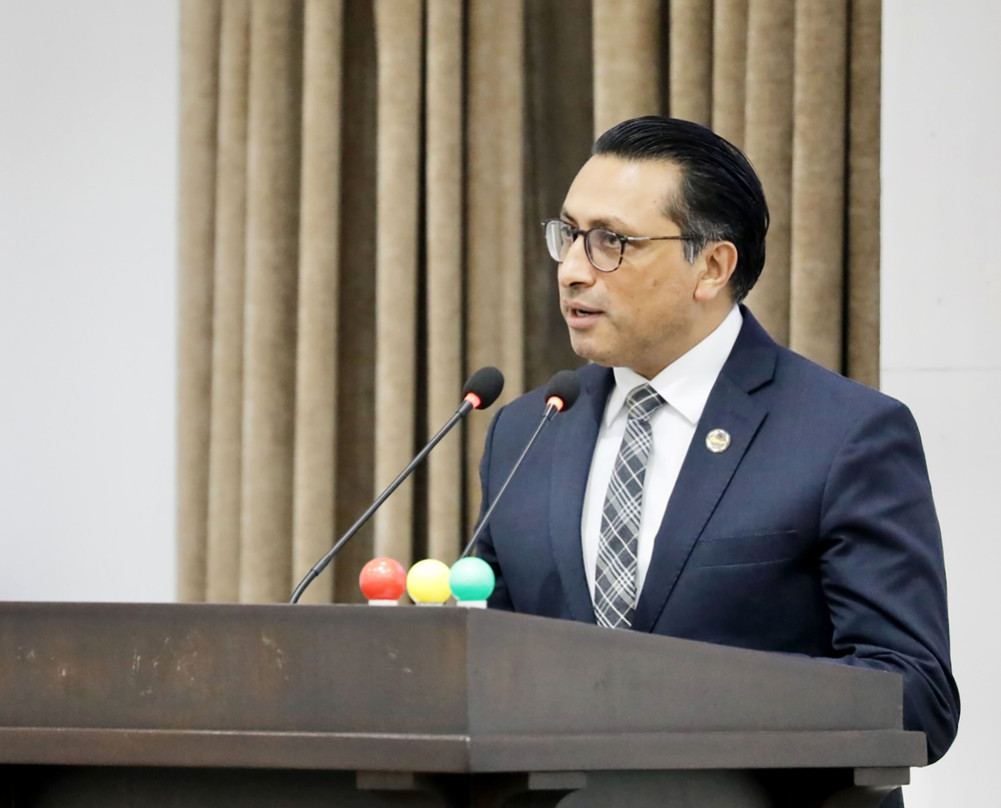
In a meeting of the House of Representatives on Friday, Finance Minister Swarnim Wagle informed that a study is being conducted to impose VAT only on electricity consumption above 100 or 150 units.
We use Google Cloud Translation Services. Google requires we provide the following disclaimer relating to use of this service:
This service may contain translations powered by Google. Google disclaims all warranties related to the translations, expressed or implied, including any warranties of accuracy, reliability, and any implied warranties of merchantability, fitness for a particular purpose, and noninfringement.
Finance Minister Swarnim Wagle has said that a study is being conducted to impose tax only on 100 units or above 150 units. Finance Minister Wagle said this in the House of Representatives meeting on Friday.
‘It is said that up to 50 units will not have to be paid.’ He said, ‘We will go into it before imposing tax from Shrawan.’ He said that since the exemption of up to 50 percent has been given, only 3/4 percent will be applied during implementation.
While presenting the budget for the new fiscal year on Jestha 15, Finance Minister Wagle had imposed a 5 percent value-added tax (VAT) on electricity and implemented a multi-rate system. In the Finance Bill, 2083, the government had earlier amended the VAT Act and initially made provision for VAT not to be levied on electricity consumed for household purposes up to 50 units per consumer. This provision was mentioned in the VAT Act. In which, a provision was made that ‘electricity up to 50 units per consumer consumed for domestic purposes’ would not be subject to VAT, but it would be levied on anything in excess of that. According to this provision, VAT would be levied on the sale of electricity by a business that trades electricity to a business that trades electricity (for example, when the promoter sells to the Nepal Electricity Authority).
Later, the provision was amended to exempt electricity traders and businesses that trade electricity and up to 50 units of electricity for domestic purposes. ‘Electricity sold by a business that trades electricity to a business that trades electricity and electricity up to 50 units per consumer consumed for domestic purposes’ is stated in the latest revised economic bill.
The latest amendment states that VAT will not be levied on electricity traders and businesses that trade electricity, but VAT will be levied on electricity consumed in excess of 50 units per consumer consumed per month.
After the government said that VAT would be imposed Kantipur had published news that 2.6 million household customers would be affected if VAT was imposed on more than 50 units. According to the Nepal Electricity Authority, around 2.6 million customers consume more than 50 units of electricity per month.
According to the authority, there are 1.998 million customers consuming up to 20 units, 4.21 million customers consuming 21 to 30 units, and 6.15 million customers consuming 31 to 50 units.
Similarly, there are 1.75 million customers consuming 51 to 100 units, 1.089 million customers consuming 101 to 250 units, and 4.42 million customers consuming more than 250 units. These are only household customers.
The electricity tariff is implemented only after it is approved by the Electricity Regulatory Commission. But after the government automatically removed him from office as per the 'Special Provisions on the Removal of Public Officials Ordinance 2083', the commission is leaderless. The process for the appointment of the chairman and members has been initiated.
10 people have applied for the post of chairman of the commission. The Ministry of Energy has stated that the presentation of the professional action plan and interviews of the candidates for chairman will begin from Saturday.
Mohan Dangi, chairman of the Independent Power Producers Association of Nepal (IPPAN), says that even though they have demanded the imposition of VAT, the risk of the ‘electricity consumption’ being reduced has increased, as the private sector will not get it and only the Electricity Authority will get it. He says that they have ‘reservations’ as electricity consumption will decrease instead of increasing.