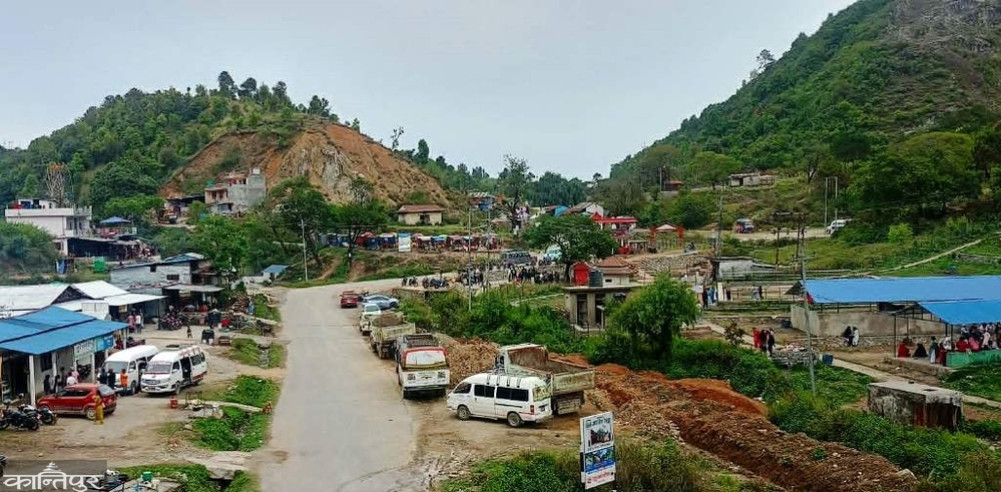
With the heat in the Terai increasing, the weather and the beautiful scenery that necessitates wearing a hijab in the month of Jestha have led to an increase in the number of domestic and Indian tourists visiting tourist destinations in the hills.
We use Google Cloud Translation Services. Google requires we provide the following disclaimer relating to use of this service:
This service may contain translations powered by Google. Google disclaims all warranties related to the translations, expressed or implied, including any warranties of accuracy, reliability, and any implied warranties of merchantability, fitness for a particular purpose, and noninfringement.
The Terai is experiencing unbearable heat and hot winds. Due to the heat, outdoor activities during the day seem deserted. At this time, some people are taking advantage of the opportunity to climb the mountains to escape the heat. Those who come to escape the heat of the Terai are flocking to the mountain destinations.
Those who climb the mountains to escape the heat are more likely to go in groups of family and friends than individually. Not only domestic tourists, but also people from various cities in India are flocking to nearby hill destinations to escape the heat. Arghakhanchi, Palpa, Chitwan and some places in the eastern hills have become destinations for those coming from the Terai and India to escape the heat.
Narpani in Arghakhanchi has become a favorite destination for domestic and Indian tourists. Narpani is a place that is crowded with tourists during the summer. With the increase in the arrival of tourists, the number of hotels opening in the Narpani-Supa Deurali area has increased. Most of the hotels there have now been booked in advance. Padam KC, supervisor of Supa Deurali Narpani Resort, said that all 20 rooms have been booked for three days. ‘Many Indians are booking and some Nepalis living in the Terai,’ he said. He said that bookings are taken through phone, WhatsApp and Facebook Messenger. He said that tourists who come here prefer local dishes to beat the heat. ‘It is very hot in the Terai and Indian cities,’ he said, ‘Even now, in Narpani, you have to sleep wearing a sarong.’ Other hotels in Supa Deurali are also booked. Rajendra Mahato, who came with his family from Siddharthanagar, India, on Tuesday, stayed in Narpani. After visiting the Supa Deurali Temple in the morning and taking prasad at the Narpani picnic spot, two kilometers away, the family stayed at a local hotel. They woke up in the morning and trekked to Khanchikot Hill Station. ‘Even after two days, staying in the cold of Narpani made me feel refreshed,’ he said. ‘Now I will go back and do business.’ He said that he has been coming to Narpani every time for the past four years to beat the heat.

Since Narpani is close to Krishnanagar in Kapilvastu on the Nepal-India border, Indian citizens often visit the Supa Deurali Temple and Narpani to beat the heat. Many people from the Terai districts of Lumbini Province also visit Narpani. Now, winter clothes should be worn in Narpani. At night, one should stay warm by the fire. Since one can sleep in a cloth, many people visit this hilly destination once.
Palpa, connected to Arghakhanchi, has turned into a 'hill station'. As the temperature rises in Uttar Pradesh, India, people have started coming to Palpa to escape the heat. Tourists from places like Sonauli, Nautanhawa, Gorakhpur, Basti, Lucknow and others in Uttar Pradesh are coming here to escape the heat. Palpa, 64 kilometers north of the Belhiya border crossing in Rupandehi, is experiencing cold weather. Palpa has an average temperature of 19 to 26 degrees Celsius. On top of that, it can get foggy and rainy soon.
Arvind Kumar Mishra, who came for a day's visit from Maharajgunj in Uttar Pradesh with his wife, said that he stayed for two days as the weather was pleasant. The arrival of Indians has increased in the district along with domestic tourists. There has been increased activity in rural areas including Tansen.

Kamal Poudel, Chief Marketing Officer of Sirjana Farm, said that the season is underway in Palpa while tourists are declining in the Terai. ‘All the resorts in Palpa are full,’ he said, ‘People who have returned from Pokhara and Muktinath are staying in Palpa.’ According to him, Sirjana Farm has been booked till Jestha 24. Apart from Indians, he said that Europeans are also coming. Since it is 39 kilometers away from Butwal, people come here to escape the heat from Butwal and Bhairahawa.
It is extremely hot in the Terai in Baishakh, and even in Jestha, it is cold in Tansen. Tourists come here to enjoy the cold weather, hill settlements, Batase and the breeze of the mountains when they reach Srinagardanda. ‘There are a lot of people coming from Gorakhpur to enjoy the summer,’ said Yadu Bhattarai, manager of Tansen-owned Hotel Pauwa. ‘The number of domestic and Indian tourists has increased. This has made the Tansen area lively.’ He said that tourists from Agra, Lucknow and Maharashtra in India come. Laxman Basyal, president of the Palpa Hotel and Restaurant Entrepreneurs Association, said that not only tourists from India and third countries but also domestic tourists are amazed by the Palpa season. He said that more tourists come from Gorakhpur, Kushinagar, Lucknow, Uttarakhand and others. Sultan Alam Khan of Faizabad, India, said that he has not experienced summer since coming here. ‘We have visited many times in summer,’ he said, ‘but there is no such good weather.’ Indian tourists often respond that Tansen is better than Nainital, Mussoorie, and Darjeeling.’
Tansen is 65 kilometers from Sunauli (Bhairahawa), 86 kilometers from Lumbini, 120 kilometers from Pokhara, and 300 kilometers from Kathmandu. Tansen, which is about 1,300 meters above sea level, and the nearby Srinagardanda, which is 1,600 meters above sea level, attract tourists.
Across Biratnagar, the temperature in Bihar, India, is above 35 degrees. It is currently around 30 degrees in Biratnagar. The temperature in Bhedetar, about 60 kilometers north of Biratnagar, is only 20 degrees. There is a thick fog on top of that. It rains occasionally. The cold season has increased the crowd in Bhedetar.
Hoteliers say that the number of Indian tourists has increased, apart from domestic ones. Bhedetar has become the choice of the residents of Bihar. ‘The number of tourists coming from Bihar is increasing,’ said local hotelier Sanjay Rai, ‘which has made the tourism sector dynamic.’
Hundreds of Indian tourists reach Bhedetar daily, located at an altitude of 1,400 meters above sea level. According to local hoteliers, many tourists are coming from areas including Purnia, Katihar, Araria, Kishanganj, Saharsa and Bhagalpur in Bihar. Most Indians enter Nepal on Saturday afternoon. After coming here, they spend Saturday night in Bhedetar and return only on Sunday afternoon, said Juddha Bahadur Limbu, a hotelier in Bhedetar.
According to Ramesh Shrestha, president of the Bhedetar Hotel Association, there is a rush of Indian as well as domestic tourists to beat the heat. The number of domestic tourists has increased even more after the two-day holiday on Saturday and Sunday. Currently, more than 200 small, large and medium-sized hotels are operating in Bhedetar. All of those hotels are usually full. The distance from Biratnagar to Bhedetar is about 60 kilometers. It can be reached in about 2 to 2.5 hours by road. Bhavish Kumar Shrestha, a tourism entrepreneur from Biratnagar, says that travel has become easier for Indian tourists after the recent improvement in road conditions.
Mayatar, a hilly village in Ichhakamana-2 of Chitwan, is famous as a place to beat the heat. Tika Gurung, who returned after spending 10 years in Malaysia and Dubai, started ‘Mayatar Homestay’ in the village. This homestay has also given a new identity to Chitwan. Tourists who come to observe the rare tigers and rhinos of the park have now started climbing Mayatar to beat the heat. The area where the park is located is extremely hot.

You still have to wear a sarong in Mayatar. They had arranged food and shelter for the pilgrims by carefully fixing a thatched house that was about 100 years old. ‘After writing about the cool climate of Mayatar on social media, many people inquired,’ he said. ‘People started coming and going, interested in a cool place in the summer.’ After that, the crowd started to gather.’ The homestay initially accommodated 20 people and now 50. Mayatar is reached via the Shaktikhor-Fisling road. From the Bharatpur Police Training Center, one reaches Mayatar by crossing the eastern Barandabhar forest via Padampur, Jutpani, and Shaktikhor.
Mayatar is 40 kilometers away from Bharatpur. Most of the roads are blacktopped. Upardanggadhi is the old headquarters of Chitwan. Earlier, people used to reach Upardanggadhi in scattered places. After the popularity of Mayatar, tourists have also started going there. ‘Now, 7 hotels have opened around Mayatar,’ said Panch Chepang, ward chairman of Ichchakamana-2, ‘People come because of the cold place.’
The sun shines brightly in the village of Mayatar even in winter. Tika said that people come to Mayatar to warm themselves in winter. Chowkidanda in Bharatpur-29 is also famous as a cold place. There are three homestays there too. There is a Chowkidanda in the southern hilly Tankura from Bhorle on the Narayangadh-Muglin road. When the weather is clear, the snow range can be seen from there. The weather is cold. Bhorle is 20 kilometers away from Narayangadh. Chowkidanda is 9 kilometers away from Bhorle. ‘The road has become easier now. We have laid gravel and paved it. It will be paved soon,’ said Surya Bahadur Gurung, ward chairman of Bharatpur-29. ‘Earlier, it was difficult to go from Bhorle to Chowkidanda. It took an hour on a motorcycle. Now it takes about 20 minutes.’