An opaque alliance between a politically well-connected 'fixer' and Nepal's oldest business family has been implicated in an investigation into the embezzlement of Rs 3.73 billion, creating a stir in Nepal's business community.
We use Google Cloud Translation Services. Google requires we provide the following disclaimer relating to use of this service:
This service may contain translations powered by Google. Google disclaims all warranties related to the translations, expressed or implied, including any warranties of accuracy, reliability, and any implied warranties of merchantability, fitness for a particular purpose, and noninfringement.
The COVID-19 pandemic was at its peak, and the streets of Kathmandu were deserted due to the lockdown. A vehicle with a blue number plate of the diplomatic mission was stopped at Naxal Narayanchaur. When the police searched the vehicle, they found a ‘thermal gun’ worth Rs 5,000 being taken somewhere for sale for Rs 15,000. The vehicle was carrying Vice-President of Shankar Group Sulabh Agarwal. The police recovered 67 ‘thermal guns’ from the same vehicle. Sulabh, who is also the honorary consul general of Kyrgyzstan, was abusing his position and selling ‘thermal guns’ at a price three times higher than the prevailing price while thousands of people were struggling between life and death. However, he was arrested before that on charges of ‘black marketing’.
This incident damaged the reputation of Shankar Group for decades. To get out of it, this group also joined hands with controversial businessman Deepak Bhatt. Bhatt, a controversial businessman who used political access and invisible influence to work for Agrawal's release, was also released. Shankar Group became a 'debtor' to Bhatt. The partnership between Bhatt and Shankar Group, which was bound by that quality, had been strong for seven years. However, that partnership has now reached the point of betrayal, betrayal and sabotage between each other. As a result, both of them are now involved in Nepal's largest money laundering investigation. And, they have even been detained. The ups and downs created by the informal, unwritten partnership are now widespread, and both parties have reached the legal dock. According to the Money Laundering Investigation Department, Bhatt has illegally transferred about Rs 3.73 billion from five companies, including Himalayan Re-Insurance, and collected shares in competing companies. Some key figures in the case are in custody, bank accounts have been frozen and a case is set to be registered soon. The 91-year-old business empire is now grappling with a complex situation that could prove to be the most devastating for both parties.
Despite years of controversial work, the Bhatta-Sulabh group had been avoiding investigation. To understand how it has now fallen into the trap of the state apparatus, one must understand the information about the start of a business deal between five businessmen in Ashar last year. Kantipur has spoken to about 10 people with direct knowledge of the matter. Among them are officials from the Money Laundering Investigation Department, two of the five partners in the deal, sources close to Bhatta, officials from the Nepal Securities Board, Nepal Stock Exchange, Insurance Authority, Nepal Rastra Bank, Himalayan Re-Insurance, and others.
According to related sources, in the month of Sawant (the beginning of the current financial year), with purely commercial objectives, Golchha Group Chairman and Managing Director Shekhar Golchha, Ramesh Corp Vice Chairman Rohit Gupta, Jawalakhel Group of Industries Managing Director Raj Bahadur Shah, Infinity Holding Chairman Deepak Bhatt and Lucky Group Managing Director Amit Mor came together to conduct a collective share transaction. As per the agreement, everyone raised money. Everyone also collected money in the same account through the banking system. Some shares were also bought from the same fund.
‘The objective of friends collecting money together and forming a fund and investing the fund amount in the capital market and earning good profits in a short time is not bad and illegal in itself,’ said a partner. But when it is discovered that one of the partners has cheated, the relationship suddenly turns into hostility. The same thing happened between the aforementioned partners.
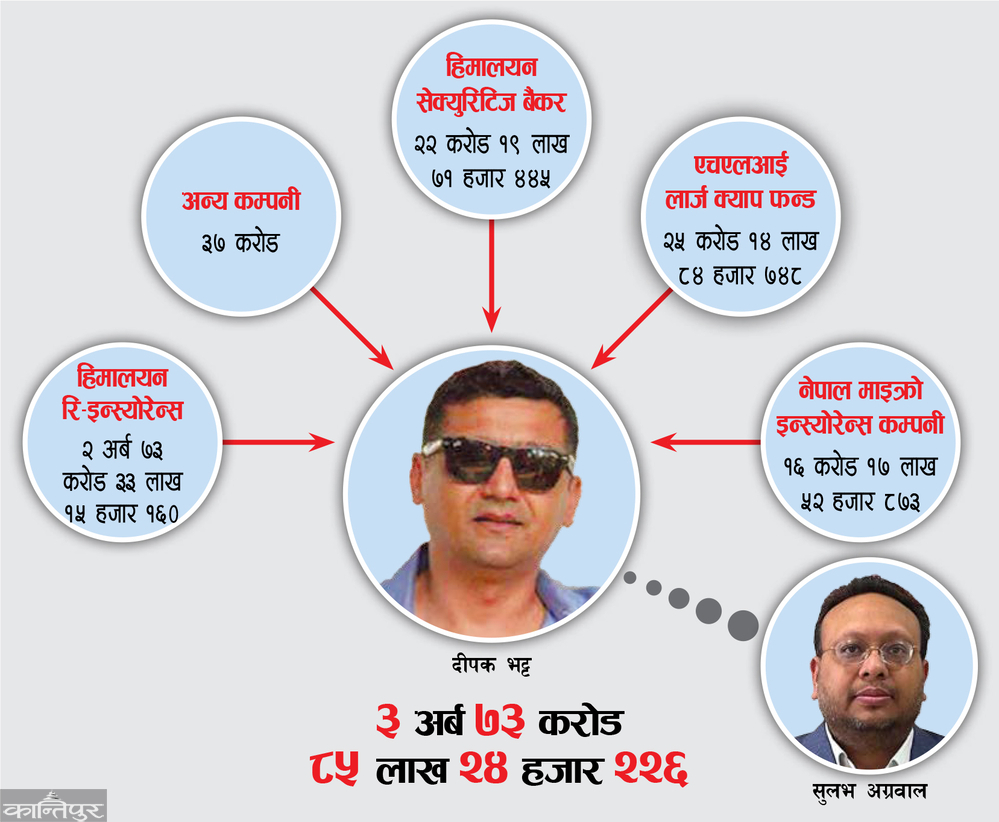
In a conversation with Kantipur, one of the five partners claimed that Deepak Bhatta had cheated them. Bhatta has illegally embezzled Rs 3.73 billion 85 million 24 thousand 226 from the public in listed companies including Himalayan Re-Insurance, Himalayan Securities Banker, HLI Large Cap Fund and Nepal Micro Insurance. However, Bhatta has been saying that Sulabh did this without his knowledge. ‘This fact has been revealed from the preliminary investigation of the Money Laundering Investigation Department. The department has also found evidence that all these share transactions were made through Sulabh and Bhatta,’ the person told Kantipur, ‘But Bhatta has said that he did not know about the share purchase. If someone buys shares worth nearly Rs 4 billion and that person says he does not know, how can we believe him? Whereas now all the details of share purchase and sale are sent by SMS to the number of the account holder concerned.'
Bhatt, in his statement to the Money Laundering Investigation Department, said that he was not aware of the broker purchasing shares in his name. 'There was an agreement between me and the broker regarding margin trading.' The agreement stated that the broker would provide a loan for the purchase of shares and would settle the accounts at the end of the year,' Bhatt said in his statement. 'As per the agreement, I had given the login and password of TMS to Bhrikuti broker number 55.'
Bhatt's statement is that the same login and password were given to Sulabh by the broker and Sulabh misused it. 'Sulabh Agarwal had bought a large number of shares in my (Deepak Bhatt) and Sulabh's wife Suvi's names.' I came to know about this only about 10-15 days ago,' Bhatt said in his statement, 'I was cheated by them because all this was done in collusion with the broker and Sulabh.'
Bhatt has stated in his statement that the agreement between him and Bhrikuti Broker No. 55 for margin trading is safe. Bhatt has stated that Sulabh's brother, Shankar Group Managing Director Sahil Agarwal, and Himalayan Reinsurance CEO Upasana Poudel also helped him purchase shares in collusion with Bhrikuti Broker and Sulabh Agarwal. Sahil was the director of Himalayan Reinsurance and the coordinator of the investment committee. However, Sahil has also resigned from Himalayan Reinsurance.
Thus, Sahil and CEO Poudel also gave Rs 2.73 billion 3.33 billion, which was obtained by selling shares of various companies in the name of Himalayan Reinsurance, to Broker No. 55, and Sulabh bought shares with that money, Bhatt said. Even though Bhatt had a margin trading agreement with the broker, by that time (2082 Ashar), no broker had started the service of margin trading (providing loans to buy shares) after obtaining permission from the regulatory body. Therefore, as Bhatt claims, the transaction said to have taken margin facilities from the broker is also illegal in itself. The statements of one of the aforementioned partners and Bhatt are clearly contradictory.
The source claims that Golchha, Shah, Gupta and Mor gave a statement to the department that the transaction was carried out in collusion with Sulabh and Deepak Bhatt. When Golchha, Shah, Gupta, Mor and others came to know that there was a mess and that their money was being misused to buy shares, they called an emergency meeting. Bhatt was also present in the meeting. There was a lot of discussion in the meeting. The issue of returning the amount of irregularities committed by Bhatt and Sulabh was also raised. However, that was not possible. Because the Money Laundering Department and other regulatory agencies had already started an investigation into Bhatt and Agrawal's transactions. At the same time, the bank accounts of Bhatt and Sulabh were also frozen and are still frozen. Their accounts are still frozen as the investigation is ongoing. According to two sources present at the meeting, Bhatt had expressed anger at Sulabh and Sulabh was apologizing in a very emotional manner. 'Sulabh started crying, admitting his mistake and holding Golchha's leg and apologizing. However, the apology was not enough to get the money back,' the source told Kantipur. The group also discussed ways to get the money back into the account.
But after the formation of a new government after the Gen-G movement, the regulatory agencies had already started an investigation. The bank accounts of both Bhatt and Sulabh Agrawal were frozen immediately after the Gen-G movement and are still frozen. Department sources have stated that Bhatta and his group have engaged in illegal activities related to money laundering by embezzling money from listed companies.
The department has sent a letter to the Insurance Authority, Securities Board, NEPSE, CDSC and other bodies seeking details of Bhatta's share transactions. Kantipur has received some of the letters sent by the department to these bodies. In the course of the investigation, the department has already collected information from the Rastra Bank, Securities Board, Insurance Authority, NEPSE, CDSC and other bodies. The source said that a case will be registered soon as the work of analyzing and verifying the information and data received, taking statements from stakeholders, etc. is in the final stage.
A large number of shares of Nepal Reinsurance Company were purchased with the connivance of Bhatta and Shankar Group Vice President Sulabh Agarwal by taking money from the mentioned five companies. The Money Laundering Department had started the investigation after a complaint was filed alleging that money was taken from various companies for the purchase of shares but they were not paid.
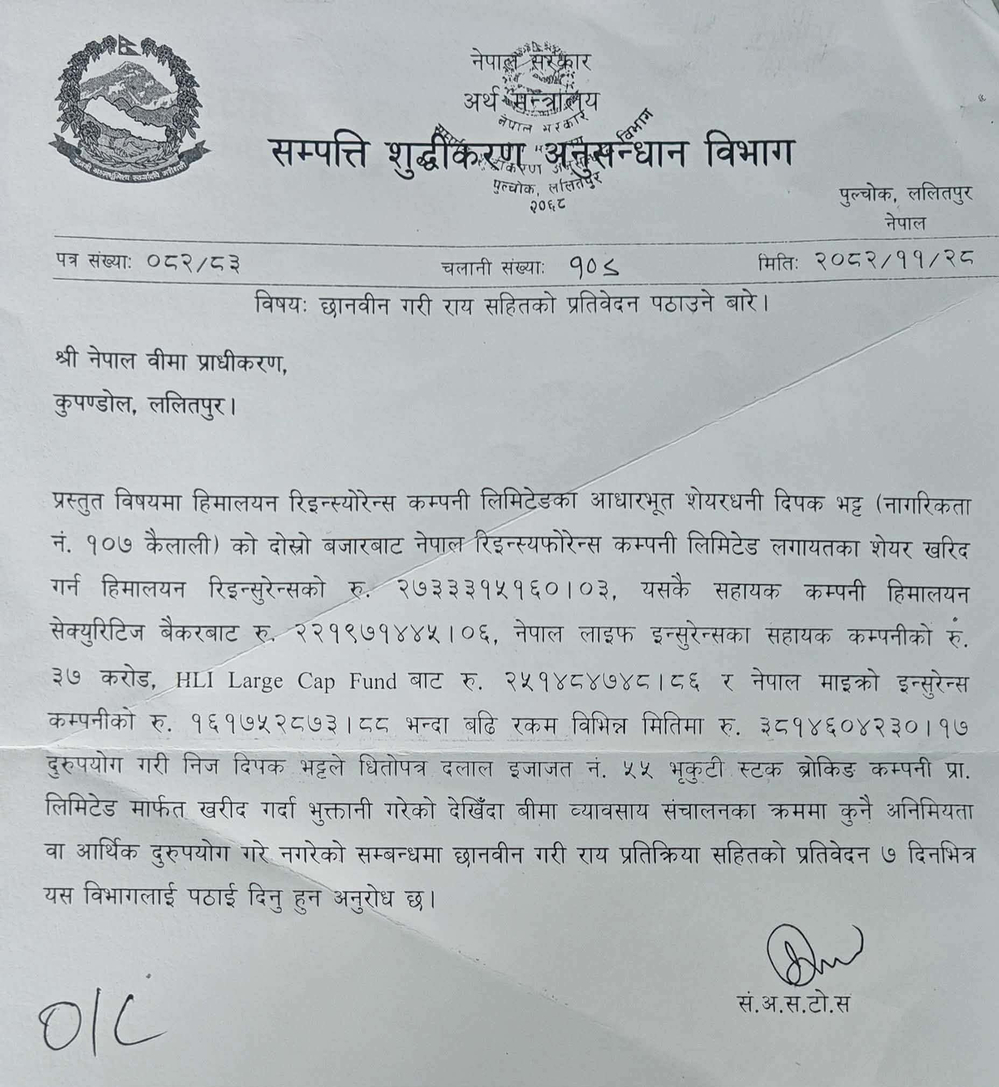
The department has accused Deepak Bhatt (citizenship no. 107 Kailali), the fundamental (founding) shareholder of Himalayan Re-Insurance Company Limited, of misappropriating over Rs 2.73 billion 33 million 15 thousand 160 of Himalayan Re-Insurance, Rs 22 crore 19 million 71 thousand 455 of its subsidiary Himalayan Securities Backer, Rs 37 crore of Nepal Life Insurance, Rs 25 crore 14 million 84 thousand 748 of HLI Large Cap Fund and Rs 16 crore 17 million 52 thousand 873 of Nepal Micro Insurance on various dates to purchase shares of Nepal Re-Insurance Company Limited and other companies from the secondary market. The department has mentioned in the letter sent to the regulatory bodies seeking details that Bhatt misused Rs 3 billion 73 million 85 million 24 thousand 260 received from those companies. However, Nepal Life Insurance Company has issued a statement on 20 Chaitra and clarified that no amount was misappropriated from its subsidiary. Nepal Life has clarified in a letter to the Insurance Authority that his company has no involvement with Deepak Bhatta or broker number 55, said its CEO Praveen Raman Parajuli.
Deepak Bhatta misused the said amount and purchased shares through Bhrikuti Stock Broking Company Pvt. Ltd., a securities broker with license number 55. The major shareholder of the broker company is Manojlal Karna, who is the former CEO of Himalayan Life Insurance and the company is registered in the name of his wife. Bhatta has mentioned the company's CEO Sandeep Chachan in his own statement as the main operator (operational figure) of the transaction. Chachan is also currently out of contact. Kantipur had also tried to contact Shankar
Group's Shankar Agrawal and Sahil Agrawal and Upasana Poudel through various channels, but no response was received. The department has intensified the investigation on the suspicion that the company's money mentioned in the share purchase was in Hinamin. Bhatta and Sulabh Agrawal had bought shares of Nepal Reinsurance Company with the money from these companies. According to the source, all these transactions were done from Sulabh Agrawal's office, and the shares of Nepal Reinsurance Company were purchased with that money. According to the source, Bhatta and his group had been buying shares of Nepal Reinsurance Company from the secondary market for the past few months.
According to the source, there were two hidden interests in this. First, Nepal Reinsurance Company was preparing to issue rights shares, so it wanted to gain dominance by buying the shares of the company and weaken its competitor. After weakening the second Nepal Reinsurance, it will either merge with Himalaya Reinsurance or establish its strong dominance in the market. Sources claim that Bhatta and his partner companies have been buying shares of Nepal Reinsurance in large numbers with this plan.
Meanwhile, Bhrikuti Broker had also sold a large number of shares of Himalayan Reinsurance Company. However, the broker did not give the amount for the sale of shares to Himalayan Reinsurance. Instead, the source said that shares were purchased in the name of Deepak Bhatta in the name of Nepal Reinsurance Company with the same amount. The company stated that Himalayan Reinsurance had filed a case against Bhrikuti Stock Broking Company in the Kathmandu District Court last week after it did not receive the money. The writ has been demanded from Bhrikuti Stock Broking Company to get the amount it is due.
The Securities and Exchange Board of Nepal (SEB) and Nepal Stock Exchange of Nepal (NEPSE) have also investigated Bhrikuti's activities regarding why Himalayan Reinsurance was not given the money for the sale of shares. In the meantime, a joint team of the board and NEPSE also conducted an on-site supervision of the company in the first week of Chaitra. Last week, NEPSE had asked Bhrikuti for an explanation after finding objections during the supervision. After not receiving a satisfactory response, NEPSE was preparing to recommend the company to the Securities and Exchange Board of Nepal (SEB) for action. However, since the board is also studying, it said that there is no need to send a recommendation now, so if necessary, we can ask for help, so the NEPSE did not send it, according to a source.
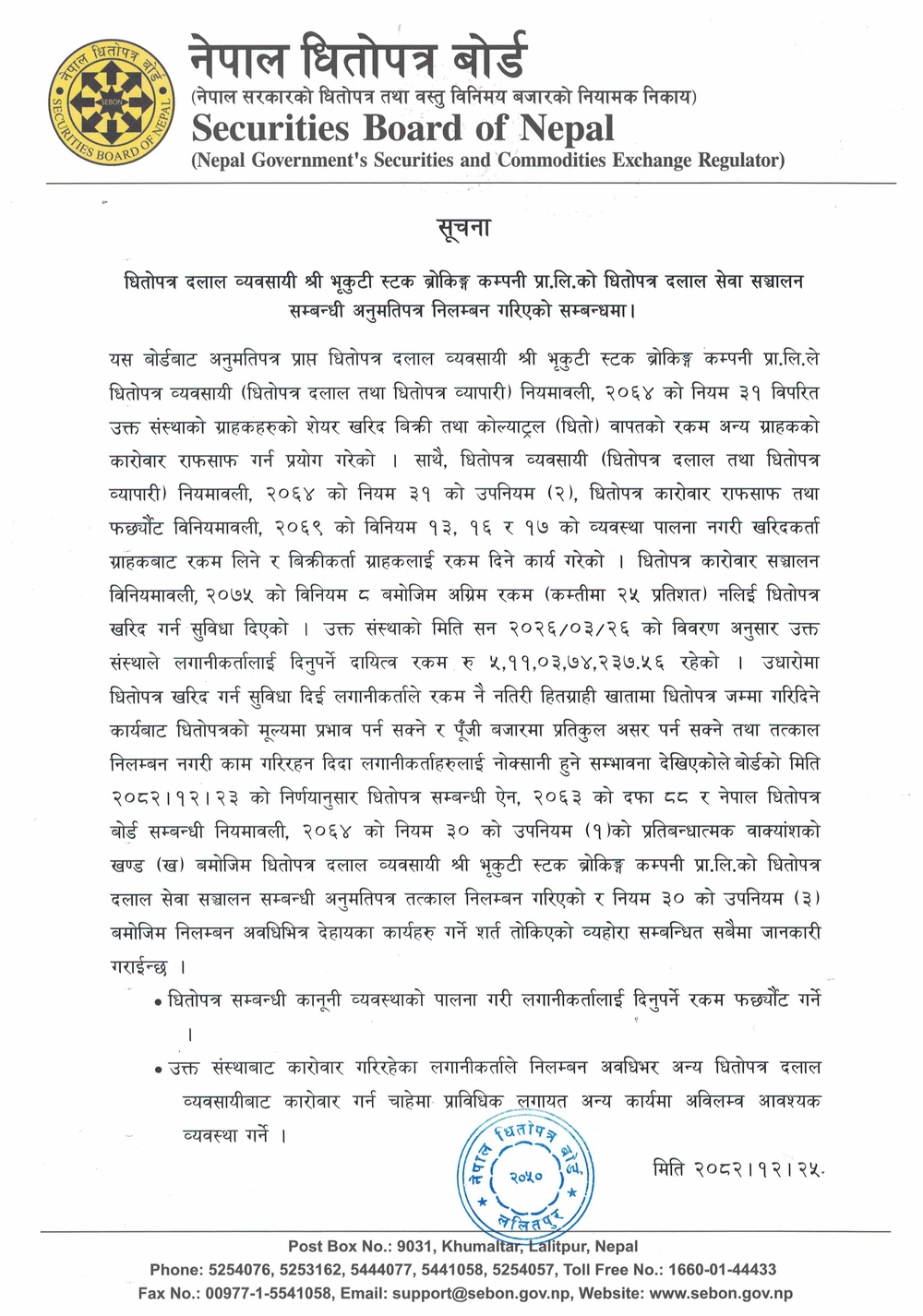
Meanwhile, the Securities and Exchange Board of Nepal (SEB) has suspended Bhrikuti's license indefinitely on Monday and has asked for an explanation as to why no action will be taken. According to a board source, broker No. 55 Bhrikuti has made three mistakes. First, the Securities Trading Regulations stipulate that transactions should be made only with an advance payment of at least 25 percent. While the broker has admitted that he did not take any payment from Deepak Bhatt. Second, the proceeds from the sale of one client's shares cannot be used to purchase shares for another client. While the money laundering investigation has found that Bhukriti Broker purchased shares in Deepak Bhatt's name with the proceeds from the sale of shares of Himalaya Re-Insurance. This is against the law. Third, the broker's explanation to the regulatory body states that he and Deepak Bhatt had agreed to buy shares on credit and to pay off all the outstanding amount after the sale of those shares. While this is also against the law. Because a broker cannot buy shares on credit to a customer and must give the shares to the buyer and the money to the seller within three days (T plus three) of the purchase. However, the broker has also violated this rule. Some directors of Himalayan Reinsurance Company have also admitted that there was a huge amount of irregularities in the share purchase. In an informal conversation with Kantipur, they said that Himalayan Reinsurance Chairman Shekhar Golchha resigned after coming to know about the irregularities. ‘Deepak Bhatta and Sulabh Agrawal illegally purchased a lot of shares.’ After knowing this, there was a tussle between other members of this group and Bhatta and Sulabh. Golchha’s resignation as Chairman of Himalayan Reinsurance is the result of this,’ the source said. ‘It seems that a lot of shares were purchased in the name of Deepak Bhatta and Sulabh Agrawal’s wife Subi Agrawal.’
Himalayan Reinsurance Company’s outgoing Chairman Golchha also told Kantipur that he resigned as Chairman after learning about the illegal purchase of shares by Bhatta and Sulabh Agrawal and his wife Subi Agrawal. ‘There was a transaction of such a huge amount, the money of various public limited companies was also embezzled in the purchase of shares,’ he said, ‘There was no proposal in this regard in the board meeting of Himalayan Re-Insurance Company. I resigned from the post of chairman the same day I came to know about this activity.’ He also claims that he was not the ultimate beneficiary of the transaction. Golchha said that the misuse of public limited company funds and arbitrarily using them was not according to the law.
After the arrest of Bhatt and Sulabh Agarwal, the Money Laundering Investigation Department has recorded statements from Golchha, Shah, Gupta, Mor and everyone else involved in the transaction. In their statements, they said that everything was done in collusion with Bhatt and Sulabh, according to sources.
Before becoming friends with the controversial businessman Bhatt, the Shankar group was doing business in its own way. They were earning good money from business, but they did not have political access. Bhatt filled that gap. The friendship between Bhatta and Shankar groups that began in this way complemented each other. This friendship facilitated Bhatta's 'cash flow', while Shankar group was able to increase political contacts. Jagdamba group alone has taken more than 30 billion rupees in loans from banks and financial institutions. Banking sources have informed that the total loan amount is around 100 billion rupees when the loans taken by the businesses operated in partnership between Deepak Bhatta and Shankar group are added. However, the partnership business between Bhatta and Shankar group flourished well. The collaboration between them, especially in the insurance sector, seems to be very 'successful'. Before 2071, there was no reinsurance company in Nepal. A lot of money was being withdrawn for reinsurance. On 21 Kartik 2071, Nepal Reinsurance Company was established with the joint investment of the government and insurance companies. The contingency insurance fund established in 2060 was converted into a reinsurance company. Initially, the company was established with 43 percent government investment and 57 percent insurance companies' investment.
The Shankar Group had already been eyeing the business of this company. At Bhatta's initiative, former Secretary Surya Prasad Silwal was brought in as the chairman of the previous Insurance Committee. The source claims that the main purpose of bringing him in was to get the reinsurance and insurance company licenses for this group. 'During his tenure, Silwal fulfilled both conditions,' the source said, 'As a result, this group obtained the licenses of a reinsurance company and more than half a dozen microinsurance companies.' Thus, Himalayan Reinsurance Company was established in Jestha 2078 with a capital of 10 billion, in which the largest share investment is from Shankar Group and Bhatta. The source claims that the then chairman Silwal played a major role in formulating favorable policies and standards to get the reinsurance license for this group.
(Editor's note: Kantipur Media Group Chairman Kailash Sirohia is one of the 111 founding investors of Himalayan Reinsurance. Nepal Bank Limited and Rastriya Banijya Bank have also bought the founding shares of Himalayan Reinsurance. Sirohia had purchased one million shares of Himalayan Reinsurance (1 percent of the company's total shares) at a face value of Rs 100 for Rs 100.) The collaboration between Shankar Group and Bhatta is not limited to insurance alone. Interventions were made in the government budget to formulate policies favorable to Shankar Group. In the fiscal year 2078/79, during the reign of the then Prime Minister Sher Bahadur Deuba, Finance Minister Janardan Sharma brought a supplementary budget, in which tax exemption was given to raw materials (sponge iron-iron dust) to the exclusion of other industries, benefiting Jagadamba Steels. At that time, some industrialists and businessmen had even protested, saying that the policy arrangements were made to benefit a particular business family.
Similarly, on 14 Jestha 2079, the night before the announcement of the annual budget for 2079/80, an incident came to light in which tax rates were manipulated in a way that benefited vested interests by inserting middlemen in Singha Durbar. Bhatta and Shankar groups were also involved in this manipulation. These incidents also led to allegations that industries and businesses under the Shankar group, with the help of Bhatta, had taken 'illegitimate profits'. To confirm this allegation, suspicious transactions were made from bank accounts in the names of the directors of Bhatta and Shankar groups at that time. Questions were also raised about their investment in Himalayan Re-Insurance. Now, since the source and ultimate beneficiary of the same investment could not be identified, the Rastra Bank had sent a letter to the Money Laundering Investigation Department in 2078 to investigate the business transactions of both groups. Earlier, both these groups were accused of influencing the decision to revoke the reinsurance license by using their 'power'. Questions were also raised about their investment in Himalayan Reinsurance. Now, as the source and ultimate beneficiary of the same investment could not be identified, the Rastra Bank had sent a letter to the Money Laundering Investigation Department in 2078 to investigate the business transactions of both groups.
During the initial investigation into the suspicious transactions between Infinity Holdings and the Shankar Group during the period 2077 to 2079, the Financial Intelligence Unit (FIU) of Nepal Rastra Bank had sent a letter to the department to investigate after finding a complaint. The letter found that Bhatta's account in Siddhartha Bank had 'transferred' Rs 450 million from his account in Nepal Investment Bank in the name of Jagdamba Steel Pvt. Ltd. in June 2021. Meanwhile, the audit report of Jagdamba Steel for 2077/78 also found that there was a transaction of Rs 450 million with Bhatta and his company. Similarly, Rs 300 million 1587 thousand was ‘transferred’ to the overdraft (OD) account in Bhatta’s name in June and July 2021 and Rs 450 million 445 thousand was withdrawn from this account.
The incidents of thermal gun, empire in insurance and share trading took place in 6 years. The Rastra Bank, Securities Board, Insurance Authority, Nepal Stock Exchange and CDS and Clearing Limited will investigate whether these transactions were legal or illegal. Sulabh lost his freedom for a few days when he was arrested in the ‘thermal gun’ case six years ago. But the partnership with Bhatta that started after that has now finally drawn him into more financial embezzlement than building commercial activities. It remains to be seen who the investigation will convict and who will prove innocent.