IPPAN has also drawn the attention of 4 agencies including Finance Minister, Parliament's Finance Committee, SEBON and CDSC, demanding the cancellation of the double IJIN system. According to Ippan, the proposed arrangement will pledge 1 trillion 28 billion founder shares.
We use Google Cloud Translation Services. Google requires we provide the following disclaimer relating to use of this service:
This service may contain translations powered by Google. Google disclaims all warranties related to the translations, expressed or implied, including any warranties of accuracy, reliability, and any implied warranties of merchantability, fitness for a particular purpose, and noninfringement.
Founder shareholders and private sector organizations have protested against the proposed system of keeping founder and general shares separate by CDS and Clearing (CDSC) as it is against international policy and practice. Organization of Independent Power Producers (IPPAN), Chamber of Commerce and other bodies have opposed it institutionally.
They claim that the proposed arrangement will further deteriorate the investment environment in Nepal saying that it is contrary to international practice and will create obstacles in investment expansion for founding investors. IPPAN has also drawn the attention of 4 bodies including Finance Minister, Parliament's Finance Committee, SEBON and CDSC, demanding the cancellation of the double IJIN system. According to Ippan, the proposed arrangement will pledge 1 trillion 28 billion founder shares.
CDSC's proposed dual International Securities Identification Number (IZIN) system is not found in many countries. South Asian countries such as India, Bangladesh, Pakistan, Bhutan, Sri Lanka, Maldives, and Afghanistan seem to have the same aisine. But in case of different types of shares than equity, they are separated in some countries.
is accordingly distinguished in the case of convertibles/debentures in Sri Lanka. In India, there is a single ID for the same type of shares, whether founder or public. Founder shares have a lock-in period but no separate ID. However, if it is a convertible debenture, preference share or a separate class of shares, the Aijin is different.
In the past, there were different limits between founder and general shares for businesses in China. However, there was no difference in that. Now all the shares are tradable, so the same ID is being used. Aizen is not used in the US. Instead, CUSIP number is prevalent. There, the difference between the founder and the ordinary investor is made by keeping the company's internal 'lock-in' or holding on to transactions.
Even though Nepal's stock market is still in its infancy for three decades, essential infrastructure is not being built, and the leadership of the regulatory body is not being selected in a fair and transparent manner. Their support is seen in the recently issued guidelines by CDS.
Nepal Chamber of Commerce Chairman Kamlesh Kumar Agarwal said that the proposed dual identity system in the 'Securities Dematerialization Work Guideline 2082' recently released by CDSC is impractical, unfavorable to investment and creates uncertainty in the stock market.
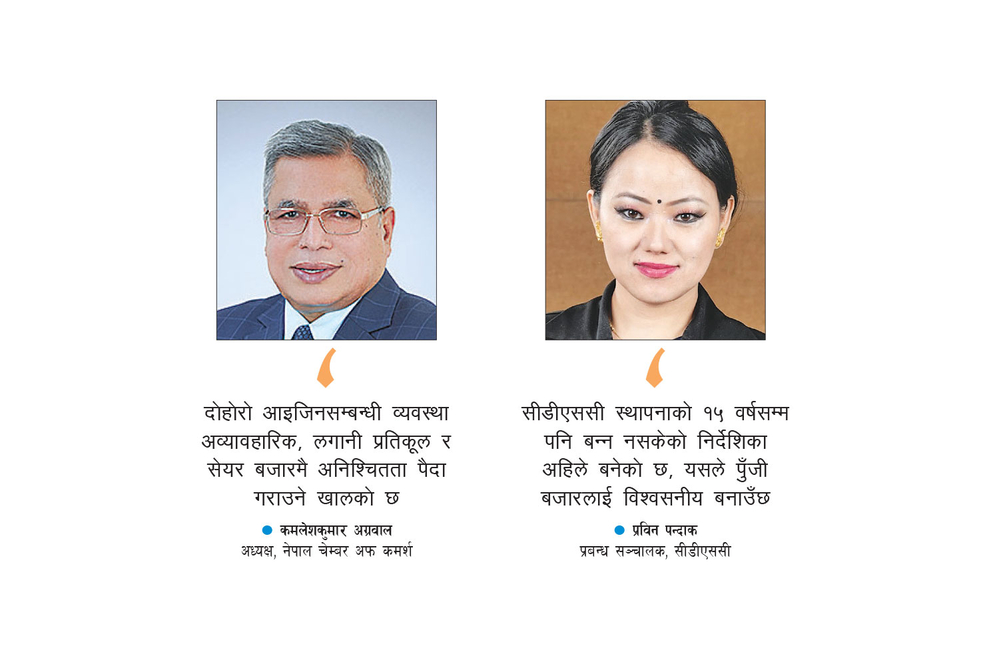
"CDSC's provision of dematerialized securities with different ID numbers for founders and general public and founder shares are not automatically converted into general public after the locking period is not appropriate," he said, "If such a system is implemented, it will have a long-term impact on Nepal's stock market." Investor confidence weakens. In particular, it will have a negative impact on the energy sector, cement, hotels, manufacturing industry, media etc.'
Agarwal also stated that the proposed arrangement is against international recognition and established practice. This guideline is against the interests of investors. Such arrangements will add confusion and insecurity to the investment environment in Nepal's immature capital market, said Agarwal.
Private sector umbrella organizations including hydropower producers, founding investors have been claiming that the proposed arrangement is not correct. According to Uttam Kumar Vlon, vice president of IPPAN, this arrangement is not only unfavorable for institutional investors in energy, media, cement and other sectors but also not in the interest of the capital market as a whole.
"The latest decision made by CDSC regarding the registration of dematerialized shares of companies will affect 870 million shares worth 87 billion in 58 industries, including energy, media, cement," Vlon said, "The proposed arrangement will affect 530 million shares worth 53 billion in only 47 projects in the energy sector and will also have a negative impact on the investment of 37 companies that have applied to issue shares worth 41 billion."
However, Vlon says that even the target of producing 28,500 megawatts of electricity within 10 years for the energy sector will be impossible. After stopping the process of dematerialization of shares for a long time, CDSC finally sent the directive to the Securities Board to issue the shares issued to the founders and general public of all companies separately. This is not right,' he adds, 'while CDSC has stopped the dematerialization process of shares for a few years now, the decision to stop the automatic conversion to founder shares and to arrange separate ISIN numbers for classification has created a crisis of confidence in the market.' The stock market in Nepal is still not investment friendly. In this case, the Chamber says that when an organization like CDSC reverses the old standards and brings a new system, negative psychology has been created in the market. If this proposal is implemented, it is against the prevailing laws, international norms and established practices that are being applied in Nepal's capital market, and it will have a long-term impact on Nepal's capital market, according to IPPA's statement.
CDSC has claimed that after the implementation of the proposed guidelines, many distortions of the capital market will be solved. "This directory will greatly help in reliability, data management, statistical documentation etc. in the market," said Pravin Pandak, managing director of CDSC. This will make the capital market more reliable.'
Chief Executive Officer of National Commercial Merchant Banking, Badri Prasad Pyakuryal, said that there will be no impact on the share price or when it will be converted to the public in the future when the founders and the general public have separate accounts.
In the case of banks, financial institutions and insurance companies, there is a provision in the relevant law that even after the lock-in period, the founder's shares cannot automatically be converted into public shares, and special permission from the regulatory body is required. Therefore, even after the lock-in period, the 'P' is kept after the founder's shares," said Pakuryal, adding, "That is not the case for companies in the sector except for banks and financial institutions and insurance. Because in the case of these companies, there is a provision in the relevant law that they can be converted to public after the 'lock-in' period is over. Therefore, the regulatory body should not allow the lock-in period to convert the founder shares into common shares.
He said that there is no need for stakeholders to panic as CDS is going to arrange two e-signs to separate the founder and general shares only for the lock-in period. Now, when the founder and common shares are kept in the same account, they are also kept during the lock-in period, if bonus shares come from the company, they stay outside the lock-in. In such a situation, some people knowingly or unknowingly sold the shares,' he added, 'to prevent such distortions seen in the market, CDSC may have arranged for two Igins. No one should be alarmed by this.
Even though the dual identity arrangement is only a very technical and data recording matter of CDSC, it was discussed as if the policy was going to be changed theoretically, Priyaraj Regmi, the former president of Nepal Stock Brokers Association, said. "There is no need for anyone to panic if CDSC keeps the founder and common shares separately for three years only and after completing the normal process, the founder shares can also be converted into common shares," he said. What is
Aizin?
AiZin is a number given to management of physical shares converted into electronic (dematerialized) shares. Niranjay Ghimire, the spokesperson of the Securities Board, said that the operational guidelines regarding dematerialization of shares came from CDSC for approval last Monday. "The board should approve the guidelines prepared by CDSC, the draft has been received for that," he said, "The board will study and proceed with the necessary process." In the
guidelines, a provision has been proposed for all other sectors, like banks and financial institutions and insurance companies, to separate the founders and common shares, and to give different IDs. According to the guidelines, the companies have to classify the dematerialized (converted into electronic) securities into two groups, founders and general public, as per their articles of association and regulations. There is a three-year 'lock-in' period for founder shares in
companies. Shares of such group cannot be sold during that period. In the case of companies in the mentioned sectors, even after the 'lock-in' period, the process including the permission of the relevant regulatory body must be completed to convert the founder shares into general public.
But now a single e-name is given for companies in sectors including hydropower, investment, production and processing (except banks and financial institutions and insurance). Founder and general shares are being held in the same name. Companies cannot sell founder shares for three years (lock-in period) after the IPO allotment.
Even if the founder's shares are held during the 'lock-in' period, even if they are in the same account, only ordinary shares are traded. After completion of three years, after 12:00 midnight, founder shares are automatically converted into common stock and open for sale in the market at the same price.

