We use Google Cloud Translation Services. Google requires we provide the following disclaimer relating to use of this service:
This service may contain translations powered by Google. Google disclaims all warranties related to the translations, expressed or implied, including any warranties of accuracy, reliability, and any implied warranties of merchantability, fitness for a particular purpose, and noninfringement.
Employees have complained that the Nepal Securities Board is in a weak state in history and has not become like a regulatory body. They say that the board has reached a very serious situation due to the weak policy base and lack of effectiveness in operations.
In a program organized on Sunday on the occasion of the 33rd anniversary of the board, the presidents of the employees' union said that the government should implement the capital market reform program as the situation is very serious.
In recent times, there has been a widespread public complaint against the Securities Board. The board has been accused of rampant insider trading, lack of effective monitoring and prosecution of culprits, irregularities in the distribution of initial share issuance (IPO) permits, asking for commissions, etc. In such a situation, the chairman of the two employee unions active in the board claimed that the situation will be very dire if the securities board is not started an immediate reform program.
"Securities Board is at a critical moment in history, now we have to seriously review the direction of the future and start the first phase capital market reform program immediately," said Ajay Dhungana, president of Nepal Securities Board Employees Union, "The capital market is dynamic, its components are constantly changing. But the legal structure to regulate these constantly changing issues is insufficient. Given such an act, the government cannot question why the board was not properly regulated/supervised?'
He asked the parliamentarians to withdraw and amend the Securities Act Amendment Bill currently submitted to the Parliament, or draft a new one, as it cannot address the existing problems in this area.
The board had never been broken like this in history. "If we follow the way we are walking now, the situation will get even worse," he said, "because we as regulators have not remained like regulators, unstable policies and regulations, policy formulation without discussion with stakeholders and many surprising policies have not given us regulatory trust, nor have the fundamental problems of the capital market been solved." The board became a mere unit to implement various directives from various sources. When the regulation took away the autonomy given by the Securities Act, we became like a unit to implement the instructions.'
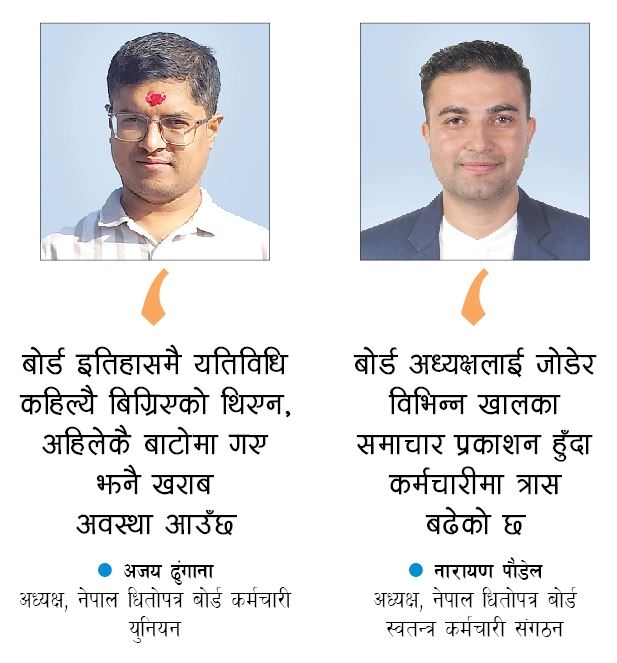 The fact that the Board has not been able to implement the Commodity Exchange Market Act for eight years is also a big weakness, he says. "How long is our indifference to start the commodity market?" he asked. Narayan Poudel, Chairman of Nepal Securities Board Independent Employees Organization, said that the Securities Board is currently facing a difficult situation amid various pressures and challenges. He said that in the context of qualitative changes in the development of the global capital market, Nepal's capital market is not only ironic but also tragic.
It is a sad matter that the board is held in contempt due to weak physical structure and lack of institutional strengthening. For a long-term solution to this, the necessary steps should be taken from the top leadership level, he said, "In the last few days, the publication of various types of news related to the chairman of the board has created an atmosphere of panic among the employees." Paudel also demanded to enhance the institutional governance by publishing and implementing various study reports related to the capital market and the board. In the
program, Deputy Prime Minister and Finance Minister Bishnu Paudel instructed the Securities Board to rise above the pressure and influence of others. Finance Minister Paudel instructed the board to adopt a policy of encouraging those who do well and punishing those who do wrong.
The role of the Securities Board in the development and expansion of the capital market is indispensable. Therefore, work above the pressure and influence of others," he said, "Encourage those who do good work and punish those who do bad things." Since the government wants qualitative improvement in the capacity and role of the Securities Board, he has instructions to work accordingly. "In the stock market, there are many problems including insider trading, share cornering, transparency in transactions, the board should adopt a zero tolerance policy to control such transactions," Finance Minister Paudel said. He said that the functioning of the Securities Board should be done in a way that instills the confidence of investors.
During the development and expansion of the stock market, the board should also play a role in introducing new tools. Santosh Narayan Shrestha, chairman of the Securities Board, accepted that the regulatory capacity of the service has not been expanded according to the market development. He says that there is a challenge in supervisory capacity. He said that in the budget of the next financial year, there are plans to increase the service capacity, to allow NRNA to enter the market, and this will help in the development of the market. President Shrestha said that the program mentioned in the budget will facilitate market entry for small and medium entrepreneurs. While there is no insider trading control in the market, while the 'cornering' of shares is increasing, Chairman Shrestha claimed that work is being done to prevent last-minute manipulations in the stock market.

