Furniture, rugs, hats and sweaters produced by prisoners are also exported to foreign countries
We use Google Cloud Translation Services. Google requires we provide the following disclaimer relating to use of this service:
This service may contain translations powered by Google. Google disclaims all warranties related to the translations, expressed or implied, including any warranties of accuracy, reliability, and any implied warranties of merchantability, fitness for a particular purpose, and noninfringement.
As you enter the door, a loud sound hits your ears. Some are busy carving wooden shoes while others are busy making furniture and rugs. There is also weaving of clothes and hats and sweaters on the loom. This is the scene of Gulmi Jail, which looks like an organized industry.
A 52-year-old man from Makwanpur, who is serving jail time, is a chief mason who makes blinds. He has been in Gulmi jail for 2 years, who has been shaping wood into flowers for 26 years. He has also taught skills to other inmates. "I used to do the same job outside, here I have transferred my skills along with my work," he said, "I am earning 45,000 per month." He is sending expenses to the family of 4 from prison.
A 30-year-old man from Palpa, who has been serving his prison sentence here for 5 years, used to do muda weaving in the beginning. For 2 years, he has been giving new shapes to the wood. He learned all these skills in prison. He is supporting a family of 6 including his parents, 2 sisters, 1 brother and 1 son. "I have been earning 25,000 per month," he said.
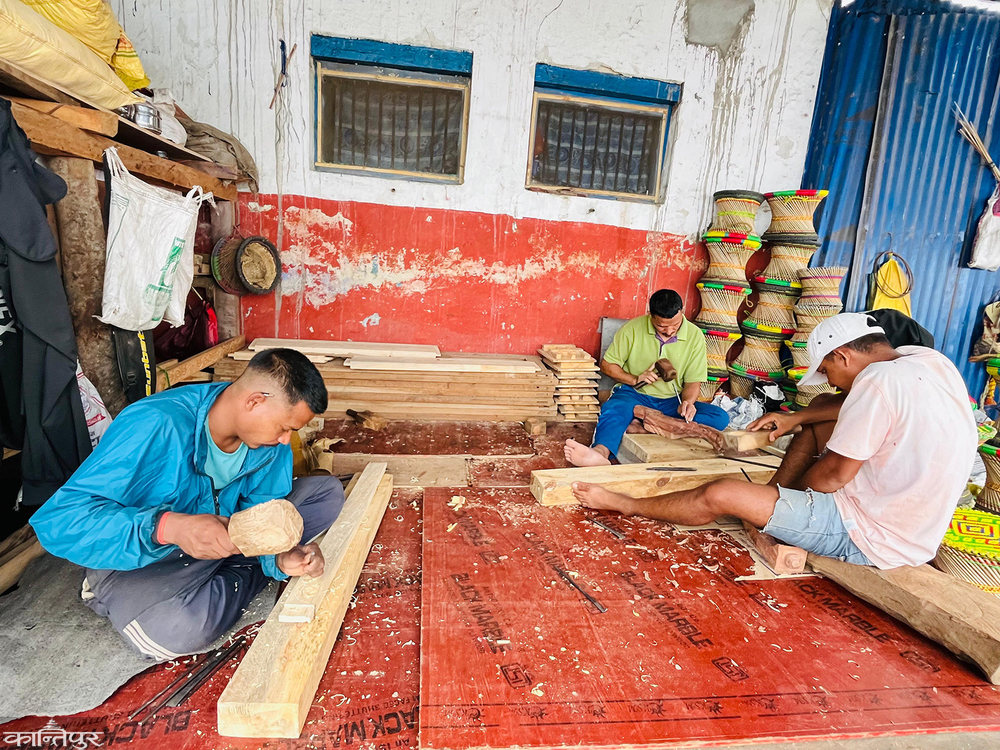
There are currently 140 prisoners in Gulmi Jail. In which, except for 1 dependent and 1 disabled person, others are doing some work. They have been earning a minimum of 10,000 to 45,000 per month. At present, eye windows, statues, chowks, doors, mudha, frames, sofas, tables, kitchen and office materials are produced in the prison.
The prison administration has also said that materials related to weaving, hats and sweaters are also being produced. For which 700 cubic feet of sal wood and another 3000 cubic feet of wood are being consumed in the prison. Reshmiraj Panthi, head of Gulmi Jail, said that a turnover of 3 crore rupees was generated from this last year. He said that he expects a turnover of 60 million this year.
The material produced here is being exported to 7 other countries including all major cities of Nepal. Hari Thapa, Head of Internal Administration (Chowdar) of the prison said that blinds and sofas made from sal have been exported to Dubai, Japan, Malaysia, India, Macau, Singapore and Australia. He said, "Demands have also come from other countries."
Thapa said that the prison, which has a capacity of 20 male and 5 female prisoners, has engaged the prisoners in the work of improving the kitchen, managing the sugarcane and generating income. Prison as an industrial village or as an industry He expressed the opinion that
should be done. Jail chief Panthi said that the jail, which was only in the form of warp and weft weaving 2 years ago, has been established as an industry in a tripartite partnership with the district administration, jail and internal administration. If it is registered as an industrial prison, the income will increase more, he said.
Chief District Officer of Gulmi, Janardan Gautam, said that making money by making use of skills in prison is a good example. "There should be a policy from the center to establish the prison as an industrial village," he said, "We are also taking initiatives from our side."

