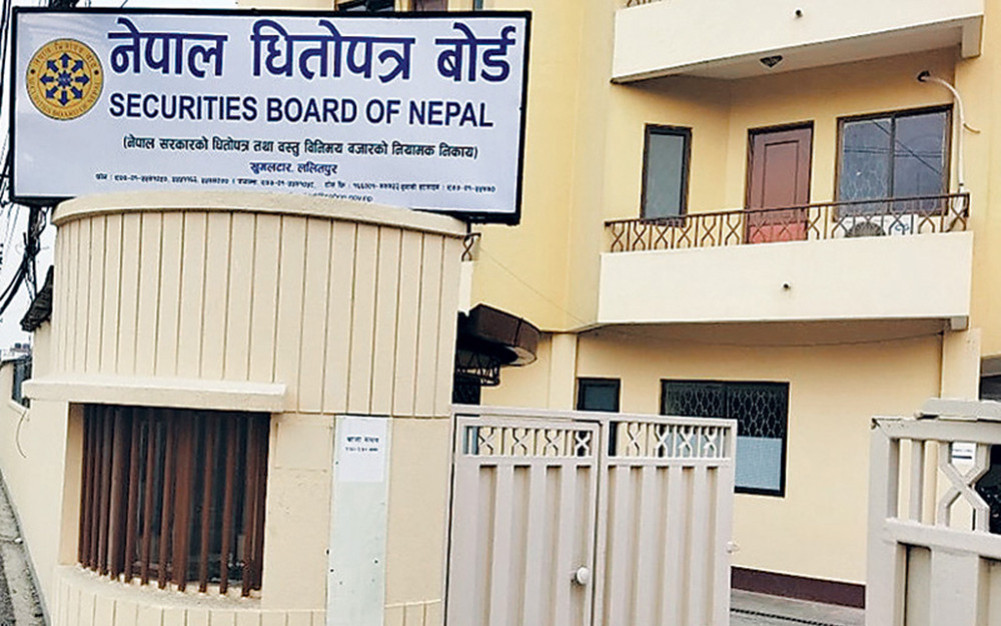
Less than a year after distributing a large number of broker licenses, the Securities Board has again taken a strategy to reduce the number.
We use Google Cloud Translation Services. Google requires we provide the following disclaimer relating to use of this service:
This service may contain translations powered by Google. Google disclaims all warranties related to the translations, expressed or implied, including any warranties of accuracy, reliability, and any implied warranties of merchantability, fitness for a particular purpose, and noninfringement.
The Nepal Securities Board has put forward a strategy to reduce the number of broker companies. The board, which was detailing the license of brokers until a year ago, has now introduced a policy of mergers and acquisitions to reduce the number. For this, the Board has issued 'Guidelines for Amalgamation/Merger or Acquisition of Securities Dealers, 2081'.
The Board has issued guidelines for brokers on merger/amalgamation or acquisition for the first time. Along with this, the way is now open for merger and acquisition of broker companies. During the tenure of Chairman Ramesh Kumar Hamal, the Securities Board distributed new licenses to 42 broker companies. After the addition of 50 broker companies, this number has reached 92.
Experts say that due to the lack of short-term foresight in the regulatory bodies, a large number of licenses are distributed in one year and pressure for mergers is growing.
"In the past, the National Bank and the Insurance Authority made the same mistake, the Securities Board has repeated the same mistake in recent years," said the former Chairman of the Securities Board, "rather than learning from the mistakes of others, he did it, and there is a tendency to think why we shouldn't do it."
Board sources said that the Guidelines on Amalgamation/Merger or Acquisition, 2081 have been issued. In the fifth amendment of the Securities Dealers (Securities Brokers and Securities Dealers) Regulations-2064 on August 29, 2079, the paid-up capital of the broker company is specified. Schedule 9 of the
regulation stipulates that the paid-up capital of limited acting securities brokers should be 200 million rupees, the paid-up capital of pre-acting securities brokers should be 600 million rupees and the paid-up capital of securities traders should be 1.55 billion rupees. In
guidelines, initially the broker will have to apply to the board for in-principle approval. According to this, qualified securities traders should jointly apply to the Board for its theoretical approval if they want to merge/merge or acquire. When submitting a
application, the decision made by the Board of Directors and the General Assembly regarding the merger/merger or acquisition of securities dealers, the initial agreement regarding the merger/merger or acquisition, the action plan with a time-bound schedule related to the merger/merger or acquisition, the audited financial statement report of the last financial year, details on staff management and the authority authorized by the Board of Directors regarding the merger/merger or acquisition There is a system to be determined.
There is a provision in the directory that the merger committee and its work responsibilities, the basis on which the securities business can be merged/amalgamated or acquired according to the prevailing laws regarding the company should be disclosed. The board will grant in-principle approval to applications that meet the
process and criteria. "On examination of the submitted details and documents, if the board deems it appropriate to grant in-principle consent, within 15 working days, it may grant in-principle consent with the necessary conditions to proceed with the process of merger/amalgamation or acquisition of such securities businessmen," the directive says, "If it is found that it is not possible to grant in-principle consent during the investigation, the reason for not granting such in-principle consent shall be disclosed to the applicant within seven working days from the date of the decision of the board to not grant such in-principle consent." Information must be given. Before going to the
merger, the broker companies will have to conduct an asset and liability assessment (Due Diligence Audit - DDA). "Securities businessmen who have received theoretical approval must have their assets, liabilities and business transactions evaluated (due diligence audit) from an independent appraiser," the guidelines state.
Independent evaluator means a person, firm, organization or auditor who does not have any kind of interest with the securities business (conflict of interest) in the directory. 75 percent of the calculated adjusted net worth of the securities dealer while making the DDA, future receivables
15 percent of the commercial valuation prepared using the present value of cash flow (discounted cash flow) method, 10 percent of the valuation made using any other method calculated based on international valuation standards.
"The share swap ratio can be reduced by 10 percent from the price established in this way," it is said in the guide, "The final share swap ratio of the stockbroker will have to be determined based on the evaluation report." According to the guidelines, within 15 working days from the date of the decision regarding the merger/amalgamation or acquisition with the share swap ratio after the final agreement, the securities business must submit an application to the board for final approval in a jointly prescribed format.