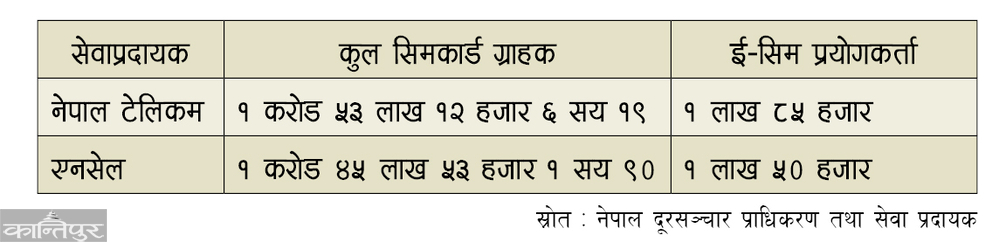
The number of e-SIM users of Nepal Telecom is 185 thousand and Ncell is 150 thousand
We use Google Cloud Translation Services. Google requires we provide the following disclaimer relating to use of this service:
This service may contain translations powered by Google. Google disclaims all warranties related to the translations, expressed or implied, including any warranties of accuracy, reliability, and any implied warranties of merchantability, fitness for a particular purpose, and noninfringement.
The number of e-SIM users in Nepal has reached three and a half lakh in two and a half years. According to the companies, Nepal Telecom reached 185,000 and Ncell reached 150,000. In Nepal, since August 31, 2079, the government-owned Nepal Telecom started distributing e-SIMs from its customer service center in Sundhara, Kathmandu.
The company started distributing e-SIMs from all telecommunication offices across the country from November 2079, and introduced the facility to get such SIMs online from 22nd January 2081. "The adoption of e-SIM in Nepal should be considered good, there is a lot of interest, they ask whether it is possible to get e-SIM from abroad," said Hari Dhakal, spokesperson of Nepal Telecom, "We have issued about 2500 e-SIM online." Nepal Telecom's e-SIM is also used in the smart meters of the Nepal Electricity Authority. For this, Telecom provided 150,000 E-SIMs to the authority in 2080 Baisakh.
Private sector mobile service provider Ncell has also started distributing e-SIM from 9th of November 2079. Ncell also collaborated with UK's leading e-SIM platform provider Truphone to implement e-SIM in Nepal. "Currently, there are about 150,000 e-SIM users in Ncell's network," the statement provided by the company to Kantipur said. complained about the problem. Telecom spokesperson Dhakal says that this is happening because verification has been tightened. "If the name filled in the form by the SIM card user and the name in our system do not match, the verification will be rejected," he said, "we have taken strict measures to prevent SIM misuse."
Ncell users will be charged Rs 100 for upgrading their SIM to E-SIM. Nepal Telecom users who want to get an e-SIM should also have a minimum balance of 50 rupees in the SIM. But the company is providing e-SIM for free. From your mobile *#06# When dialing, if you see the number with EID written on it, you can know that the E-SIM works in that set.
E-SIM is a type of digital SIM. It is embedded within the mobile device itself. It works like a physical SIM card. Since it does not have to be put in and taken out, there is no problem of losing or damaging the e-SIM. Since different network profiles can be kept in the same e-SIM, the user can easily switch to the network he wants.
According to the latest survey of Mobile World Live under GSMA, a global network of telecommunication service providers such as Nepal Telecom, Bharti Aitel, Ajieta, more than 175 mobile network operators in 69 countries are currently providing e-SIM services. E-SIM is considered convenient when traveling abroad. Because it eliminates the hassle of buying a SIM card. Users can download and use e-SIM of any operator online. It also eliminates the need to pay expensive roaming charges.
According to the recently published 'Mobile World Live Industry Survey Report 2025', it is estimated that the number of smartphones with e-SIM connection will reach 1 billion by 2025. By 2028, half of the world's smartphones will have e-SIM. The conclusion of the survey is that since E-SIM is a new technology worldwide, its use has not increased significantly due to the lack of information among users and the technical problems encountered while installing E-SIM.
Currently physical SIM cards are being imported in Nepal with significant results. According to the latest data of the Customs Department, in the last seven months, 1 million 71 thousand 481 SIM cards have been imported into Nepal and 4 crore 79 million rupees have been released.

