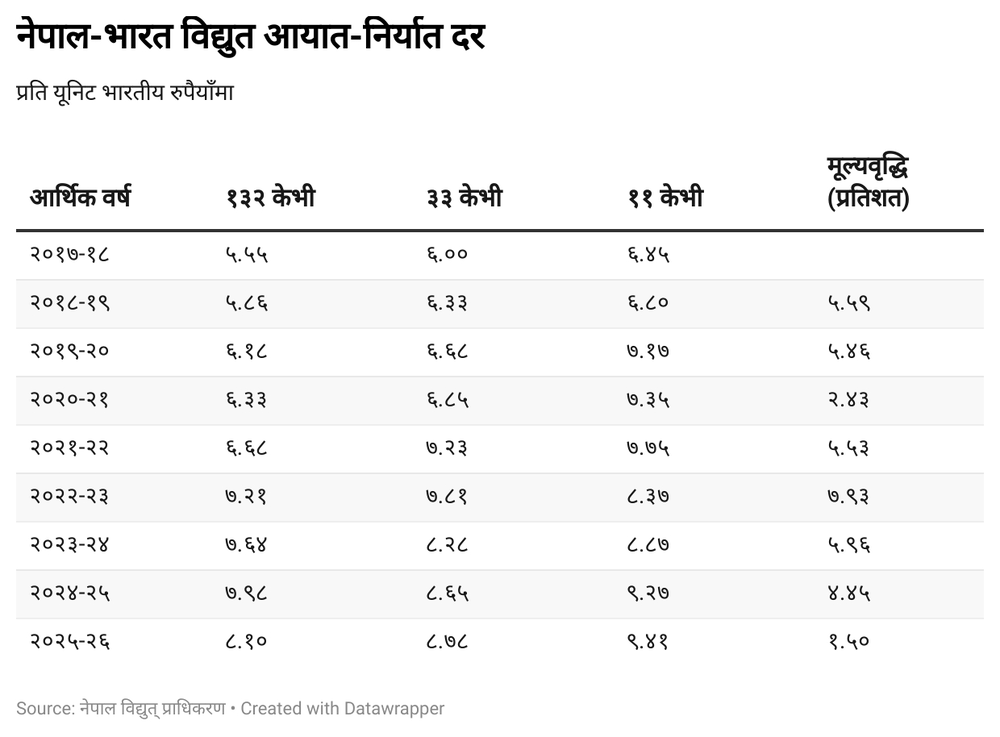
According to the authority, the average increase is 5.5 percent, but this time it increased only 1.5 percent
We use Google Cloud Translation Services. Google requires we provide the following disclaimer relating to use of this service:
This service may contain translations powered by Google. Google disclaims all warranties related to the translations, expressed or implied, including any warranties of accuracy, reliability, and any implied warranties of merchantability, fitness for a particular purpose, and noninfringement.
The Nepal Electricity Authority has informed that the meeting of the electricity exchange committee between Nepal and India has discussed with the Minister of Energy Deepak Khadka and Secretary Suresh Acharya about setting the new rate of electricity to be imported and exported through 132, 33 and 11 KV transmission lines.
The Authority has issued a press release on Tuesday saying that there are comments being made in various media and social networks about the meeting of the committee held in New Delhi on January 30. The
meeting discussed the import-export of electricity through 132, 33 and 11 kV transmission lines from April 2025 to March 2026. The rate per unit has been set at INR 8.10, 8.78 and 9.41 respectively. The said rate will be applicable only after getting approval from Nepal Electricity Authority Board of Directors and approval from Electricity Regulatory Commission . "When trying to hold a meeting of the management committee, the meeting has not been able to be held for a long time. If there is a situation where it is not approved by the management committee and the regulatory commission, we would like to make it clear that electricity will not be imported as per the electricity sharing agreement," the authority said in a statement.
The Authority has claimed that there is a trend and practice of fixing the rate in the same way in the past years. The committee meeting which has been implemented since 1985 is held under the co-chairmanship of a member of the Central Electricity Authority of India and the Executive Director of the Authority.
"In the previous years, the average price increase was 5.5 percent, this year's meeting has been arranged to increase the rate of 1.5 percent from April 2025 to March 2026."
According to the requirement, the authority has been importing electricity through this agreement only during the dry season from 4 pm to 9 pm and if there is no electricity import approval by competing with the Indian Energy Exchange. "Currently, the new rate fixed in the Indian Energy Exchange is cheaper than Rs. 10 per unit during the peak period," the statement said, "You will have to pay the rate only if you have to import electricity as per the requirement." Due to non-importation of electricity, there is no mandatory arrangement to pay and take the fixed rate or any other penalty.
According to the authority, the agenda of the meeting was discussed in the Ministry of Energy, Water Resources and Irrigation. "It was agreed between both sides to hold the meeting of the Nepal-India Secretary-level joint directorate committee the day before and the meeting of the power exchange committee the next day," the statement said, "the representatives of the Ministry and the Nepali Embassy in Delhi also participated in the meeting scheduled accordingly." Power, Water Resources and Irrigation Minister Deepak Khadka and Secretary Suresh Acharya were on a visit to India at the same time, and the mandate was taken after discussions with both of them to decide the new tariff.
At present, the authority is importing about 190 MW of electricity daily during peak times from Raxaul-Parwanipur in Bihar and Mainhia-Samptia 132 kV transmission line in Uttar Pradesh. At other times, electricity has been imported from the Indian Energy Exchange through competition.

