Uncertainty in the market and lack of certification of produced honey attracted towards shell sales
We use Google Cloud Translation Services. Google requires we provide the following disclaimer relating to use of this service:
This service may contain translations powered by Google. Google disclaims all warranties related to the translations, expressed or implied, including any warranties of accuracy, reliability, and any implied warranties of merchantability, fitness for a particular purpose, and noninfringement.
Unhealthy competition is going on in the market to sell the produced honey. Therefore, instead of producing honey, I sell hives and shells with bees, he said. He said that the annual turnover is from a minimum of 1.6 million to a maximum of 2.9 million.
Pashupati Basyal of Bagnaskali Rural Municipality-8, Barangdi of Palpa sells bees and bee-related products and does a business of up to 2 crores annually. Basyal, who is also the owner of Himali Bee Concern, sells honey, beehives, beehives with bees, and bee supplies. They export to more than a dozen districts including Palpa, Gulmi, Rolpa, Rukum, Acham, Gorkha. ``I have been exporting according to where the demand comes from,'' he said, ``but the support of the government mechanism is minimal.'' Retired from Nepal Police, he started beekeeping for 5 years. In the beginning, he started the business by buying 100 beehives for 4 lakhs. Unhealthy competition is going on in the market to sell the produced honey. Therefore, instead of producing honey, I sell hives and shells with bees", he said. He said that the annual turnover is from a minimum of 16 lakhs to a maximum of 29 lakhs.
Giriprasad Gayre of Bagnaskali Rural Municipality-7, Khanigaon Basuwakhola is the president of Ranimahal Beekeeping Farmers Group. The group formed in 2077 has 31 members. Gayre has also been selling bee shells instead of selling bee honey. 15 to 20 lakh rupees are earned annually from the sale of shells with bees . "Our group has emphasized on bee shell production rather than honey production," he said. As a result, we have produced bee balls.' According to him, the group sells bee balls up to one and a half million annually.
These are just a few examples of Serena breed bee hive sales. Besides, honey is produced from 800 hives in the district. Palpa honey is exported to the local and nearby Butwal market. But Tej Bahadur Bhandari, the former president of Manimauri Development Cooperative, says that honey has not been marketed. "On the one hand, there is unhealthy competition in the market, on the other hand, there is a problem with the lack of certification of the produced honey," he said, "Therefore, there are more farmers selling shells than producing honey."
Those who used traditional hives in the past now keep bees in modern hives. Meen Bahadur Lamtari of Ribdikot Rural Municipality-6, Thimure, Lowtal said that the annual income of two lakhs from the sale of honey is now up to one million rupees from the sale of shells. First, bees were collected from 50/60 hives by searching in the forest. All 16 households in his village had started beekeeping. But when the market of honey is uncertain, some have left .
'Even the local level has not been able to support the beekeepers,' he said, 'They have started paying more attention to the sale of shells than honey production.' He demands to get subsidies for hives, chaka, aadharchaka, mahdani to increase honey production.
"Because beehives are expensive, if subsidies are not given, poor families will not be able to afford modern beehives," he said. 4 thousand to 6 thousand when selling bees with shells. That's why Humnath Neupane of Rampur Municipality-6 said that it is more common to sell beehives with base wheels than to sell honey. According to him, there is no shortage of pasture in Palpa for beekeeping. In the forest of the village, there are biennial flowers like Asuro, Musikath, Bhakteso, Chiuri, Mustard and plants that bees like.
Neupane said that since there was no support from the government to promote the beekeeping business, even though the number of beekeepers increased, the production of honey did not increase. Keshav Kunwar of Ribdikot Rural Municipality-7, Palungmainadi, who started with a modern hive in 2055, now has 170 beehives. But he said that it is more beneficial to sell shells than honey. Kunwar, who has produced up to 10 quintals of honey, has now started selling shells. He informed that the income of 7 to 10 lakhs from honey sold at 1000 per kg and 3/4 lakhs from beehives.
Pashupati Basyal of Himali Bee Concern, located in Bagnaskali Rural Municipality-8, Barangdi, Palpa, is preparing to export bees and bee products outside the district.
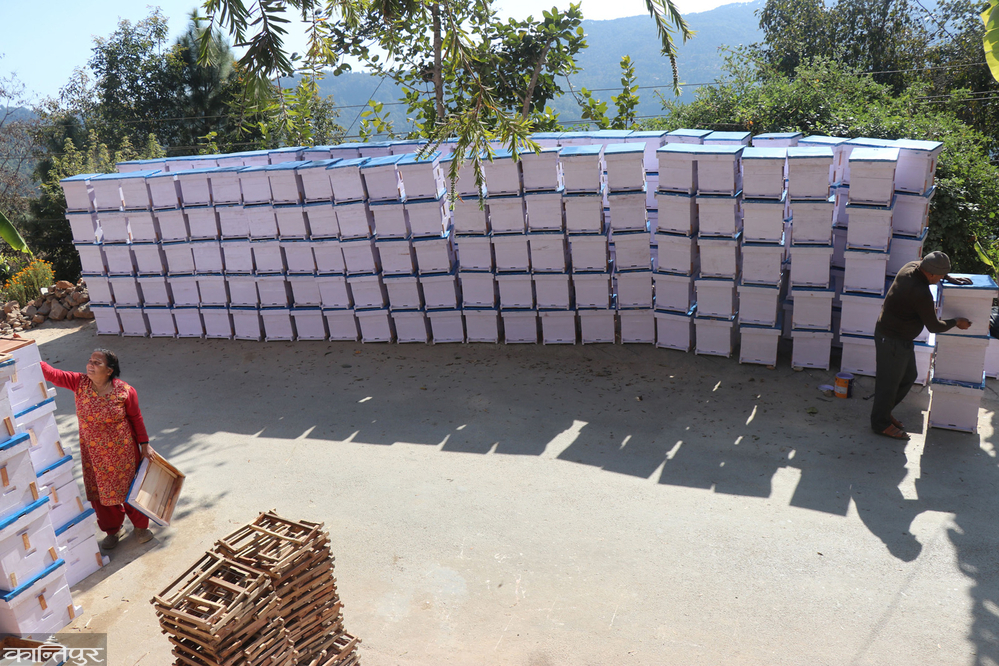
There is no data on how many farmers do commercial beekeeping in Palpa. Santosh Kumar Choudhary, head of Krishi Gyan Kendra, informed that there are 800 beehives. "There is no data on how much is produced," he said. Commercial beekeeping was started after the first registration of Bee Resource Center in 2057 and Manimauri Development Cooperative Society in 2060 in Nepal with government support.
Mudhe, Khope, modern beehive cooperatives, commercial beekeepers have no data about how much has reached the farmers, said Mohan Karki, president of Manimauri Development Cooperative. He says that due to indiscriminate deforestation, the grazing area for bees is becoming scarce. Karki says that honey production has also decreased due to processing and marketing problems. "There is an additional problem in processing and marketing," he said, "since chemical honey is available in the market at a low price, organic honey sales have decreased."
Palpa Serena is a suitable district for beekeeping in Lumbini province. Agriculture Knowledge Center, Prime Minister's Agriculture Modernization Project, local level should also help in promotion by designating pocket areas to develop and expand the beekeeping business, said Tankanath Khanal, Head of District Coordination Committee Palpa. The income of farmers is increasing from beekeeping. Now we should give subsidy for its expansion," he said, "The demand for beehives, shells and honey comes from outside districts, but there is not much government investment in it."
A support organization to search for the market
The market access program for the Nepali honey value chain is about to start to search for the market for the honey produced in Palpa at the national and international levels. The program promotes coordination and cooperation between beekeeping farmers, processors, traders, government representatives and It is believed that it will help to establish a network. National Technical Coordinator Jagdish Bhakta Shrestha informed that the program will be conducted at the Technical Implementation Partner of Business Kit Development Center Lalitpur.
The beekeepers lack technical knowledge, training, skills, knowledge as well as quality, lack of coordination between traders and processors, because they are selling shells rather than selling honey, he says that this program will help. National Quality Infrastructure Expert Manju Chhetri said that farmers will be attracted to beekeeping by facilitating inspection, testing, certification, standardization, metrology, technical regulation, evaluation, and market monitoring. The
program is supported by the United Nations for Industrial Development Organization. National Value Chain Development Expert Suresh Baral said that the program aims to improve the living standards of small beekeepers, small and medium entrepreneurs, and honey processors in the districts of Nepal where the project has been implemented through the sale of high quality honey. He said that this program will be helpful in expanding access to domestic, regional and international markets of Nepali honey as well as Palpa.


