Even though the external indicators of the economy continue to be strong, there is no improvement in government finances, the situation of revenue, capital expenditure and credit expansion is critical.
We use Google Cloud Translation Services. Google requires we provide the following disclaimer relating to use of this service:
This service may contain translations powered by Google. Google disclaims all warranties related to the translations, expressed or implied, including any warranties of accuracy, reliability, and any implied warranties of merchantability, fitness for a particular purpose, and noninfringement.
In recent months, the growth rate of remittances entering Nepal has started to decrease continuously. According to the monthly report of Rashtra Bank, remittances of 1 trillion 14.3 billion rupees and 1 trillion 18.8 billion rupees were received in November last October. Compared to last October, Nepal received 30 billion rupees less remittances in October and 26 billion rupees in November.
Last October, remittances of 1 trillion 44 billion 20 million rupees were received. Even when the economy of the countries (Gulf countries, Malaysia, Japan, South Korea, America, Japan, Australia, etc.) which are the main destinations of Nepalis for foreign employment are on the road to improvement and the number of Nepalis going abroad for employment is increasing, the decrease in the growth rate of remittance inflow is seen as meaningful.
Economic experts say that with the increase in illegal transactions in the country, remittance money has started to be used there, so the growth rate of remittances coming from legal means (banking system) has decreased.
There is no doubt that informal economic activities have expanded in the last few months due to the loose regulation and supervision of the government, and the amount of remittances may have been used in such transactions. Otherwise, there is no reason for the decrease in the remittance growth rate," said an economist. "Until last December, commercial banks did not import gold in most of the months. But the gold shop was not overcrowded. Where did that gold come from and how was it paid for? Once the answers to these questions are found, the increase in informal transactions is automatically confirmed.
In the second week of November, the government reduced the 20 percent customs duty on gold imports to 10 percent. Before that (last July to the second week of November), commercial banks had imported only 150 kg of gold. But there was no shortage of gold in the market. During that period, gold import through illegal means and other informal activities also increased and remittance money may have been paid there (outside the country) for its payment.
In 5 months of the current financial year, 6 trillion 40 billion 43 billion rupees of remittances have entered the country through remittances. Compared to the same month of the last financial year, it is 4.4 percent more than the economic and financial report of the month of November released by the National Bank on Friday. Remittance inflow increased by 24.2 percent in the last fiscal year.
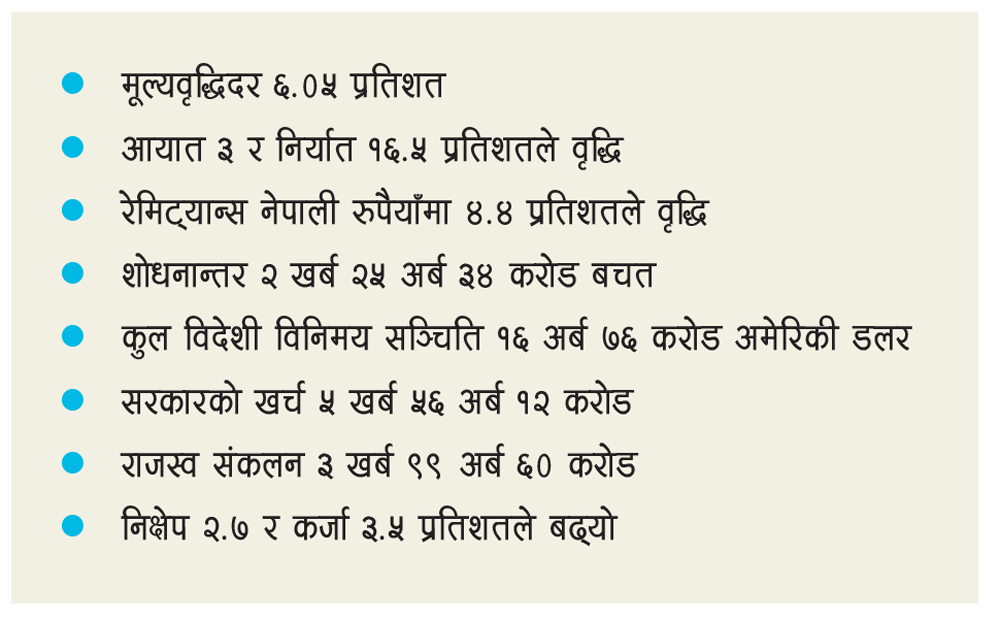
Remittance inflows in US dollars increased by 2.5 percent to 4.73 billion. Last year, such flow increased by 21.1 percent. Within 5 months of the current financial year, the number of Nepalis who took the final work permit (institutional and individual-new) for foreign employment is 190 thousand 384 and the number of those who took the work permit again is 135 thousand 425. During the same period last year, such numbers were 171 thousand 975 and 12 thousand 542 respectively. The mentioned data confirms the increase in the number of Nepalis going abroad for employment in the same period of this year as compared to 5 months of the last financial year.
Although the economic and financial report of 5 months showed that the growth rate of remittances decreased, foreign exchange reserves, foreign exchange position, current account and other indicators remained strong. With excess liquidity in the financial system, interest rates are low and still falling. In this situation, the government and the private sector have got a suitable opportunity to expand investment.
However, the government and the private sector are not able to take advantage of that opportunity. In recent months, while imports have been increasing, the growth rate of remittances has also decreased. According to experts, such trends seen in the last months indicate that the situation of excess liquidity in the financial system is not likely to last for a long time.
In recent months, increasing imports and decreasing remittance flow indicate that the excess liquidity in the financial system will not last for long, said Gunakar Bhatta, Head of Research Department of Nepal Rastra Bank. "The recent trend of imports and remittance flows indicates that the current high liquidity situation in the banking system will not last long," he said, adding that interest rates are low and declining. This has given the government and the private sector a suitable opportunity to expand investment. This condition may not always be available. Therefore, we should be able to take maximum advantage of this situation.'
The trend of rising market prices continued last November as well. At the same time, the annual point consumer price increase (inflation) reached 6.05 percent last November. It was 4.95 percent in the same month last year.
Last November's average price increase was the highest in the last 14 months. Earlier in October 2080, the average consumer price inflation rate was 7.50 percent. Since then, although at a low rate, the market price has been rising continuously. At the same time, it reached above 6 percent last November. The rise in inflation in recent months is due to the rise in Indian inflation.
India's average price increase has declined slightly to 5.48 percent in October from 6.21 percent last October. According to the experts, price increase has also entered Nepal along with the goods and services imported from India last October. They say that unless supply management is improved in Nepal, it will be difficult to control the price increase.
A high official of Nepal Rastra Bank said that the data of price increase which has been rising continuously in the last month shows signs of growth. It seems that mainly food price increase is under pressure. It seems that this type of price increase will continue until the supply system is made systematic and effective,' said the official, 'Indian price increase has a direct effect on Nepal's price increase.' The group has 3.92 percent. In the same period last year, the inflation of these groups increased by 5 and 4.92 percent respectively. In the 5 months of this financial year, the price of vegetable sub-group under the food and beverage group has increased the most by 43.05 percent, pulses and pulses by 10.66 percent, food and food products by 9.70 percent and ghee and oil by 9.39 percent. But during the same period, the price increase of maramsala sub-group decreased by 1.18 percent and that of sugar and sugar products by 0.83 percent.
Under the non-food and service group, the price increase of miscellaneous goods and services sub-group was 7.98 percent, alcoholic beverages by 7.01 percent, clothing and footwear by 6.75 percent, and furnishings and household appliances by 5.29 percent.
Foreign exchange reserves have again set a new record last November. Compared to last June, foreign exchange reserves increased by 11.5 percent and reached 22 trillion 73 billion 26 billion rupees. This is the highest ever. Foreign exchange reserves have been setting new records every month.
Last June, the country's total foreign exchange reserves were 20 trillion 41 billion 10 billion. According to the monthly report of the National Bank, such reserves in US dollars were 15.27 billion at the end of June 2081 and increased by 9.7 percent to 16.76 billion at the end of November 2081.
Based on the 5 months of imports of the financial year 2081/82, the foreign exchange reserves held by the banking sector will be enough to support 17.6 months of goods imports and 14.6 months of goods and services imports, according to the Rastra Bank. The National Bank had set a target of maintaining foreign exchange reserves sufficient to cover imports for at least 6 months in the current financial year.

