As the government finances could not be improved, the expected loan demand in banks and financial institutions could not increase
We use Google Cloud Translation Services. Google requires we provide the following disclaimer relating to use of this service:
This service may contain translations powered by Google. Google disclaims all warranties related to the translations, expressed or implied, including any warranties of accuracy, reliability, and any implied warranties of merchantability, fitness for a particular purpose, and noninfringement.
Due to the formation of a coalition government of two major parties, economic reforms will be prioritized and the economy is expected to be stable because of political stability, but no sign of it has been seen. Due to the failure to improve government finances, the demand for loans in banks and financial institutions has not increased as expected.
Interest rates have dropped to single digits as money piles up in banks. Economists say that even with low interest rates, the expected improvement in the economy has not been achieved due to lack of loan demand.
In the three months of the current financial year (July, August and October), loans from banks and financial institutions have expanded by 1 trillion 28 billion 65 crores (2.5 percent). In the same period last year, such loans increased by 1 billion 9.3 billion (2.3 percent).
According to this, last July, 14 billion rupees, 59 billion rupees in August and 55 billion rupees were extended in October. Experts say that although the loan expanded during that period was more than last year, it was very low compared to general expectations.
In the last three months, deposits in banks and financial institutions have increased by 1 trillion 70 billion (2.6 percent). In the same period last year, such deposits increased by 1 trillion 58 billion 500 million (2.8 percent). According to the mentioned data, less loans have been provided this year than last financial year when there was very less loans.
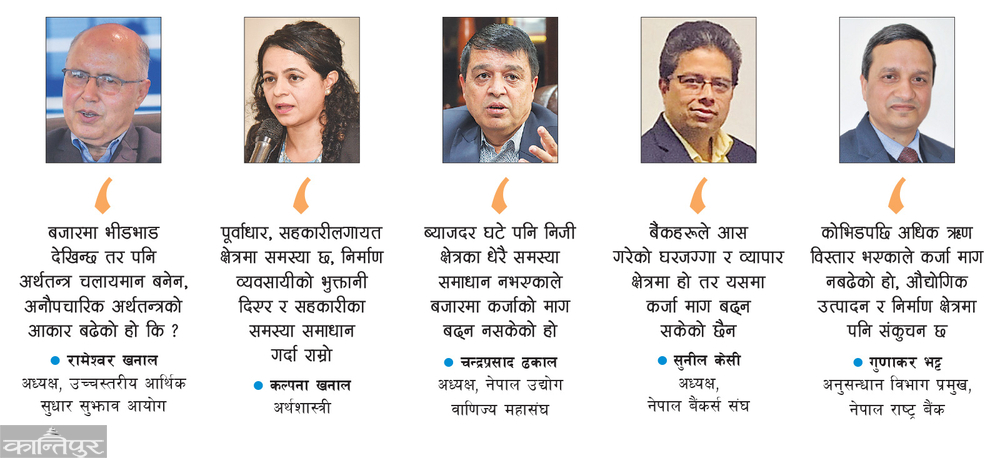
President of Nepal Bankers Association Sunil KC said that the loan did not go as expected. "Banks are hoping for real estate and business, but loan demand has not increased," he said. Therefore, the bad loans of banks are increasing. However, he claims that efforts are being made to expand more loans by introducing new products in areas such as real estate, housing, and margin lending.
The construction sector has been affected, the informal economy has increased, borrowers are unable to take more loans, and now the demand for loans has not increased as expected, said Rameshwar Khanal, former finance secretary and chairman of the High Level Economic Reform Suggestion Commission.
'The market is crowded, this is a sign of increased economic activity. But the economy did not become viable. This raises doubts whether the size of the informal economy has increased," he said. "Trucks and tippers have started running less on the roads. This shows that the construction sector is affected. Apart from that, the facts do not say that other sectors of the economy are weak. This is why the informal economy has expanded?
He said that even though the bank has accumulated money that can be loaned, the demand for consumer goods and loans in the market has not increased due to the lack of money in the hands of individuals. "In the past, a large part of the loan flow was invested in real estate, which was not sold when there was a slowdown in that sector. Due to the lack of sales, the borrowers could not pay the loan and take more loans,' he added, 'to solve this problem, we had to do something to create an environment in which the sale of real estate and housing sector would increase.' said People who have deposited in the cooperative have not received it. Therefore, people's ability to take loans has decreased,' he adds, 'therefore, the environment in which the citizens can get the money saved in the government should be told. In general, there is no problem in all areas of the economy, if the problems are removed, the economy can be made more dynamic. He says.
When the expected improvement in economic activity is not happening, last July, the National Bank introduced a monetary policy with an ambitious target of 12.5 percent credit expansion.
The facilities given to the construction sector, the reduction in the limit of the provisions related to the loss of good loans, the new provision to be counted in the capital fund, the cancellation of the limit of institutional share loans, the flexible policy on blacklisting, the provision of unsecured loans for foreign employment and the policy to encourage sectorial loans this year. Rashtra Bank claimed that credit expansion would be significant. But the data of the last month has shown that credit expansion is slow.
Banks and financial institutions will have to expand loans by an additional 6 trillion 54 billion 75 crore rupees this year to meet the target of the National Bank. Last year, the target of expanding credit by 11 and a half percent was set, but only 7 percent, i.e. 3 trillion 44 billion 72 crores was inflowed.
'In the past two decades, bank loans went to land and business. This area had also reached its peak. However, in the last few years, the policy of the National Bank has stopped lending to that sector," said economist Kalpana Khanal, "There are problems in infrastructure, cooperatives and other sectors. The government can make those sectors viable by paying the money of the builders and solving the problems of the cooperatives.'' He also said that there is a negative commentary on the economy in the market, and a great effort from the state level is needed to eradicate it.
The credit-deposit ratio (CD ratio) of banks and financial institutions is 78.61 percent as of last Sunday. During the same period, the total deposits of banks and financial institutions are 66 trillion 44 billion rupees. Banks and financial institutions can lend up to 90 percent of the total deposits as per the instructions of the National Bank.
Based on this, even now, the amount that can be loaned from banks and financial institutions is around 7.5 trillion rupees. In all months of last year, banks kept enough money to lend. At the end of June 2008, nearly 5 trillion rupees of investable funds were accumulated in banks and financial institutions. In mid-July, this amount was 3 trillion 74 billion, in August 4 and a half billion, and in October and October more than 5 trillion.
Although the loanable amount was more than 6 trillion in November, March and January, it fell below 6 trillion in February and March. In April and May, more than 6 billion and in June 8 billion of investable money was accumulated in the bank. Bhuvan Dahal, the former president of Nepal Bankers Association, said that there is no possibility of profit to repay the loan.
'Lack of confidence in the private sector, there had to be a profit after taking a loan, without that, the loan would not have gone,' he said, 'Banks have brought home loan products by lowering the interest rate. Loans have not flowed as expected.'
'For the last three years, the central bank has introduced a policy to reduce the overall demand. For that, some regulatory arrangements have been tightened,' said Chartered Accountant Analraj Bhattarai, 'for example, tax payment details have to be kept in personal loans, current capital loan guidance has been introduced, the result of that policy is now seen in the economy.' , the government's expenditure has also decreased. Business houses (corporate houses) are also facing problems in loan recovery. He said that there is no immediate improvement. "Even though business houses are profitable now, their cash flow is negative," he adds, "Bad loans of banks are increasing at a high rate, they have to manage old loans rather than new loans."
Although the interest rate has decreased, the demand for credit in the market has not increased because many other problems of the private sector have not been solved, said Chandra Prasad Dhakal, president of the Federation of Nepalese Industries and Commerce. "Industrialists have not been able to take more loans due to strict policies of the past including current capital loan guidance," he says, "If there was some flexibility in these policies, industrialists could have taken more loans." Therefore, he said, the government should do more to increase the confidence of the private sector by creating an investment-friendly environment.
Rajesh Kumar Agarwal, president of Nepal Industry Confederation, claims that the industrialists are unable to take more loans because the government has not taken any steps to improve the economy. The Confederation did not say that the interest rate has become expensive even in the past. Because now even if the interest rate is reduced, the demand for the products of the industries is still 30/40 percent,' he said.
Working capital loans are linked to the size of the business, Agarwal said that if the business is increased, the loan will not be raised, if the business is not increased, there is a situation where more loans will not be received. Current capital loan guidelines should be canceled/suspended for a certain period of time. Until then, industrialists could not take more loans," he added, "when there is a problem in the economy, even the money of industrialists could not be raised from the market. Even if we make the market run by sending few goods, there is no situation to take more loan from the bank due to current capital loan guidance. In the existing policy system, there is no condition for industrial construction and wholesale and retail sector to rise.' Kamlesh Agarwal, president of Nepal Chamber of Commerce, said that the economy has reached a state of stagnation.
In the last two years, many entrepreneurs have been blacklisted. They don't have the capacity to repay the debt, how can they get more?' Agarwal said, 'There was no enthusiasm and high morale in the private sector.' It was said that a flexible monetary policy would come at the beginning of this financial year. But in the first review nothing was done as initially stated. He said that the economy will not be able to accelerate unless the contractionary policy introduced in the last three years is reformed.
The government has set a target of 6 percent economic growth this year. The World Bank has projected economic growth of 5.1 percent and Asian Development Bank 4.9 percent. Economists say that if the expansion of the economy is in this state, there will be a problem in achieving the target economic growth.
In the past, there was lack of liquidity and high interest rates in the market, since that problem has been solved, the private sector should make full use of this opportunity, said Mahesh Bhattarai, spokesperson of the Ministry of Finance. There is enough liquidity in the market now. Interest rates have fallen to single digits. It is a favorable time for new investors," he said. "Banks can also expand more investments. It is not good to have excess liquidity in the long run. Therefore, a situation has been created where the private sector can take more advantage of this situation.'
Nepal Rashtra Bank Research Department Head Gunakar Bhatt said that because the family and business sectors are already over-leveraged, the demand for loans has not increased. "Despite the increase in loans after the Covid-19, the loan demand has not increased," he said, "There has also been a contraction in the industrial production and construction sector."

