Forming a committee to assess the situation in the telecommunication market, the needs of new operators and the problems faced by old operators
We use Google Cloud Translation Services. Google requires we provide the following disclaimer relating to use of this service:
This service may contain translations powered by Google. Google disclaims all warranties related to the translations, expressed or implied, including any warranties of accuracy, reliability, and any implied warranties of merchantability, fitness for a particular purpose, and noninfringement.
The government is preparing to bring Ncell under its control after four and a half years. However, doing so raises the question of what will be the future of telecommunication services in Nepal.
The two current competing service providers, Nepal Telecom and Ncell, will merge and become one, remain as two separate government companies, will Ncell become inactive like Smart Telecom due to government incompetence or what will happen? Amid these unanswered questions, the government has started looking for the possibility of bringing in a new telecommunication service provider. The regulatory Nepal Telecommunication Authority has formed a committee to study for that.
The committee formed under the coordination of the director of the regulation division of the authority, Amber Satham, has received the mandate to prepare the report within the next one and a half months. Director Santosh Paudel, Deputy Director Pradeep Paudyal and Sundar Pyakurel along with Assistant Director Sunil Khatiwada of the Authority's Law and License Division are members of the committee.
'A committee has been formed to study whether a third operator is necessary for us along with Nepal Telecom and Ncell,' Santosh Paudel, a member of the committee who is also the spokesperson, said, 'The study has been done after realizing the need for a third service provider, but nothing more can be said about it now. No, we are discussing and studying regularly.'
Paudel said that it is within the authority's responsibility as a regulator to continuously assess the condition of the telecommunications market, the needs of new operators (mobile service providers) and the problems faced by old operators, and studies have been conducted accordingly.
Although there has been a discussion for a decade about the need for a strong service provider like Ncell and Nepal Telecom, the authority has not requested applications for new mobile service providers. Now, the reason for re-emerging this issue is that considering the confusing situation after 5 years, bringing in new service providers as well as the economic/political benefit from license distribution is also considered as a special reason.
A new operator (voice service provider) is now necessary to sustain the telecommunication market. Recently, when the income of the telecommunication sector is decreasing, the application was not requested because there is doubt whether a new operator will come or not," says an official of the authority. told the authority.'
An authority source has informed that more than half a dozen subjects are being studied by analyzing various aspects related to the needs, possibilities and challenges of the new service provider. Performance of current service providers and income of last 5 years is also being reviewed. After this study, a proposal will be prepared on how, when and under what conditions the new operator can be brought in. To attract new operators, the authority has planned to allow 5-G service for commercial purposes.
Earlier in 2078, Nepal Telecom was given permission to test 5G service, but the company has not been able to test the speed yet. Ncell has not received permission for this. Now instead of testing 5-G, the experts say that the study has been advanced on the issue of directly starting commercial use through a new service provider.
Telecom service providers like Smart Telecom, Hello Nepal, CG Telecom entered Nepal for the last time in the 2060s. According to Section 22 (1) of the Telecommunications Act, the then 'Mero Mobile' got a GSM cellular mobile service license in 2061.
Then in the year 2065 according to section 23 (2) of the Act, companies like Smart Telecom, Hello Nepal got permission to provide services in rural areas. Those companies later obtained licenses for basic telecommunication services. This means, no new application has been opened for mobile services since Ncell was introduced by opening the application according to section 22 (1) of the Act, nor has the authority requested an application for telecommunication services after 2065.
No one can operate telecommunication services in Nepal without obtaining a license. According to Section 22 (1) of the Act, the authority should publicly publish a notice with the deadline for filing applications for permits. Section 22 (2) states that if there is an additional need for licensed telecommunication services, the authority can grant licenses to other persons. Section 23 (2) mentions that the government can apply for a license to operate telecommunication services as prescribed by taking the recommendation of the authority and publishing a notice in the gazette at any time.
There were six telecommunication service providers operating in Nepal at one time, but now only two have been able to survive. Bhupendra Bhandari, Chairman of the Authority, is of the opinion that this has created a situation of duopoly (dominance of two service providers) in the telecommunication sector.
The authority wants to end this duopoly in the background that both operators are suing the authority for some issues, from cartelizing by two operators, the other takes action only after looking at the strategy of one, and only if the other reduces the fee.
At present, Prime Minister KP Sharma Oli and ruling partner Congress Chairman Sher Bahadur Deuba along with Minister of Communications and Information Technology Prithvisubba Gurung are also positive for the third service provider, so this issue is also linked to political and economic benefits.
However, the failure of companies like CG Communications, Smart Cell, Hello Nepal, UTL, declining income of the telecom sector, and high license and renewal fees, experts question whether new service providers will come. However, even as service providers' revenues are declining in voice services, growth in data services is showing new potential, they note.
Telecom companies are not only analyzing revenue but also shifting from voice to data. Authority Chairman Bhandari had previously told Kantipur that the third service provider could not survive only because the rules and regulations adopted by the authority based on the competitive market were ineffective.
In the past few years, Internet service providers like Worldlink have been interested in expanding mobile services. On November 13, Worldlink signed an agreement to bring in 10 million euros of foreign investment from Finfund, in an event held in Kathmandu, the managing director of the company, Dilip Agarwal, said that they are ready to come as the third telecom operator. "We are also ready to provide mobile services, whether we get it or not, that is not in our hands," he said.
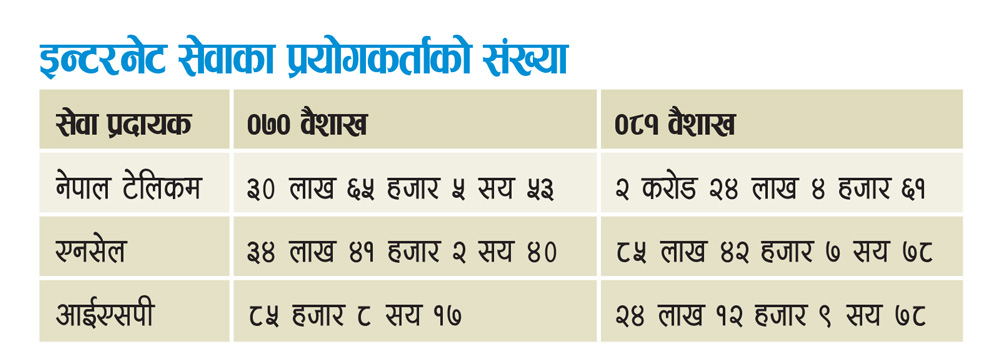
Even though Patan High Court rejected the plea to preserve the license of rural telecommunication services, CG Telecom is still in favor of rolling out (service expansion) all over the country once it gets the basic telecommunication service license. An official of the company said on condition of anonymity that they still have this plan. "Like internet service, we are ready to provide telecommunication services at an affordable price," he said, "However, the government should give opportunities to new operators in the latest technology like 5G."
Telecom experts have been saying that there is plenty of room for three strong service providers in a country with a population of 30 million. However, due to technical and policy challenges and unhealthy competition, past service providers have not been able to operate the business in the long term, says Bheshraj Kandel, an expert who is also the former chairman of the Authority.
'The reason for the failure of the previous telecom companies in Nepal is due to the policy challenges and their own lack of capacity and lack of clear purpose to do business,' said Kandel, 'companies like Smart Telecom, Hello Nepal, which have no experience in the telecommunication sector, fail to meet the obligations of network expansion and face high rates. Struggled to meet requirements like license renewal fees. Rising operating costs and a competitive market made it difficult for these companies to sustain their businesses. Newcomers should consider this.'

