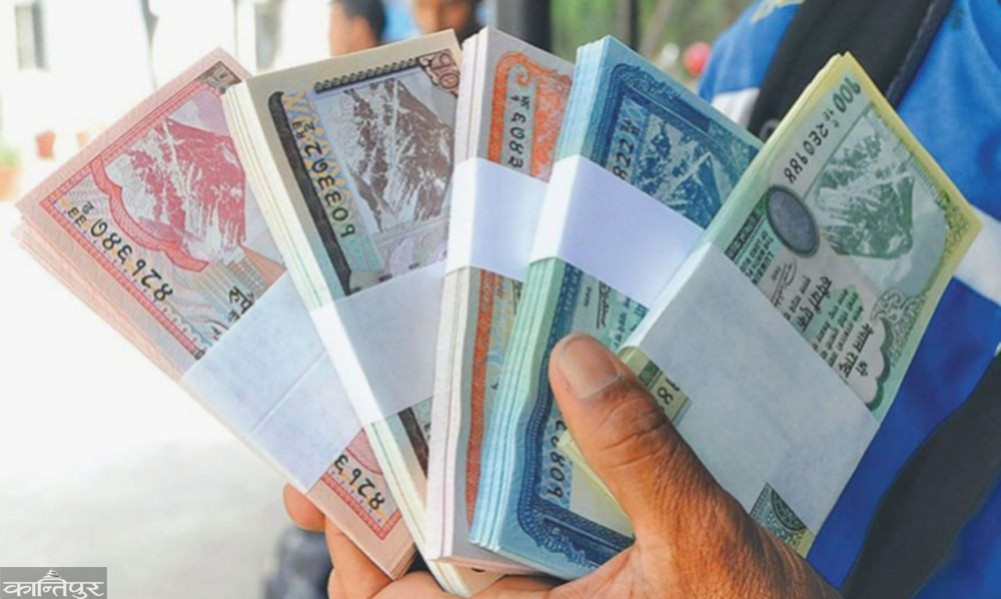
The common people are complaining about not getting new notes, the crowd is not able to exchange notes
We use Google Cloud Translation Services. Google requires we provide the following disclaimer relating to use of this service:
This service may contain translations powered by Google. Google disclaims all warranties related to the translations, expressed or implied, including any warranties of accuracy, reliability, and any implied warranties of merchantability, fitness for a particular purpose, and noninfringement.
In earlier years, many people were in a hurry to exchange new notes on the eve of Dasain. The new note was becoming the main gift of those who went to the village to celebrate Dasain. Common people also easily accepted the necessity of standing in line from 3/4 in the morning for the new notes.
This year it was a different situation. The National Bank decided to distribute clean and dry notes instead of new notes for use. Accordingly, since last Sunday, banks and financial institutions including Nepal Rastra Bank have been distributing Sukila notes to common people across the country. It has been mentioned in the notification of Rashtra Bank that it will provide the facility of note exchange till next Tuesday (October 22) for Dasain. However, public interest in Sukila notes is less. Experts say that for the notes, the Rastra Bank has less crowding in the Rastra Bank and banks and financial institutions.
Nepal Rastra Bank spokesperson Ramu Paudel said that it was decided to distribute dry notes instead of new ones this year in order to encourage cashless (electronic payment) transactions to the society, to manage notes that were previously distributed as new notes but are now dry notes, to save costs for printing notes, etc. told "The new notes distributed in the last three days are now in dry condition in the stock of National Bank Central Office, Regional Office, Banks and Financial Institutions, Bank Note Fund," Spokesperson Paudel said, "If those notes in stock are not used, it will take about 2 Billions of rupees are spent. If those notes are used now, the cost of printing new notes will be saved.' Spokesperson Paudel said that in the four days (Sunday, Monday, Tuesday and Wednesday) after the
, banknotes worth about 500 million rupees have been recovered from the central office of the National Bank and all seven regional offices. Paudel also explained that this data does not include the details of notes distributed by banks and financial institutions to the general public.
It has been said that Sukila notes can be exchanged till October 22 for Dasain, all banks and financial institutions including central and seven regional offices of Rashtra Bank will provide currency exchange facilities. According to the data, only Rs. 84.47 lakh has been taken from Rashtra Bank Central Office on Sunday, Rs. 180 lakh on Monday, Rs. 233 lakh on Tuesday and Rs. 292 lakh on Wednesday.
Only 8 counters have been set up at the Central Office Baluwatar for currency notes. Pradipraj Paudyal, Head of the Rashtra Bank Currency Management Department, said that only 6 have been put into operation after the crowd of common people has reduced. He says, "This year, because Sukila notes are going to be distributed, there is no crowd like in previous years. Poudyal says that all the banks and financial institutions are also easily providing note facility, so there is no crowd in Rashtra Bank.
As in the previous years, this year too, the National Bank is distributing notes at a rate of 18,500 rupees per person for all rates. However, the National Bank has stated that if the reason is clear, the common people can change the notes according to their needs.
Rastra Bank has been distributing new notes to the common people every year not only on Dasain, Tihar, Chhath and other festivals but also on demand. On Dasain and Tihar, the Rastra Bank has been providing facilities with new notes by issuing notices. New notes worth 60 to 70 billion are issued from Rashtra Bank on Dasain and Tihar. Of this, 12 to 15 billion rupees go to the general public. The remaining amount is used by banks and financial institutions for banking purposes. Looking at the data of the last four days, it is unlikely that as much money will be released this year as in the previous Dasain.
Especially the general public often exchange notes with a rate of less than 100. According to the National Bank, banks and financial institutions have been using more notes with denominations above 100 (500 and 1000). Coins are not counted in this amount. On the occasion of Dasain and Tihar, along with ordinary coins, silver and gold coins, silver souvenir coins and gold asarfis are also being sold.
Rastra Bank has been spending huge amount of money for printing new notes. According to a study of Rashtra Bank, in the last five financial years, an average of 1.33 billion 64 lakh rupees has been spent on printing notes and 3.87 billion rupees for distribution across the country.
On the one hand, the cost of printing notes is increasing and on the other hand, the interest of citizens towards new notes is increasing, so the National Bank was facing a big challenge. In recent years, the National Bank has been encouraging electronic transactions.
On the one hand, encouraging electronic transactions, on the other hand, increasing the money supply in the market by distributing new notes in large quantities every year, Rashtra Bank was also criticized saying that it is a contradiction in itself. Due to this reason, the challenge to Rashtra Bank was how to reduce the attraction of the citizens towards the new note and how to bring the Sukila note into use.
Some of the notes distributed during major festivals go back to Rashtra Bank through banks and financial institutions between Dasain and Tihar and most of them after Tihar. After returning to Rashtra Bank, those notes become 'Sukila'. Even though the banks and financial institutions have taken those notes, they have been piling up in the vaults of the Rashtra Bank because the common people do not take them.
Rashtra Bank claims that it is now going to manage the same note. The National Bank has said that the demand for new notes but the tendency of not wanting to take good notes that can be used is piling up a large amount of notes in the treasury.