We use Google Cloud Translation Services. Google requires we provide the following disclaimer relating to use of this service:
This service may contain translations powered by Google. Google disclaims all warranties related to the translations, expressed or implied, including any warranties of accuracy, reliability, and any implied warranties of merchantability, fitness for a particular purpose, and noninfringement.
Industry or business? What I want to say about this is that the focus should be on import-oriented economy or production-oriented economy. As a whole, I am convinced that Nepal will not prosper as long as agriculture cannot be industrialized. What has stopped it? When saying why not, the biggest problem is in the policy.
The policy programs brought by the state in agriculture are not practical . Grants in agriculture are not scientific. We don't even have the data. When will progress be made by providing loan-based subsidies? When will production-based subsidies be arranged? When will technology-friendly policies be introduced?
Today, our small country is sitting between two huge states. There is a difference between the policy of India and ours. We bought a vehicle, if a farmer needs a vehicle, he is given a vehicle at a customs discount. Those who cultivate five bighas will be given a vehicle at a customs discount. That vehicle cannot be used one day a week, a farmer has that white elephant. But what has our neighboring country India done? If it manufactures in its country and distributes agricultural products across the border, it gives 100 percent subsidy on rent.
When the material produced in Gaziwad of Delhi reaches Kalimati in Kathmandu, a vehicle comes with 6 tons of goods worth 80 thousand rupees . Those businessmen make a bill of lakhs when they apply that full deduction. He earns 20,000 on rent. And when we produce in Chitwan, it costs five rupees per kg to deliver to Kathmandu, which is 146 km away from here . And how do the farmers here compete?
We lend . We gave it as subsidy in agriculture. Those who have access, get subsidies but they don't go to agriculture. Whoever takes five million rupees does not invest fifty million rupees in agriculture . And where does the product grow from?
What is state resource management for official marketing? As now, it has arranged to give subsidy on milk liter. Various municipalities and provinces have given grants. Scientifically, if someone produces 100 liters of milk a day and consumes it at home, the government does not have to invest in it. Those who are official, have sold in cooperatives, are included in the state statistics will pay. Unless we can improve it is unlikely .
Forever we hear when the farmer plants the crops and there is a lot of talk in the parliament . Urea rectangle, yettender opening . When the farmer's crops grow and the plants turn yellow and start to cry, it is said that the goods have been stopped by customs tomorrow. When will that arrangement be arranged ? And how is the development based on agriculture . As long as we cannot basically industrialize agriculture, there will be no prosperity .
Deer conservation is first for tiger conservation. Deer grazing is done, if the number of deer increases, then the tiger can be destroyed . As long as small industries cannot be protected, the state is not prosperous. Poultry is a self-sufficient profession. We claim to supply 50% of the state's eggs, meat, chicks, grains and fertilizers. If there was no poultry, Nepal's agricultural production would have been 50 percent more difficult. We have completed the mall . Today, the best technology in the world is in Nepal. Be it in egg production, chick production or feed quality .
We are living in an open border . When the state wants to increase production, there is a problem because it has not been addressed as a policy. Chickens, grains and eggs that come freely through the long open border without customs will ruin the farmers of Nepal . Outbreaks of various diseases occur, which cannot be addressed by the state in a timely manner. I will say about the vaccine against various diseases, its vaccine is not allowed to be brought legally in Nepal.
has been used in 90 percent of Nepal's firms. Is this a challenge to the state or what? It is open border. All those vaccinated poultry products are imported into Nepal. The varieties of the same breed are kept here. It is unlikely to be consumed . No problem here from India . 90 percent are applied. Why doesn't the state bring it? If the same thing goes beyond the limit, the vaccine for 1000 chickens is available for 3500 . If others bring it, they sell it for three times. Why doesn't the state address why this selling environment is created?
What do we expect Poultry will last forever tomorrow . How long can we expect to be able to eat eggs and meat produced in Nepal?
Another thing, 70 percent of the total expenditure on feed is spent on poultry . 20-24 percent of soybeans used in its grain is used as a drink. 90% should be imported in Nepal. There is a 9 percent duty on grain made by importing it. Rather than wearing it, our wings are spread . Bhatmas can be applied even in dry places. Why doesn't the state take a policy to put it in that place ?
Nepal should import 80 percent of corn. Why is there no policy to produce corn in those lands that have become barren? Today, when the poultry businessmen come here, the price of corn, which is not sold at 12/15 rupees, is 40/50 rupees per kg. Poultry business has also supported it.
As long as these things cannot be addressed by the state . Can't cultivate corn and soybeans with commercial chaklabandi. The minimum cost of the farmer was not determined only by fixing the price. If the farmer produces and even the minimum transport to the market does not come, if the farmer plows the vegetables he has produced in the field, why does he stay as a farmer forever? It is easier than that to go to Mughal with a bag. This is something that the state should pay attention to.
We are not too pessimistic and hopeful. We are able to provide quality international standard products required by the state . What we are saying is that for the marketing of corn and soybeans, the poultry businessmen want to make an advance agreement for the guarantee . We are ready to invest in advance. Farmers should be given seeds or fertilizers. The minimum cost price fixed by the state has to be paid . We are ready to give . The state had to address it as a policy.
Another thing, the biggest challenge in poultry is insurance, is it voluntary or mandatory? No one can take the challenge of my property, can I insure it, or should I insure it for taking out a loan? Poultry businessmen's poultry has been destroyed. Can the bank take a claim? That is not likely.
Again the state has paid 80 percent of the insurance amount . Now cut in the middle . In order to get that insurance, the insured needs to look for the document. When a disease occurs in a poultry firm, the neighbors have a situation of how to escape the business. And the bank will get income and money by taking the loan of all the villagers, why put it on paper that is not possible What is the relationship with insurance and banks? Why is it made binding . If not, the loan will not be paid, nor will the insured get the insurance compensation after the accident happens tomorrow. How long is this binding situation ?
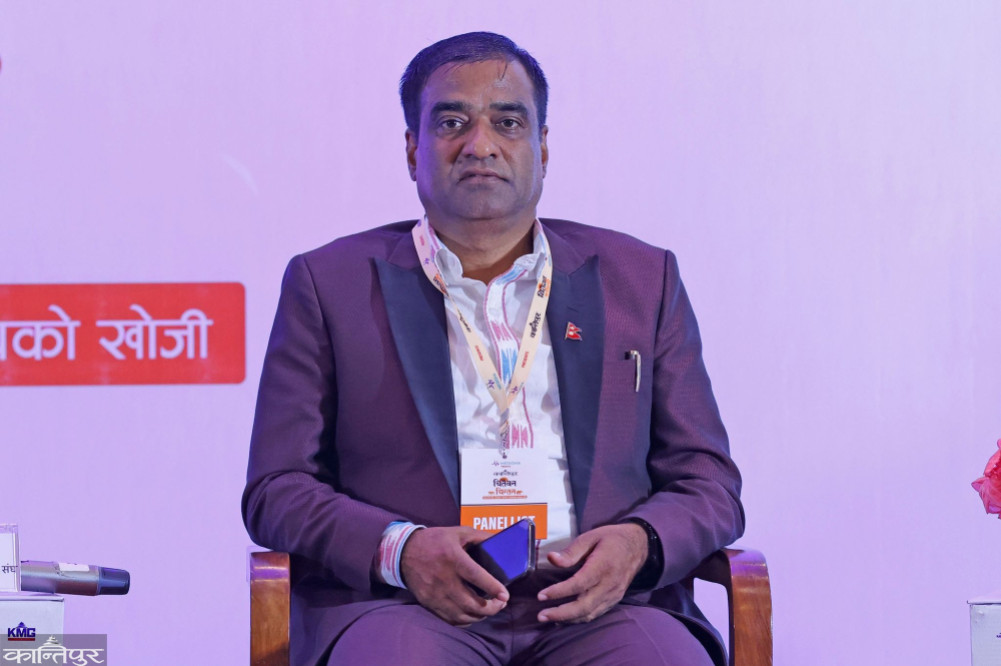
- The edited part of the opinion given by Kandel, the outgoing president of Chitwan Industry and Commerce Association, in the program 'Chitwan Chintan' organized by Kantipur Media Group