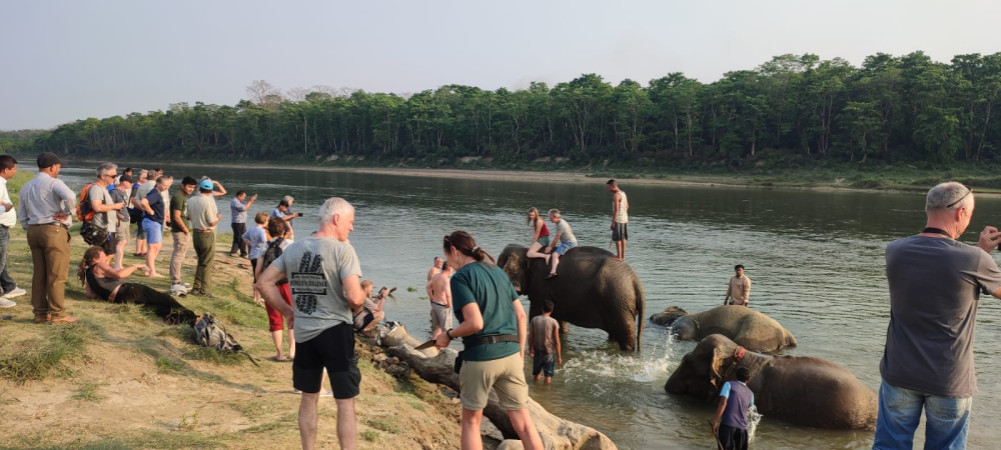
The history of modern Chitwan seems to have progressed on the foundation of the plan started by America for the development of Rapti Valley and later on the Raptidun project started by King Mahendra.
We use Google Cloud Translation Services. Google requires we provide the following disclaimer relating to use of this service:
This service may contain translations powered by Google. Google disclaims all warranties related to the translations, expressed or implied, including any warranties of accuracy, reliability, and any implied warranties of merchantability, fitness for a particular purpose, and noninfringement.
Although the Golic history is long, the history of human habitation in Chitwan is not so long. Its plains were inhabited by the Tharu community and the hilly areas by the Chepang tribe. After the change in 2007 and the start of the Raptidun project in 2013, the Pahadiyas started migrating to Chitwan, which is covered with jungle. Only then, the dynamic history of Chitwan began.
How long is the history of Chitwan? In order to understand this topic, the history of many stories and myths should also be explored. Moving forward the story of Valmiki's ashram in Chitwan, some people have stretched the history of Chitwan to the mythological period. There are still people who believe that Lavakush was also taught here since Sage Valmiki wrote the Ramayana here in the Treta Yuga.
Some argue that if you look for how Chitwan got its name, you will find its history. The people of the Tharu community say that our ancestors came here from Chittor in India, hence the name Chitwan. Some say that once a king named Chitrasena ruled here, on this basis it is called Chitwan. Whatever the name, Chitwan has been a place of choice for rulers since history.
Sometimes the warlords came down to Chitwan to play hunting, sometimes the landlords went to Chitwan to have fun. After the increase in popularity, it also became the center of politics in various aspects of the time. Whether it was during the Rana period or the Panchayat, whether it was the time of democracy or the time of the republican system, Chitwan remained at the center of discussion and discussion. Those who recount the history of Chitwan, the fascinating hunting done by the Rana rulers here And tells a sunny story. In such a story, the Rana period, the Shah period and the story of predatory diplomacy adopted by the rulers to please the foreign viceroys in both these periods are mixed. Some narrate the struggle of the Tharu tribals here and their lifestyle in harmony with nature. Some even tell the story of the path that Chitwan has been trying to walk since the beginning of the tourism industry. In all these stories, Chitwan can be seen as a dynamic and full of possibilities land.
Chitwan was being talked about in the country due to its flat land, easy transportation arrangements, easy availability of natural resources due to its forests and rivers, and its productive role in agriculture. It seems that this geography has been discussed abroad since history. Behind this comes the matter of victim diplomacy of those rulers. Chitwan was chosen as a hunting ground for British officers in British India. Since the Rana had a good relationship with the rulers, when they ruled India, the British kings-maharajas, princes and other high-ranking officials used to come to Chitwan to play hunting. George I, George VI, the Prince of Wales also have a history of hunting in the area. Due to this history, the talk of Chitwan spread abroad. The question of whether Chitwan got the benefit of such a discussion continues till today.
The forest here is as meaningful as the citizens who migrated here in search of possibilities for Chitwan. The forest is not only a natural resource for Chitwan, but it is also the cornerstone of the thriving tourism industry in Chitwan. If we look at the Rapti and Narayani rivers and the national park here separately from Chitwan, what kind of picture will be created of this district? It's hard to even think.
The history of modern Chitwan seems to have progressed on the foundation of the plan started by America for the development of Rapti Valley and later on the Raptidun project started by King Mahendra. Chitwan has started to become dynamic with the influx of people migrating from hilly districts. The construction of an airport in Bharatpur in 2013 and the construction of the Narayangadh-Hetaunda road with American support in 2016 further polluted it.
After the east-west highway was built, Chitwan became more dynamic when it was connected to cities like Hetaunda and Butwal and Kathmandu became an easy route. One thing that should not be missed in the meantime is the new education scheme that starts in the year 2028. It started from two districts across the country. One of those districts was this Chitwan.
Road infrastructure, investment in education and the availability of natural resources not only made Chitwan more dynamic, but due to the increasing migration under the guise of this, the population in Chitwan increased rapidly. Where the number of migrants is high, the market will flourish. And under the guise of that market, investment in infrastructure such as education, health and transportation will also increase.
Chitwan, which once excelled in agricultural production, then moved into the tourism industry. Gradually, it is becoming an educational center and a health center as well. From the government cancer hospital to the big hospitals opened by the private sector, Chitwan is making Chitwan more dynamic. The leap made by Chitwan in the rural roads and with it the pace of construction of small market and the economic possibilities spreading in this background - the confluence of all these is not only making Chitwan dynamic, but also identifying it as a district of opportunity. When talking about the mobility of Chitwan, it is impossible not to talk about the bicycles that run here. Once upon a time, Chitwan was like a city of bicycles. Which made the men to women dynamic here. A society that is dynamic, the same society also searches for the possibilities of Urpajan.
Chitwan's growth in the hatchery industry in recent years sheds more light on the district's potential. Milk, eggs and chicken meat produced by Chitwan are in great demand in the country. And this is the market picture, the potential of Chitwan. This dynamic district full of possibilities has now reached a new era. Because the growing population is putting pressure on the natural resources here. The search for new opportunities is also questioning what is the special potential of Chitwan or what is the priority of this district.
When the lands are fragmented into pieces, it is difficult to reach the land even to say let's do commercial farming on a large area. Therefore, it is necessary for the stakeholders to think about integrated commercial farming in collective ownership.
Chitwan has also started to face another challenge of systematic urbanization. While there is talk of moving the capital from Kathmandu, it is time to ask whether Chitwan can hold the capital city. For that too, it is time to work to confirm that Chitwan is an orderly city.