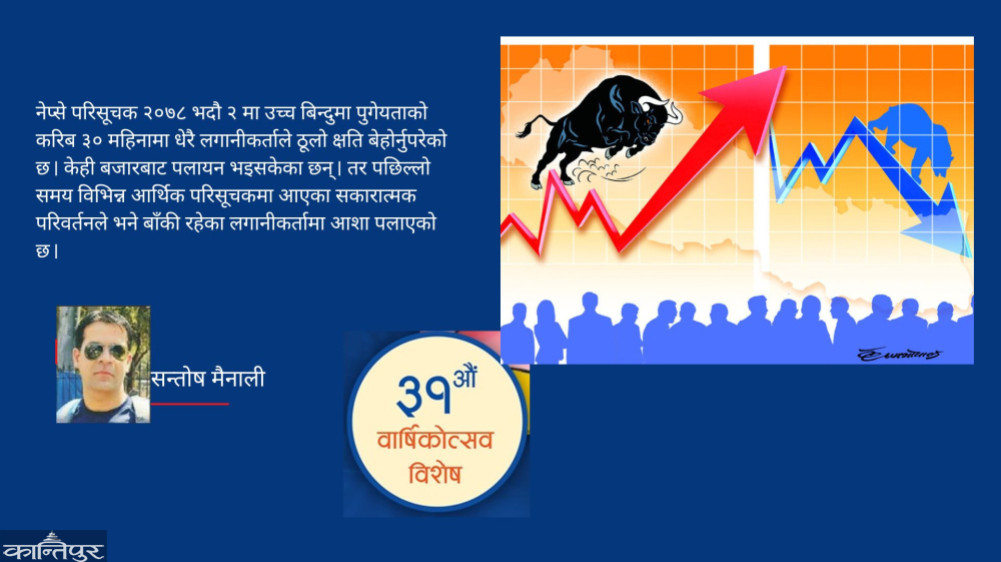
In the nearly 30 months since the NEPSE index reached its high point on August 2, 2078, many investors have suffered huge losses. Some have already fled the market. But the recent positive changes in various economic indices have given hope to the remaining investors.
We use Google Cloud Translation Services. Google requires we provide the following disclaimer relating to use of this service:
This service may contain translations powered by Google. Google disclaims all warranties related to the translations, expressed or implied, including any warranties of accuracy, reliability, and any implied warranties of merchantability, fitness for a particular purpose, and noninfringement.
The NEPSE index was at 3199.03 points on August 2, 2078. This is the high point so far. After that, the NEPSE began to decline, falling by about 43 percent in a short period of about 13 months until around 1815.
After that, the market has tried to set a higher journey several times, but it has not been able to go above 2227 and is moving sideways within a narrow range between around 1800 and around 2200. Currently the NEPSE index is around 2100. During the 30 months following the peak, many investors in the secondary market suffered heavy losses, while some investors fled the market, losing all their assets. But the recent positive changes in various economic indices have given hope to the remaining investors in the market and it seems that the possibility of market growth is increasing accordingly.
Market rise and fall is due to interaction between demand and supply of shares. As the market rose to 3200, there was no significant increase in the supply of shares. Due to the lockdown, the listing rate of new companies was very low and the issuance of additional shares by listed entities was also very low. Because of the lockdown, people who are engaged in other fields have also entered the market for a short period of time, there is a situation of high liquidity and low interest rates, it is very easy to get margin loans, there are regulatory changes that support the market, the use of technology in business and Rafsaf is becoming more widespread, and so on. When it was created, the market saw rapid growth in a short period of time.
But when the market reaches around 3200 or starts to decrease, most of the activities seem to increase the supply rather than the demand in the market. In the 30 months since the high point, the number of listed entities is about 24 percent, while the listed entities have largely increased their supply through rights shares. The number of securities listed has increased by more than 40 percent. Many non-financial institutions are increasing their supply by fully converting their founder shares into common shares. During the lockdown, a large group of people who entered the market from other areas, which created a huge demand, have returned to their original areas.
The arrangements made in the monetary policy and budget to increase supply, decrease demand, and lower investor sentiment have not been fully corrected. Due to the slowdown in the economy, the financial condition of most of the listed companies is not satisfactory. Due to the recession, industrialists have to fulfill their obligations by selling shares, while common investors have to sell shares to pay interest on loans or meet their regular expenses. Various financial institutions are also selling their invested shares to reach their minimum regulatory capital.
Investors are optimistic that the market will rise, but they are not completely confident. Therefore, investors are more focused on short-term trading than long-term investments. Therefore, ignoring the financial condition of the company, investors tend to go for companies with low market capitalization or small number of tradable listed shares, which have been listed in the market only recently and have a little more fluctuation. This tendency is especially seen among investors who lack awareness about the stock market, and it seems that it can put such investors at risk.
To tell the truth, the growth of the stock market is more necessary for the government and the National Bank than for the market. Our external economy is getting stronger but our overall economy is not able to take advantage of it. The domestic economy is somewhat frozen. The challenge to the government to increase its revenue and the income of the common people by increasing economic activities is increasing, while the National Bank is also facing a challenge to maintain financial stability due to the increasing bad loans due to the sluggish economy. After the various policy changes made to make various sectors of the economy work, everyone is wondering whether the engine of the frozen economy can be restarted only through the stock market.
Accordingly, some improvement efforts have also been made. But those efforts seem to pale in comparison to the current needs. In other words, those policies have not been effective in increasing demand more than supply. In order to see the effect of high bank liquidity and low interest rates in the market, cheap money should come into the market. There are two ways for that. One as a margin loan and the other by depositors investing their deposits and less shares. Some investors in the market do not have the ability to borrow more margin. Even those who have the capacity are not able to take more loans due to the limit of 15 crores and 20 crores. On the other hand, although many lending institutions are willing, they are forced to stop margin loans with more than 100 percent risk due to shrinking capital funds. Some institutional and individual depositors have started investing their deposits in shares as the interest rate will further decrease. If the National Bank becomes a little more flexible on margin lending and interest rates stay around the current level for a long time, the effects of more liquidity will certainly be more pronounced.
The current need is very great. New companies are getting listed by raising large amounts of money in the primary market. A large number of small investors who invest large amounts in the primary market are taking funds from the secondary market with a profit of up to 20/22 times on their primary market investment. That huge amount is spent on household expenses and other personal purposes. When a company brings an IPO of one billion, up to 5/6 billion rupees come out of the secondary market. Large-sized rights issues are being issued. The rights reserved for filling are being auctioned at a premium price. This also means that large sums of money are flowing from the secondary market to listed institutions. Founder's shares of non-financial companies that have completed three years of listing are being sold to the public in a frenzy. All this is leaving a large amount of money out of the secondary market. Therefore, 10 percent additional margin loan or additional 6/7 billion rupees is just like pouring water on sand.
It seems that the demand for shares in the market will increase at a high rate in the coming days. It has some solid foundations. First, the improvement in the external economy and the relaxed economy seem to result in more liquidity and lower interest rates for a little longer and a large amount of investment in the market through margin loans and institutional deposits. Second, it seems that there will be a change in the investment structure of the general public. Real estate, which is the first choice of investment for the general public to this day, has a large population migrating abroad, abnormally high prices of real estate and common people's
As attractiveness diminishes due to declining incomes, the first means of holding property as an alternative may be equity investment. Thirdly, the financial condition of the listed company which is currently in poor condition will gradually improve. Fourth, due to the continuous development of technology used in the primary and secondary markets and the reduction of other income options, more people from the country and abroad will enter the market, and if the government makes policy arrangements, there will be a possibility of the entry of foreign institutional investors.
Looking at these fundamentals, the market seems to grow well in the future. But the market depends not only on demand but also on supply. If more and more new organizations are listed, the process of issuing large-scale rights continues, and the founders sell their ownership after the change in the general public, the supply will increase faster than the demand, then the growth of the overall market may not be as expected. In that case, when the demand in the market is not enough to increase the overall market, such demand will be concentrated in some areas of the market, and it may become an environment where investors can take unnatural benefits from those areas.
problem solving solutions and possibilities
The problem can be solved by effectively conducting more investor awareness programs, conducting a thorough study of the objectives and financial conditions of the companies willing to be listed and issuing rights shares, and considering the demand of the secondary market.
It seems that there is a need to improve the system such as making the price fixed in public and rights issue more real and transparent, abolishing the shameful and unreasonable system of premium price of IPO and FPO, not being able to issue rights at a price lower than the face value. Monitoring of undesirable activities in the market through technology, strict action should be taken against anyone involved in such activities. Similarly, if the listed organization does not send all the necessary information to its shareholders in time, strict action will be taken, if any body has to change any rules or regulations that affect the stock market, it should be done with Sebon's opinion and suggestions.
correction from the high point to 43 percent. It seems that the market is gradually improving in the bearish zone for about 30 months. Improvements in various indicators of the economy and increased participation of investors are providing more support to the market. More than 650,000 people have opened demat accounts, while about 2.3 million people have opened trading accounts in the secondary market. About 21 percent of people are involved in the capital market and this trend is increasing. But most of these investors do not even know what shares are. Most of the investors entering the market today are not able to understand what to pay attention to while investing and what kind of risk it involves. On the one hand, the state of awareness of investors is like this, on the other hand, there are a few good companies in the market, and a large number of companies that do not have direct regulators, are financially weak due to the weak economy, have weak institutional governance, and those who want to get rid of their personal debt by raising money from the market and paying off the company's debt, will continue to enter the market. seems
Likewise, the number of companies that don't even know that they have to send financial reports every quarter, or even if they know, don't send such reports for several quarters due to the weakness of the regulator, is also increasing. In the absence of effective monitoring and strict punishments, the risk is increasing in the market.
Investors are forced to lose their assets in a constantly declining market. A solid plan and desire to raise the market is not seen in the related bodies. No one seems to be interested in how to create demand in the market. In such a situation, if all interested companies are allowed to issue IPO and rights shares and if they are not regulated, it seems that a dire situation will emerge in the coming days. Even in the fifties, companies from various sectors were listed in the market. But later many companies that were not directly regulated disappeared after taking investors' money. It cannot be said that the same will not happen in the future. At that time only a limited number of people were involved in the market, so the economy did not suffer. But in the future, a large part of the population will remain in the market and if a large population loses its investment, it cannot be said that the economy will not be in a state of instability.
– Mainali Nepal Stock Brokers Association's The former president is .