No one has the exact data of how many e-commerce businesses are operating in Nepal. 111 e-commerce platforms have been listed in the Department of Commerce, Supply and Consumer Protection since the government asked for mandatory listing from this year.
We use Google Cloud Translation Services. Google requires we provide the following disclaimer relating to use of this service:
This service may contain translations powered by Google. Google disclaims all warranties related to the translations, expressed or implied, including any warranties of accuracy, reliability, and any implied warranties of merchantability, fitness for a particular purpose, and noninfringement.
The history of e-commerce i.e. online business in Nepal is not very old, only two decades have passed in this field. Around the year 2000, an e-commerce platform emerged in the country with the launch of Thamel.com. In the last decade, especially after the arrival of companies like Daraz, Fudmandu, Total, Pathao, our market, online business has become stable.
Currently, no one has the exact data of how many e-commerce businesses are operating in Nepal . However, it is expected that the market size will gradually open up as the government has issued a notification for mandatory listing of e-commerce businesses from this year.
E-commerce business was initially started in Nepal through private efforts . Technology entrepreneur Balkrishna Joshi started Thamel.com in the year 2000 to facilitate buying and sending gifts from abroad to relatives in Nepal. The incident of Khasi selling from that platform is still considered interesting. Joshi remembers that even the international media made news about this at that time.
After Thamel.com, Muncha House launched an online department store called Muncha.com. Not limited to gifts, it started selling other retail items online . In 2007, Napbay dotcom (now Big dotcom) was established and in 2009, e-seva became the basis for digital transactions. In 2010, Nepal's first online food delivery service, Foodmandu, came into operation. This brought about a change in the food culture of the urban area. Now there are food-tech companies like Foodmandu.
In the last financial year, Foodmandu took food orders worth Rs 75 crore. This is an annual growth of 40 percent. Manohar Adhikari, the founder and managing director of the company, which delivered orders worth more than 1 billion rupees this year, told Kantipur earlier. Foodmandu is handling an average of 2,000 orders per day and has delivered food to more than three and a half lakh people.
In 2011, Amun Thapa's group founded Cheapdeal . This platform, which aims to facilitate online shopping, became the most popular e-commerce site in Nepal for some time. Launched in 2012, Urban Girl (UG Bazaar) focused on youth-targeted lifestyle products and later expanded to include other comprehensive services . Urban Girl's cake is popular.
Likewise, in 2013, Chemu Nepal was launched in the marketplace model. In 2016 Daraz Group acquired Kemu and established Daraz Nepal. After the arrival of Daraz, the e-commerce sector of Nepal came into a new mode.
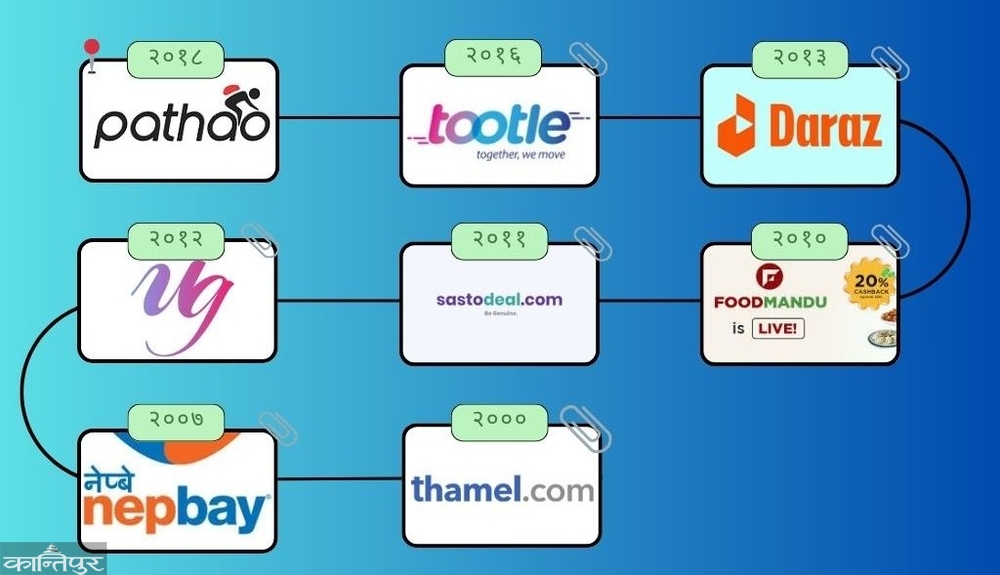
In May 2018, Alibaba Group, the company of China's famous technology entrepreneur Jack Ma, bought Daraz. It is considered as the 'turning point' of Nepal's e-commerce sector. With the entry of such large foreign investment and expertise, Daraz has now become synonymous with e-cursom in Nepal.
After the spread of the Covid epidemic in 2020 and 21, the process of getting used to e-curriculum increased . However, the e-commerce sector has spread a lot on platforms like Facebook, TikTok, and Instagram respectively. In this way, the trend of understanding the market and shopping in Nepal through 'Social Media Dominant E-Commerce' seems to be growing . While buying and selling is flourishing in the marketplace of social networks, the local e-commerce platforms such as Cheapdeal, Gapu, Nepbay, e-seva shops, which were once very famous, have become inactive.
Similar news
Ride sharing service under e-commerce was officially launched in Nepal in 2016 . 'Tootal', founded by Ekhita Bhatt, is considered to be Nepal's first indigenous ride-sharing app. Tutal added a new dimension to the transportation sector amid the frustration of public transportation and the fact that vehicles are not readily available. It started providing the facility of taking passengers to their destination by motorcycle. In 2018, the Bangladeshi company "Pathao" came to Nepal. Currently, it has become the leading ride sharing company in Nepal. Now there are many local and international ride sharing apps in the market like Indrive, Zumzum, Easy, Yango.
In order to make the business transactions using information technology systematic and reliable, the government and the House passed the Electronic Business (E-Commerce) Act 2080 last May and implemented it . According to the Act, the Department of Commerce, Supply and Consumer Protection under the Ministry of Industry, Commerce and Supply issued a notice on June 18 and called upon the businessmen who are doing such business to be listed on the 'e-commerce portal' by July 2. According to the department, so far 1 thousand 56 businesses have applied. Of these, 111 have been listed and 500 applications have been returned due to lack of documents and other details. According to Bharat Prasad Acharya, director of the

department, the government has considered the listing of e-commerce platforms as the first step. "What kind of businesses were listed, we have not checked their website," he said, "We have not been able to understand the nature of those registered." However, the businessmen of places like Ranjana Mall, RB Complex have also registered the online version of their shops with the department. According to him, now doing business through social media has also started adopting the process of listing. He says that this will formalize the market.
The businessman has responded that the listing process is not clear . Businessmen are confused about what to do, what happens after registration, and how to use the ID. In addition, they have also complained that it is mandatory for new businessmen to create their own platform at the beginning. Sagradev Bhatt, the founder of Mero Kirana.com, who is also the president of E-Commerce Association of Nepal, said that if new businessmen are forced to create their own website or app, it will be difficult for them to enter the market. Now you need a link to the platform while registering in the online business department. This may discourage new entrants from entering the market.' Officials of the
department said that the types of online businesses that have come to be listed have made a preliminary analysis indicating that the business model is changing in Nepal. Another director of the department, Achyutaraj Regmi, says, "Instead of bricks and mortar (physical stores), there is a tendency to move online." Some businessmen do not need physical shutters.' The department has also informed that the government has discussed about creating guidelines on e-commerce to address some unclear issues that are not explained by the law. Acharya, the director of the department, said that after listing the
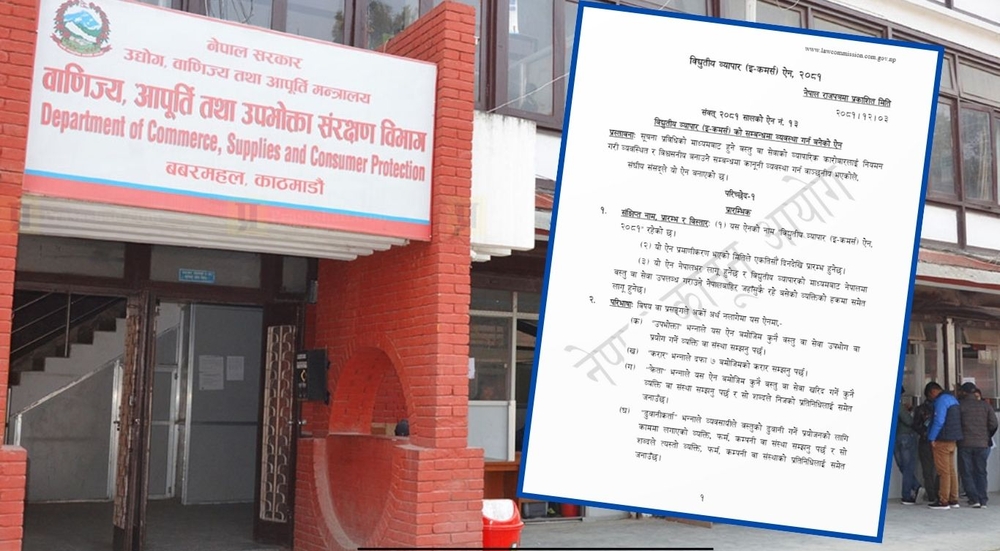
, the monitoring work of the e-commerce platform will be carried out. "The role of monitoring belongs to our department, we have not thought about what to do with those who do not register, there is no clear mention in the law about unregistered platforms, now discussions are going on to make a guideline to address this issue," he said, "There are 500 complaints filed with the police regarding cheating, non-service, data security, it will be easier to deal with them now . First, it was difficult to find out who did the bullying. Now that it has been listed, it will be easier. There are also actions in the Act.'
Businessmen say that it is a challenge for e-commerce businessmen to deliver goods to their homes as the address or mapping is not fast in Nepal. It has been my experience as a grocer that e-commerce has been discouraged due to the lack of facilities such as the right for customers to return payment (charge back). With the lack of skilled manpower, digital access and technical infrastructure, new entrepreneurs are also forced to create their own platforms, and this sector is not able to flourish quickly . There are consumer complaints about fraud, late service or non-delivery.
The market size of e-courses in the neighboring country India in 2024 is about 147.3 billion dollars and in China is 2.2 trillion dollars, the market of Nepali is not even equal to them. The e-commerce sector here is still in a transitional stage. On the one hand, the market and services are expanding in the digital medium, while on the other hand, its legal structure, regulation and facility development are incomplete .
However, the e-commerce sector has not only changed the nature of the market in Nepal, but is also redefining social and economic relations . Instead of going to a store and buying goods, people are starting to order online from their mobile or computer. Since it is possible to send gifts online, the relationship between distant relatives has also been helped to stay strong is .

