The Department of Health Services could not purchase alternative nutrients due to price disputes in the tender
We use Google Cloud Translation Services. Google requires we provide the following disclaimer relating to use of this service:
This service may contain translations powered by Google. Google disclaims all warranties related to the translations, expressed or implied, including any warranties of accuracy, reliability, and any implied warranties of merchantability, fitness for a particular purpose, and noninfringement.
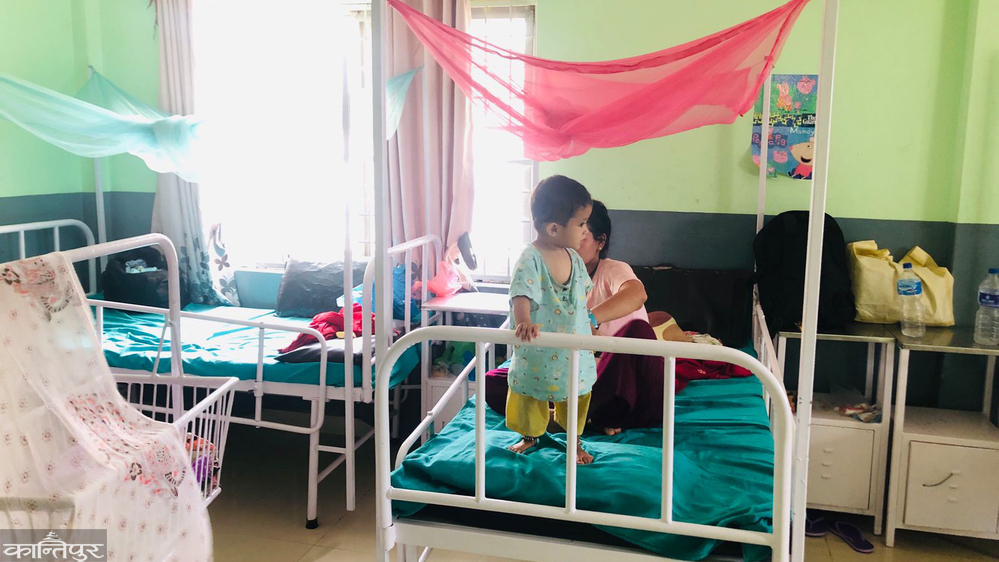
A 12-month-old girl suffering from severe malnutrition, KC, is undergoing treatment at the Nutrition Rehabilitation Center in Butwal. Even after 7 days of being admitted to the center, there is no sign of improvement. The reason for this is the lack of nutritious medicine for malnourished people.
11-month-old Simran Payza, who is being treated at the center, has also not been able to improve due to severe malnutrition due to lack of medicine .
There is a lack of medicine named 'F 75' and 'F 100' (powdered milk powder) for children with severe malnutrition problems at the Nutrition Rehabilitation Center in Butwal under the Lumbini Provincial Hospital since last February . "Despite the lack of medicine, we have been taking care of those who came in distress. We have continued the treatment by feeding them home-made nutrients, but they have not been able to return,'' said the head of the center Pratishka Thapa.
According to him, due to the lack of effective medicines, they are being treated at the center by feeding them nutritious food including milk, jaul, litho, and dal. It is not as effective as medicine. "It is fed in the center so that it works little by little," she said.
Nutrients named 'F 75' and 'F 100' contain high nutrients including vitamins, zinc, and other minerals. It is an effective alternative food for those with severe malnutrition.
Nutrition officer Thapa informed that 75 people have been treated and sent home nutrients since last February due to lack of nutrients. 6 people are currently being treated in the 10-bed nutritional rehabilitation center. Severely malnourished children are treated residentially at the center for 10 to 18 days. After that, they are referred to the OTC center in the district health center for regular medication and examination.
The treatment of severe malnutrition is started only after the doctor examines the children who arrive at the center and no other diseases are identified. Malnourished children from 6 months to 59 months are treated at the center. Children from West Nawalparasi, Palpa, Gulmi, Rupandehi, Arghakhanchi and Kapilvastu go for treatment at the rehabilitation center in Butwal. Nutrition Rehabilitation Center is in operation in Butwal since 071 . There are also centers in Dang and Nepalgunj in Lumbini province.
Similarly, 10 children with severe malnutrition in Saptari are admitted to the center under Rajviraj Gajendra Narayan Singh Hospital for treatment. However, even there, the center has not received therapeutic milk (F-75 and F-100) for seven months. Treatment of severely malnourished children is becoming a problem due to lack of therapeutic nutrients.
Rashmi Jha, the center's manager, said that when the children were treated by feeding dairy milk for seven months, they did not get the expected results. "There has been a shortage of therapeutic milk since January. Since then, bringing dairy milk and purifying it to make it like F-75 and F-100 does not achieve as expected," she said. "After the first phase of reform, we feed nutritious food by feeding F-100," she said, "but now there is a problem in the treatment of malnourished children due to the lack of therapeutic milk and the budget is also insufficient to buy dairy milk." However, the division under the Health Service Department has not paid attention to the fulfillment. In the 10-bed nutritional rehabilitation home, five from Rajviraj Municipality, two from Chinnamasta Rural Municipality, two from Hanumannagar Kankalini Municipality and one each from Tilathi Koiladi and Bishnupur Rural Municipality are currently receiving treatment for 10 severely malnourished children from birth to five years old. According to Manager Jha, three of them need to be treated with F-75 while seven need to be given F-100.
Malnourished children of Swamikartik Khapar Rural Municipality-1 Muktikot, which is in the worst condition of Bajura, are deprived of treatment. No therapeutic food (RUTF) for them. According to the survey data, there is no RUTF in Muktikot, which is the most malnourished in Bajura, since the beginning of March.
According to Brij Bik, in charge of Muktikot Community Health Center, two malnourished children died last July. Among those who died, 16-month-old Santosh Neupane of Khadalbarada and 17-month-old Jamuna Bik of Muktikot died. According to Bik, both the children were being treated at OTC. According to Anami Mala Bam of the health center, both of the children were referred after learning. "We referred both children after they became ill, but they were not able to take treatment elsewhere, so we did not take them anywhere." Then those children died, said Anmi Bam.
According to the in-charge Bik, it has been about five months since RUTF and the best flour has been finished . At that time, some remaining RUTF packets were stolen from the warehouse. After that, due to lack of RUTF, malnourished children could not be treated . "We immediately informed the municipality," he said. According to
Bik, in the preliminary survey conducted this week, 25 children in the ward were found to be malnourished. "11 people are severely malnourished while 14 are moderately malnourished," he said. "Only after the arrival of RUTF, the treatment can be started by admitting malnourished children," he said.
Bhakta Kaila, head of the health branch of the rural municipality, said that preparations are being made to send RUTF to Muktikot. "There is no traffic on the road, there is a situation where porters have to be sent," Kaila said. It takes a whole day . We will send it as soon as possible.'
Jhanak Dhungana, head of the Provincial Health Supply Management Center in Dhangadhi, claimed that there is no shortage of RUTF in the entire province.
Price dispute in the tender
Although the Health Services Department has the necessary budget to purchase medicine, even though it has reached the end of the current fiscal year, there is a shortage of essential medicines such as nutrition for malnourished children, vitamin 'A', iron pills, rabies vaccine, and temporary family implants.
According to the data of the Department of Health Services, there are about 40,000 severely malnourished children across the country. Last year, the highest number of new malnourished children was seen in Kapilvastu, 2,261. Last year, 52 people died due to malnutrition.
The Department of Health Services has yet to call for tenders for the purchase of nutritional F 75, F 100, RUTF, Bal Vita and family planning temporary implants to feed malnourished and other physically ill children . In the current financial year, there is a budget of 41 lakh 55 thousand rupees for purchasing nutrients and 15 million rupees for purchasing temporary equipment for family planning including implants. 13 crores have been allocated for the purchase of anti-rabies vaccine.
Among the various reasons for not being able to purchase nutrition for malnourished children, implants, 'Vitamin A', only one company in collusion with the suppliers put a tender above the cost price, not calling for tenders on time, lack of communication between employees and suppliers are the main reasons .
Revachi International charged 40 percent for the purchase of nutritional supplements for malnourished children, 4.72 percent for the German manufacturer Bayer G for the purchase of implants, and 25 percent for the purchase of vitamin A from the Indian manufacturer Cinenader.
The cost price of last year's nutrients F 75, F 100 and RUTF was 851 rupees, 942 rupees and 44 rupees per packet respectively. Dr. Pawanjung Rayamjhi, director of the Health Service Department Management Division, said that due to the inability to make purchases on time, there was a delay in moving the file forward due to the frequent changes in the decision-making staff from higher to lower levels. "However, it is not that the medicine could not be purchased due to the lack of agreement between the employees and the contractor," he claimed, "There was a delay in the purchase because the tender for the purchase of the medicine could not be increased from the previous cost." However, the Director of the Management Division, Dr. There is an accusation against Rayamazhi.
After the lack of medicine, the Department of Health Services, Family Welfare Division planned to get support from nutrition donor agencies to feed malnourished children . But, for that donor has not been found yet .
Dr. Vivekalal Karna, director of the Department of Health Services Family Welfare Division, said that the management branch, which has the responsibility of purchasing medicine, did not take it seriously on time and now there is a problem. "Time was not taken care of". "Now the problem is starting to appear," he said.

