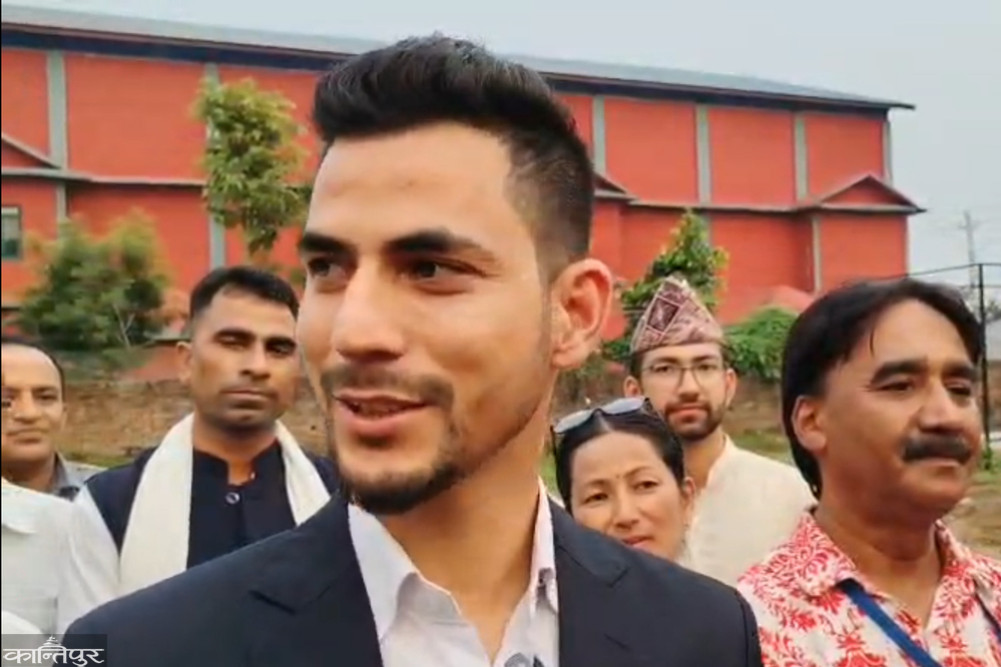
In an interview with Kantipur, he says - Due to the large number of aspirants, there is a strong possibility that the general convention will now proceed through the democratic process, that is, through elections.
We use Google Cloud Translation Services. Google requires we provide the following disclaimer relating to use of this service:
This service may contain translations powered by Google. Google disclaims all warranties related to the translations, expressed or implied, including any warranties of accuracy, reliability, and any implied warranties of merchantability, fitness for a particular purpose, and noninfringement.
The general convention of the Rashtriya Swayamsevak Sangh (RSS) is underway in Chitwan. The party will elect a new policy and new leadership from the general convention. There is widespread interest in the leadership to be elected and the policies to be adopted by the first general convention of the country's largest party. In this context, DP Upadhyay, Jaisingh Mahara and Gaurav Pokharel spoke to the general secretary of the RSS, Bhupdev Shah, for Kantipur: Will the RSSS present any political report with its views on federalism, the relationship between the union and the provinces, and republic and inclusiveness? The party president's report on the political document to be presented at the general convention will clarify the views of the RSSS. Why was the party started? How relevant are the initial objectives when reaching the leadership of the country? It will shed light on the direction of how the party will be built in the future. It will also explain the ideology of the party and its role towards the masses. However, this report will not discuss in detail the basic structures of the constitution such as federalism, republicanism and other issues. The party has looked at these issues separately. After the general convention, preparations are underway to organize a statutory general convention within some time, where these sensitive and structural issues will be discussed in depth. There is a plan to decide the party's long-term vision by holding an open, detailed and intensive debate on all issues. The life of the party is not always about ups and downs, there are also ups and downs. That is why we have not been able to complete the issue of inclusiveness at various stages. However, we did not close that path. We are clear on the issue of federalism and Madhesh, we have not sought amendments to federalism - we are clear about federalism and this system. If the right leadership and a capable party run the provincial government, both the country and the provinces can flourish within this system. The problem now is not in the structure, but in the implementation and leadership. That is why the National Independent Party, when given the opportunity to lead from the provincial assembly, aims to present an effective model of provincial governance. The RSP is said to be an inclusive party. Nepal is a multilingual and multicultural country, and accordingly, that inclusiveness can be seen in the central committee and office bearers formed from the first general convention. In today's central committee meeting, in-depth discussions were held on inclusivity, minority rights, and various issues. Efforts are being made to ensure representation of women and backward communities in the government. It has been decided to move towards making the party leadership structure inclusive. In the coming days, there will be clear inclusivity everywhere in the central committee secretariat. Whatever the picture of the country is, it will also be reflected in the party's leadership. Some have also called for improved federalism. What is the opinion of your party leaders on the provincial structure? Is it right now or should we amend it and do something different?
In our opinion, the current system is right in today's situation. However, according to the democratic process, debate and discussion are necessary for future reforms. For this, we will create a debate forum, where suggestions can be made based on geography, population and other aspects. Those suggestions can help make the provincial structure stronger. However, now we clearly accept the constitution and are not in favor of immediate change.
You said – the party is inclusive. However, it seems that women have been included in the office bearers of this general convention only in the posts of vice-president or joint general secretary. Why have women not been included in the chief executive post?
Which post did we stop? The path for them to come to 100% positions is open. They can contest elections.
So this time there is competition for office bearers too, elections are being held ?
In the first phase, the election of the president and central members is being held . There are many aspirants now - from current MPs who have contributed to the party for a long time, to new intellectuals and enlightened people . That is why it seems that there will be a large number of candidacies this time . 182 of our MPs are in parliament . There are about six to seven times more candidacies than the party expected . With such a large number of aspirants, there is a strong possibility that the general convention will now proceed through the democratic process, that is, through elections . Before that, the aspirants have been advised to discuss among themselves and agree on how to proceed based on geography or region . The president has also said that it will be easier if they come together and a message of unity can be given . However, since there are so many aspirants, the party does not have a separate mechanism to manage it . Therefore, everyone agrees that ultimately the competition will be conducted through the democratic process .
The Rashtriya Swayamsevak Sangh (RSS) is a party made up of various groups and individuals. Before the elections, various political figures joined hands – groups including Bibeksheel, Sajha and others are also joining hands and are going to the first general convention. In such a situation, how often is the issue of ‘moving forward with consensus’ being raised to include everyone?
The issue of unity is being raised a lot. However, in the party’s perspective, the main thing is not to include individuals or groups, but the objective. There is a feeling that everyone should come together to fulfill the expectations of the people. There are allegations that earlier political parties often united on the basis of division of labor or self-interest, but the current environment has become different. Due to the trust and expectations of the people, various groups and individuals have been joining the party. Now, after the opportunity gained from the elections, the party has entered the phase of strengthening the organization as well as getting a role in the government and parliament. For that, a capable, competent and time-management leadership is required. Therefore, the main debate is not who will be included, but whether the party can fulfill its objectives.
However, the chairman is also interested in moving forward in a democratic process. In Saturday's central committee, the chairman may have said, 'It is better if we go by consensus.' Because some have joined the party only four months ago, some for four years. That is why the chairman has said that it may not be fair to put everyone in the same competition. How is there a plan to include everyone in such a situation?
There was a lot of discussion on this issue in Saturday's meeting. The chairman himself also said that it may not be fair to run a person who has worked in the party for only four months and has been working for four years in the same race. Keeping that in mind, we have made a 51 percent arrangement for nominations, through which an attempt is made to include everyone who has come to different stages and contributed. In this way, the party has been able to achieve the current result by including all parties.
Even if the election is held this time, will there be no election by forming a panel?
There is no such thing as a panel or faction in our party, neither yesterday nor today. We understand that the practice of dividing power by forming groups like in the old political parties of Nepal has caused many problems. That is why we are not going down that path. The party was established as an alternative to the old factionalism, division and group politics. That is why the tradition of forming panels, competing by forming groups or engaging in internal power struggles is not accepted here. Here, individuals move forward based on their ability, contribution and qualifications. Responsibilities are also given on that basis, not based on the division of any group or panel. Looking from the outside now or based on past political experience, some may see it from the perspective of a panel, but there is no such structure or practice within the party. There is a clear indication that this practice will not be repeated even after the general convention. Because our goal is to make the party united, capable and purposeful, and not to develop factional politics.
However, there is talk that the arrangement of 51 percent of the nominees was made to include the consensus group, the Balendra Shah-led team that joined before the elections, Bibeksheel-Sajha and other prominent people of society. Is the chairman given so much power to keep him in the party?
That is definitely not the case. Clearly, the conclusion of the discussion between the Central Committee Secretariat and us responsible officials with the chairman is that the person is capable, the party needs him, and if the party gives him a responsibility, he can fulfill it immediately - it can be anyone. It may not have come from the adjustment yesterday, it may have come from the adjustment. We are clear - there is no faction.
The same policy and vision of the party will remain after the general convention ?
It will remain exactly the same .
District conventions have been held only in some districts of Madhesh, not in other places. There is also criticism that beatings or imbalances have started to be seen in the conventions. Will the party seriously review the lack of conventions in districts or the appearance of factional accusations and counter-accusations in some places?
It will review it very seriously. Our organization in Madhesh was relatively weak, but despite that, we got good results in the elections. After that, many new supporters, cadres and people from different fields joined the party. However, it became difficult to organize everyone because we had to do all three tasks at the same time - running the government, responsible for parliament and expanding the party organization. Its impact was also seen in the inability to hold conventions in some districts.
The problems seen now are the challenges of management. And, we are seriously reviewing them. After the general convention, the conventions will be moved forward systematically by strengthening the organizational structure in all districts. Similarly, the party has clearly adopted a policy of controlling opportunistic tendencies and people coming with wrong motives. Both the cadres who have contributed from the beginning and those who are now looking for opportunities - if they have wrong motives, it is not acceptable. Attempts to exert influence within the party by showing access or personal relationships have been completely rejected. The party has a clear policy of giving responsibility only on the basis of ability, contribution and purpose. We have taken the general convention not only as a celebration, but also as an opportunity to reform the organization and set the future direction.
As we go into the process of selecting a new leadership, you are also in the government, there is a large number of representation in parliament, and responsibilities are being shared within the party. In such a situation, do leaders who are in government and parliamentary responsibilities also take responsibility within the party or not? Does the party follow the principle of 'one person, one post' or do you bring those who are in important responsibilities in the government to the party as well?
The party has not put a strict provision of 'one person, one post' in its statute. It is said that the decision on the role of MPs or ministers within the party will depend on their personal ability and independence. However, they have been asked to move forward if they can handle both responsibilities by making the best use of their time management and abilities. In cases where they cannot, the idea is also to give opportunity to other capable people. The party has not yet reached the stage of conducting a deep review of the government's work, because it has only been a short time since the government was formed. The priority now is how to improve coordination between the government, parliament, and the party. The party is working on the necessary structure, resources, and human resources management for that. However, it is said that it will take some time to see concrete results.
Let's add the context of Madhesh. Due to a decision recently implemented by the government, citizens living in the border areas are facing difficulties. If the issue of the system of taxing goods worth more than 100 rupees is raised in the party's closed session's 'Government Review', how will the party address it?
It is unlikely that this issue will be raised immediately in the closed session. Because all the participants are responsible officials. And, there will be discussions only according to the specific agenda. Issues outside the agenda may not enter the closed session at this time. However, since government representatives and people from related bodies will also be present, informal discussions may be held if necessary. Even if this issue is raised, it will not be concluded immediately there, but arrangements will be made to discuss it through a separate forum or the related ministry.
Is it almost certain that Ravi Lamichhane will be the chairman again?
Respected Chairman Ravi Lamichhane is the chairman and the respected Prime Minister Balendra Shah is the senior leader.
Where will your place be?
Wherever the party places me, I will be there. I will come according to the method and process that I have to come through.