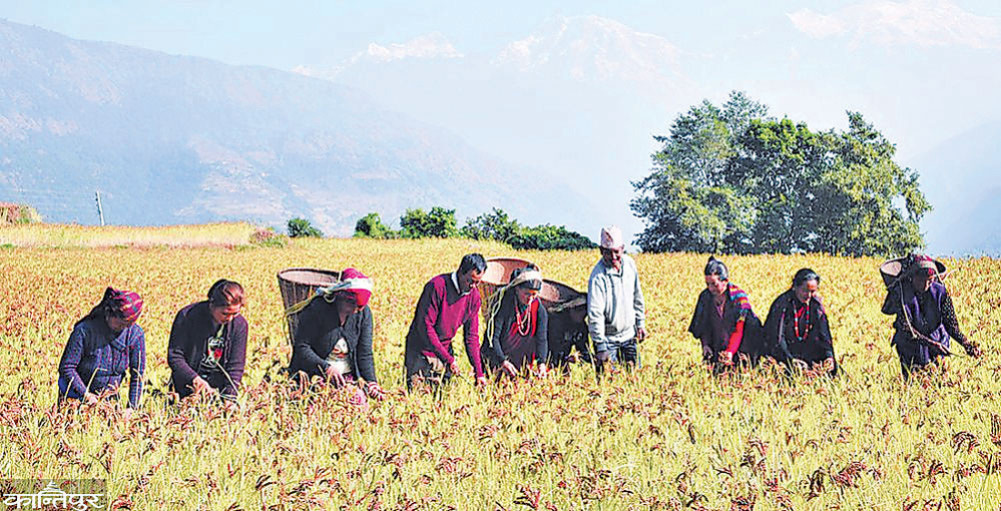
If our selling price is fixed, the buying price should also be fixed, and only the farmers get incentives, Raithane products of Nepal have their own uniqueness, their marketing should be from the government level.
We use Google Cloud Translation Services. Google requires we provide the following disclaimer relating to use of this service:
This service may contain translations powered by Google. Google disclaims all warranties related to the translations, expressed or implied, including any warranties of accuracy, reliability, and any implied warranties of merchantability, fitness for a particular purpose, and noninfringement.
After covid, the importance of Raithane food in Nepal, the nutrition obtained from it, caught everyone's attention. Common people started to make Raithane food as a daily basis for nutrition. After the demand increased, Raithane products from Humla, Jumla to Manang, Mustang were easily available in Kathmandu Valley. But no one company promoted Raithane products as a brand.
When I left the previous company, I already believed that I could do branding, marketing, sales and distribution in a better way. There was a big 'gap' in establishing farmers' produce as a single brand by adding value through processing, grading and packaging.
A group of 25 people have formed a group of 25 people in Pahadi Foods, which was started with wife Kamna to fill the same gap. We started official sales from January last year. We did a business of 4.5 crore rupees that year. The target is to triple the turnover this year. Pahari Foods market is concentrated in Kathmandu Valley. Since some time ago, we have started sales and distribution in Butwal and Bhairahawa areas as well.
is a separate distributor of other companies. After the company gives the goods to the distributor, the same distributor delivers the goods to the retail store. But Pahari does not have a separate distribution company. We don't have much margin to give to distributors. Even if the transaction amount is big, we cannot make any kind of commitment with the distributor at the beginning. Therefore, by having our own depot or warehouse, we are delivering mountain products to retail stores. Now more than 7 thousand retail shops are connected with Pahadi.
Our aim is to work together with farmers. It can increase the production of Raithane. Last year we bought old rice from Pokhara by paying 6 thousand rupees. While at that time only 55 hundred farmers were selling in Murree. This year production in Pokhara has doubled due to the increased demand for old rice. We are finding it difficult to meet the demand of rice.
There is no doubt that farmers will produce if the price is stable and the demand does not decrease. There was no situation where the farmer's produce was wasted and had to be sold at a loss. Now we are studying how to enter into a buy-back agreement with the farmers. We already know the demand for old budha rice and how much rice we can sell. If our selling price is fixed, our buying price should also be fixed. There is a plan to share seeds and make agreements with the government agencies to save the old rice that is disappearing.
Raithane production including lentils and millet is decreasing. Nothing could be done by the government to protect and increase such products. Standardization, quality etc. will be done by the government. 90% of the world's butter is produced in Vihar, India. Government of India established the 'Makhna Board' through the budget of the next financial year. Production, marketing, quality, training and other related work of Makhana will be done by the board. Last year, millet was advanced in this way.
There is a Tea and Coffee Development Board in Nepal. But there are more private companies than Sakari. The government of Nepal should also identify an item and promote it in the same way. This is beyond the reach and capacity of private companies. Raithane products of Nepal have their own uniqueness. Its marketing should be from the government level.
The price of turmeric varies in India. Turmeric is priced according to its curcumin value. Turmeric with a curcumin value above 6 is sold more expensively in Europe. But turmeric is sold at an average price in Nepal. There is no practice of pricing according to quality or grading.
Only milk is known in Nepal. Because the farmers get the price according to the milk fat. But in India, farmers get price according to the grading and quality of every commodity, not just milk. In Nepal, it is customary to sell everything from cardamom to ginger at Salakhala. The government had to reach the farmers' level and give them information about grading to get more value for their products. Our challenge and problem in agricultural production is to sell and distribute at wholesale prices.
The government will work together with private companies. Having said that, you should not work only with one private company. It is necessary to open the way for other private sector to compete. Government should look at market, production, productivity. Farmers should also be made aware accordingly. Once upon a time in Lamjung, a farmer used to grow 3 muri of Zhinua paddy.
Now Shankar 4, Radha 4 have grown 6 muri. Shankar 4, Radha 4 rice is sold at Rs 80/90 per kg while Jhinua rice is sold at Rs 400 per kg. The government should understand this and should be able to explain it to the farmers as well. That which is endangered gains value. It is necessary to attract the farmers to produce Raithane.
Raithane products are different according to the district. After collecting and bringing such products, a government agency is needed to measure their quality, conduct lab tests, and standardize them. With that, the price of Raithane products that are currently being sold can be further increased. Lately, the production of Dalle Chilli has increased. A few years after the current noodle factory started production of Dalle Chilli in Gulmi and Palpa. Before that there was no production. But it continues to be the case that the produce fetches value in some seasons and not in other times. It is important to give the farmers a place to be sure that the produce is not wasted and that they get the price.
We are buying Raithane products from farmers and selling them with added value. If this business is done correctly, the turnover will increase by 10 times in the next 5 years. As the demand for Raithane products increases, many problems can be solved if it becomes serious. Such as village return campaign, agricultural revolution, economic leap, employment problem, import substitution and other problems will be solved. But if we do not pay attention, our economy will deteriorate further.
What will we do if the Gulf countries do not take Nepalis tomorrow? There is chaos. Anyone involved in the promotion of Raithane products. Nepalese Raithane is being sold by importing from different countries. Branding is not just about selling goods once. For a long time. The customer also needs to know which is the real Raithane product?
The old Raithane variety of rice is running out. Now anyone will be attracted to the business of branding and selling the country's local products. Nepal SACAR is working on making policies by addressing the procurement process. The world is working to increase production and productivity. Nepal cannot compete with India on the basis of quantity.
Being a neighbor of China, India, Sri Lanka, Bangladesh and other countries, it is zero commercial policy to say that Nepal will increase its production in quantity. What is Nepal's Unique Selling Point (USP)? Looking at it, it is necessary to proceed with the plan and work. In countries including Japan, they buy and eat slippery thick rice. Andi rice is produced in Nepal. It is better to produce and sell rice in Nepal at a high price and to buy rice that we like.
India is planned state by state looking at products that can go global. India promoted Kalanamak rice in Vihar. He is promoting it by identifying one rice from each district that can reach the world. It should be the same in Nepal. There are pocket areas, zones etc. in Nepal. But this arrangement has been made only to meet the budget. It has not actually been implemented.