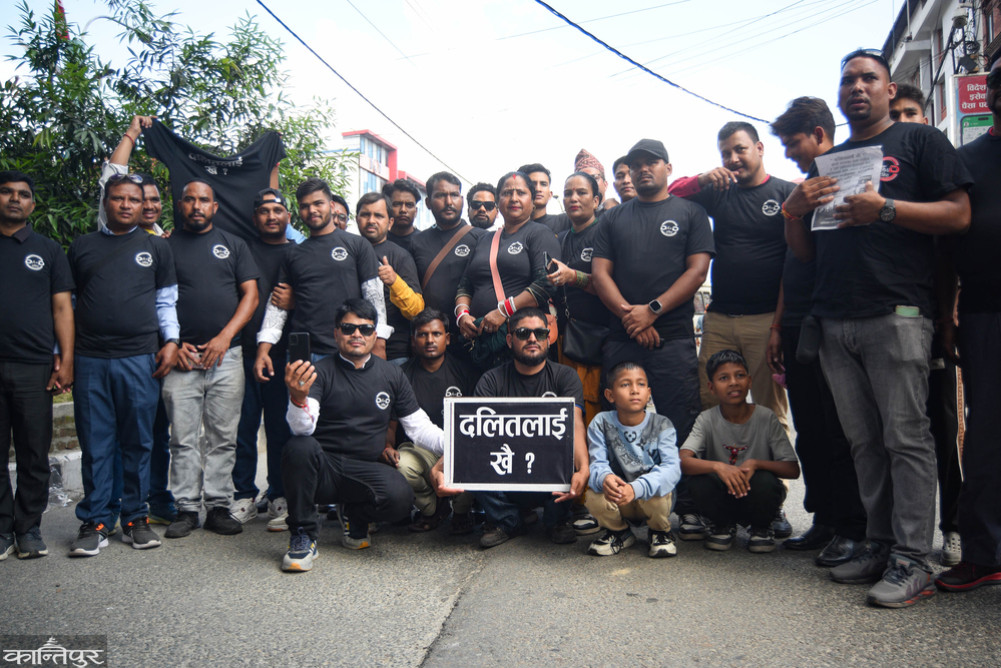
The constitution has guaranteed 33 percent rights to women in every field, but according to that, the presence of women and Dalits in the mainstream of the state is very low.
We use Google Cloud Translation Services. Google requires we provide the following disclaimer relating to use of this service:
This service may contain translations powered by Google. Google disclaims all warranties related to the translations, expressed or implied, including any warranties of accuracy, reliability, and any implied warranties of merchantability, fitness for a particular purpose, and noninfringement.
Representing the Dalit community, I have become a member of the Koshi State Assembly. I have been active for a long time, especially in the field of Dalit and women's rights and issues. As a party worker, I am constantly involved in building the organization. Basically, my responsibility is the women's department within the party.
He was active in Mahila Morcha from the beginning. That's why women's department became my choice.
A long experience in the women's department taught me a lot. Especially, I got to gain experience in building an organization and organizing workers. My experience is the only exception. Most women don't seem to believe the team the way I do. As a Maoist worker who has led the change, I got that chance and showed it. Getting a
responsibility is also a learning process. I got the opportunity to understand and learn the party's overall policy, thinking and working style through the organization. Female leaders of many parties are probably deprived of that opportunity. When will the party give equal opportunities to all women? When to create an environment of trust like men? This is a very thoughtful question.
In Nepal, women have been guaranteed 33 percent rights in every field by the constitution. However, their participation in all areas is 33 percent? Not really. The reality is different. Although the country has gone to a federal system, the presence of women or Dalits in the mainstream of the state is very low. Even after the restructuring of the state, discrimination against women in proportional inclusive participation remains.
The chain of discrimination against women in particular seems to have started from our homes. Nepali society is not very generous. Society continues to try to bind us under many names. At first glance, many people may think that there has been a change in our social structure. However, our mentality is still archaic. A glimpse of this trend that has spread from home and society has also spread to political parties.
When does the tradition of trusting women begin? Who guarantees it? When will the patriarchal thinking change in the question of giving responsibility to women or Dalits? When will disenfranchised women and Dalits reach leadership roles? which can strengthen their reach and influence.
Maoist is known as a revolutionary thinker and leader of change. However, it is not very generous to bring the youth to the leadership. As a mountain of mistrust has been erected on Dalits and women. Similarly, Bhimkaya doubts the mountain of youth. In the past, the youth led from organizations to the army. However, that practice is not seen by any party now. Even if it does, it is very low. From an inclusive point of view, although Maoist is liberal compared to other parties, it is understood by the common people that in practice they are failing to give equal opportunities to youth, Dalits and women.
The 12-year-long Maoist "People's War" brought many kinds of social changes. The right to change the overall system of the country is no different than the Maoists. Created historic opportunities for Dalits, women, marginalized communities. Election of the Constituent Assembly and the drafting of the Constitution opened the doors of many opportunities for the Dalit community. Did a lot of work based on the principles of affirmative action and proportional inclusion.
However, in recent times, the danger of losing all the achievements brought by the Maoists has increased. Suspicion has started to arise especially about the latest working style of Maoist, the leader of change. This is not a good message. Disappointment and suspicion have been created among the general public towards the working style of the Maoists. If it cannot be resolved in time, there is a danger of losing the rights, rights and changes that have been made by so many sacrifices.
It is a fact that the people's war gave the Dalit community an opportunity to move forward politically, socially and economically. However, another reality is that the Dalit community is still finding it difficult to get opportunities due to the failure to convert the government's policy into a plan.
There are many examples of union, state and local governments becoming too lenient towards the Dalit community. Ensuring the post of a Dalit woman member at the local level is a big deal. The participation of Dalits would be further ensured if similar posts could be fixed in the state and the union as well. Which would strengthen the confidence of the Dalit community.
However, not only rights but also budgets are being given to Dalits at union, state and local levels. Let us look at a small but serious example of Koshi Pradesh. This province has not allocated even a cent on the title of Dalit rights or empowerment. Another wrong practice is being done in Koshi state assembly. In the first term, more than 64 laws were passed by the state assembly. Even now, more than a dozen laws are in the process of being passed. However, it is worrisome that the process of 'Dalit Empowerment Bill', which started from the first term, has not been prepared yet. The news that the Ministry of Social Development sent the concept to the Chief Minister's Office for an in-principle agreement, but it disappeared there, came to the media.
The issue of why and with what intention the law that was going to be brought for the rights of Dalits was stopped is not a common issue. It is said that the Chief Minister and the Law Minister are leading to block this bill. Their argument seems to be that the Dalit Act will increase the expenditure. However, they are not very serious about the achievements of the Dalit Act.
For the upliftment of Dalit, women and youth communities, not only policy changes, but also their effective implementation is necessary. Although it is clearly mentioned in the constitution, the implementation in practice seems to be weak. Some measures can be taken to strengthen it.
policy implementation: parties must commit to not only creating policy, but also implementing it in practice. Only then can the overall disparity end.
Ensuring equal opportunities: Policies that give equal opportunities to Dalits, women and youth should be created by the parties and emphasis should be placed on its effective implementation. Only then is equal opportunity ensured.
Eradication of caste discrimination : Caste discrimination continues even now. On the pretext of touching water, on the pretext of love and on the pretext of entering a temple, barbaric oppression continues on Dalits. There are examples in front of us of not only repression but even murder. There are also plenty of examples of such wrongdoing being supported and protected by the state. Dialogue between three generations (grandparents, fathers and children) is necessary in society to end discrimination. Only when these three generations can end the discrimination mentally, the overall discrimination can be ended. Otherwise, we may have to wait for hundreds of years.
Strengthening the reservation policy: Systematic implementation of the principle of proportional inclusion can pave the way to end discrimination.
Education and employment: Ending discrimination requires increasing investment in education in the long term. The constitution has guaranteed free education up to class 12, but this has not been implemented. There are many such complications. Because of this it is difficult for Dalits to get education. Without education, there is no way to get a job.
State investment: The state should allocate the budget directly to ensure Dalit rights. No budget has been allocated for the upliftment of the Dalit community in Koshi province this year, but it is sad that crores of rupees are being invested in other unproductive areas.
Representation in political leadership : Dalits, women and youth should be brought to parliament through direct elected system. The trend of giving tickets to them in areas where they lose in elections should be stopped. Elections should not be made expensive. If it is not expensive, then Dalits and women can win elections and become MPs, ministers and prime ministers without spending money.
Mentality change: Dalit, women or youth quota has been created in the society as a false comment that they have come only to eat. This misunderstanding needs to be cleared up. It is necessary to take eligible Dalits and women to directly elected positions without limiting them to the proportional process. It may be better to give opportunities to Dalit women than to always make them 'poor'.
Finally, political parties, society and state policy are interrelated. The state should adopt an effective policy to establish women in leadership roles, give opportunities to the Dalit community and create an atmosphere of trust in the youth. In order to end social discrimination, it is necessary to strengthen the legal structure as well as emphasize on implementation. Building an egalitarian society is possible only if the party and policy makers take this issue seriously.