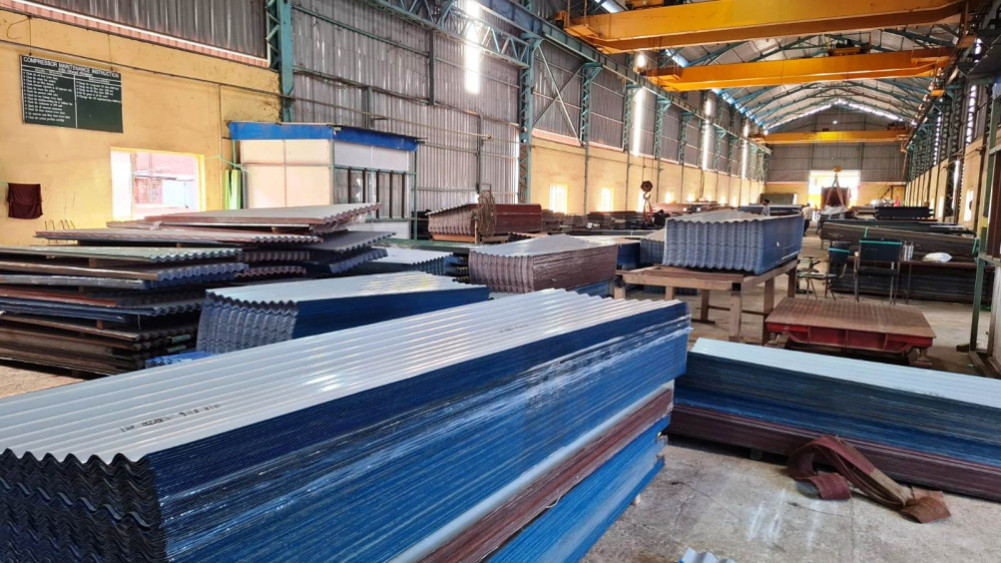
The private sector slowed investment in large-scale real estate and industrial projects, resulting in lower-than-expected steel consumption.
We use Google Cloud Translation Services. Google requires we provide the following disclaimer relating to use of this service:
This service may contain translations powered by Google. Google disclaims all warranties related to the translations, expressed or implied, including any warranties of accuracy, reliability, and any implied warranties of merchantability, fitness for a particular purpose, and noninfringement.
Production in Nepal's steel and iron industry has increased significantly over the past two decades. The condition of Nepal dependent on imported products has changed. Nepal has developed a strong base by producing steel pipes, rebars and structural steel domestically.
The steel sector is directly linked to the country's construction, infrastructure and industrial growth. The biggest challenge is the lack of raw materials.
Nepal does not have iron ore or locally sourced raw steel production. We depend on import of HR coal, billet, scrap steel. This has increased the risk of price fluctuations. This increases production costs. This makes it difficult to compete with imported products from major steel producing countries like India and China.
In the last five years demand was expected to increase from several large infrastructure projects. Accordingly, industries expanded their production facilities. However, the government's expenditure on highways, hydropower and industrial development has not increased as expected. The private sector slowed down investment in large-scale 'real estate' and industrial projects. Due to this, steel consumption has been lower than expected. An oversupply has been created in the market. But not consumption. This is the reason why there has been intense competition in the price of steel.
Many steel producers are forced to sell at low profit to survive. Which is not a sustainable business model in the long term. Instead of healthy competition, a price war has arisen. Though production in Nepal is sufficient, we have not become competitive in exports.
Some companies have exported steel to India and Bangladesh. But our production cost is expensive. Cost of production is still high compared to India and China. The main reasons for high costs are expensive raw material imports, volatile energy costs. Also, lack of government concessions and limited industrial infrastructure. This is the reason why production costs are increasing.
The government needs to make significant policy changes to increase steel exports. Rather than exporting electricity, Nepal should use this electricity for industrial production. Emphasis should be placed on steel exports which are in preparation. The government needs to provide capital subsidies to reduce the cost of new production plants. Financial assistance should be provided for industrial expansion. Competitive electricity tariffs should be implemented for industries to reduce production costs. If the right policies are implemented, Nepal can be established as a regional hub for steel exports.
Another big challenge for Nepal's steel industry is manpower. Although there is no shortage of ordinary labour, there is a shortage of skilled manpower in areas such as metallurgy, industrial automation, steel production and quality control. The government's role in producing skilled manpower remains important. The best engineers and technicians of Nepal prefer to work abroad. The reason is service facilities and salary. This has created a shortage of talent in the local industry. Companies are having difficulty finding qualified manpower. Nepal's education system does not match the needs of the industry. Many engineering and technical graduates lack practical experience in steel production, pre-engineering buildings. This requires training.
Irregular interest rates discourage industry in the business sector. Even though Nepal has surplus electricity, there are problems in transmission and distribution. This is why the industry is not able to fully utilize it. The government has also caused problems by repeatedly revising import duties and tax rates. This makes business operations uncertain. It is important to consult with the concerned industrialists during policy changes. There is no effective VAT refund system in Nepal. Large capital projects have many problems. This leads to cash flow problems.
Nepal's land laws have also made industrial expansion impossible. Industrialists have not been able to acquire large plots of land. The government should revise the land policy to enable industrial growth.
The government should conduct a steel-focused vocational training program in collaboration with development-manufacturing organizations. Partnerships between universities, infrastructure development and steel companies should be encouraged. Cooperation for practical training should be promoted.
Similarly, tax incentives and subsidies should be provided to companies that invest in skill development, which will help support skilled manpower development. Frequent changes in import duties and excise taxes should be stopped. Land boundary laws should be reformed to support industrial expansion. Cash flow friendly i.e. VAT refund problem of delay should be solved.
Nepal should stabilize import duties and taxes to create a world-class competitive steel industry. Frequent changes make it impossible to plan for the future. The company should provide concessional electricity tariff, it will reduce production cost and increase competitiveness.