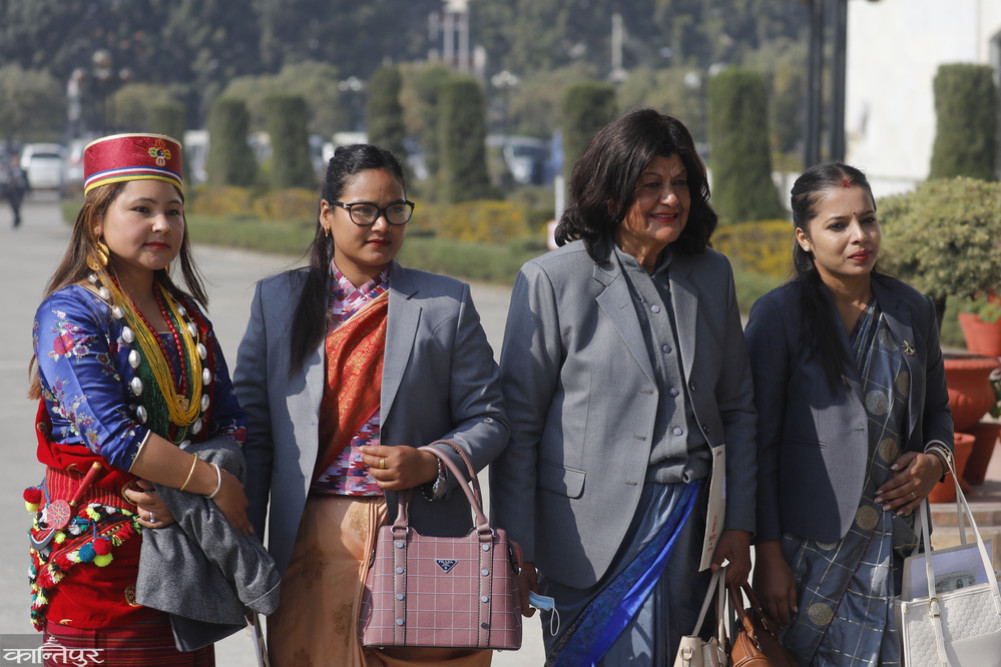
There is a clamor to do something among the young MPs, no matter what party they belong to, there seems to be a common opinion that the old way of doing things will not work, but here there is an obligation to follow the decision of the party, there is a situation where the words of the old leader must be accepted, the words of the young MP are rarely heard, the decision of the main leader is enforced.
We use Google Cloud Translation Services. Google requires we provide the following disclaimer relating to use of this service:
This service may contain translations powered by Google. Google disclaims all warranties related to the translations, expressed or implied, including any warranties of accuracy, reliability, and any implied warranties of merchantability, fitness for a particular purpose, and noninfringement.
Before joining politics, he wanted to work in the health sector. Accidentally came to represent a political party. I formally joined the Rashtriya Prajatantra Party in January 2073 while I was working in a hospital after completing my studies.
The 2074 election was coming. I did not even think of being a candidate for proportional or direct elections. At that time, I told Salyan RPP President, I am not a candidate of the party. It is better to make other friends. At that time I was preparing for public service.
When I was working in a hospital after completing my studies as a health assistant (AHEB), RPP made me a proportional candidate. Many others wanted to become candidates within the party. Many wanted to be a candidate on behalf of Khasarya in the proportional list. But the party nominated me from the Dalit cluster. Then I was elected as a member of the House of Representatives from the proportional list.
Before becoming an MP, I did not know much about the parliamentary process. After taking the oath and entering the parliament, I realized that this is a different place. As we think from outside, it is difficult to go there and work for the people. After being elected as an MP, I thought that I would do this and that, the enthusiasm that I had, slowly waned after becoming an MP.
There is widespread partisanship within Parliament. There is a fierce conflict between the ruling party and the opposition. It is a bit easier for MPs from the ruling party to work. But MPs from the opposition, even smaller parties, are not heard. It is difficult to do people's work. If the ministry goes with some work, the party will be watched. The
bureaucracy seems to look at whether it belongs to the ruling party or whether it belongs to a major party even if it is the opposition. Parliamentarians have to act according to the party's decision. The party has to act according to the decision it takes. You can't even say what you think is wrong. Because it should be presented to the parliament according to the party's decision.
Our party has a policy of encouraging youth. So I got the opportunity to become an MP at the age of 30. President Rajendra Lingden made an open call in the convention that people under the age of 40 should be given opportunities. Accordingly, written and oral interviews were conducted to select the central committee. We became central members that way. We were selected as central members based on our past work, educational status, awareness level. Some of the central members were engineers, lawyers, people who had studied the health sector.
Young MPs are clamoring to do something. No matter what party they belong to, young MPs seem to be of the same opinion that the old way of doing things does not work. But here the party boundary line does not allow all young MPs to work together. There is an obligation to follow the decision of the party. There is a situation where it is necessary to kill the talk of the old leader in the parliament. Young MPs are rarely heard. The decision of the main leader is enforced. This is the case with all parties.
The politics that the old leaders have been doing for years and the politics that the young generation thinks are different. If we talk about the young MPs, they think for the younger generation and make opinions, while the old MPs have a traditional way of thinking. It seems that senior MPs have understood and discussed some issues. Maybe the young MP doesn't have that. If they get responsibility, young MPs can work in a new way.
The big political parties went to the polls with very attractive manifestos. But in the government, after coming to the parliament, they forget. There may be national and international influence on some parties. MPs are unable to act in favor of the people because they have to look after the interests of the party. The party that really wants to do good work has not got the opportunity to run the government.
Main power and party interests are seen in the parliament. Leaders then look at their districts and constituencies. Only outwardly they show that they care for the public. Opposition MPs raise many issues related to the people but the government does not listen. MPs continue to raise their voice against injustice, tyranny and corruption, but the government does not implement. As many as 45 times I have raised various issues in the Parliament, only two issues have been addressed.
MPs of all parties are raising voices about the interests and concerns of the youth. But it is a serious matter that the youth generation has no future in Nepal. It is a very serious matter if the youth who make up the country say that there is no future in their country. Young parliamentarians are worried about building a country. But the government and the leaders of the party do not address it. Education, health and employment are the basis for making the youth believe that they have a beautiful future in their own country. There is a voice in the parliament that a bright future can be made even by staying in the country. Hundreds of youths are leaving the international airport while it is happening in the record of the parliament.
When Salyan Darmakot goes to his village, he interacts with a young man. They have hope and trust that an MP can do a lot if he wants to. He says that he is happy after hearing the people's concerns in the Parliament meeting. If their work is really done, how much more happy they are. The youth who have received a good education in the country have a lot of hope and trust from the parliamentarians. But we have not been able to help them specifically. If the parties work shoulder to shoulder with them, the country will not be formed.
Young people approach the union, state and local governments every day with some proposals. I have often seen young people sent away by discouraging rather than encouraging. Even if the youth try to do new work, the lack of policy and budget is shown. No government seems to pay attention to the fact that a small contribution will lead to a big work tomorrow.
The country has not been destroyed, but education, health, employment and government services have not been improved. This does not mean that the country is doomed. There is a risk, if the country is not brought on the right path, a worse situation may come. MPs are indulging in the interests of their government, party. People's representatives should look at the interests of the people and act accordingly. Here, the interests of the party are seen more than the people. It is not difficult to build a country if you put the people first. The youth power that will work for the country and the people should be promoted.
Kathmandu metropolis can be taken as an example. Although the full results are yet to come, Balen Shah, the mayor of Kathmandu Metropolitan City, is being talked about all over the country.
I see when I go to the village, it is empty. Why are the villages empty? It should be a subject of debate in the parliament. A village being empty means a decrease in production. Decreased productivity means dependence on others. Our country, which was fed by village production, is now becoming dependent on production. If there is an atmosphere of education, health, employment and opportunity, the production of agriculture and other things can be increased in the village. The government should create a policy and prevent the village from being emptied. If we talk about
education, it is connected with competition. The competition between people studying in government (community) schools and private schools has affected the village. If children studying in government schools have an environment where they can compete in any field, there would be no compulsion to come down to the city to educate their children. How beautiful the village would be if there was an environment where children could get good education and health treatment by consuming the products of their own farms. People who were forced to enter the city would probably return to the village again. If education and health are quality and free, villages will be green again.
The policies of the parties are good, the intentions are not clear. If those who run the country insist on policy implementation, the country becomes a country. Policies were made, but those policies were not implemented. There is total politicization in development. When I tried to build a road in Darma Rural Municipality of Salyan by spending the budget of my constituency, the big party obstructed me. Due to the interference of the parties, it seems that many local government works have been blocked.
Directly elected MP and I have the same status. But the view is different. My party is not in government. I don't think I have enough access. When I go to the ministry or other bodies with the demands of the people, they are ignored. People's representatives also have to suffer government discrimination. If it falls into the hands of the right leadership, Nepal will become a paradise. Because we have resources, means, manpower. The main problem is not being able to use it properly. There is a need for leadership with a new approach. Politics should be done to build a country. You should not do politics for your own and party's interests.