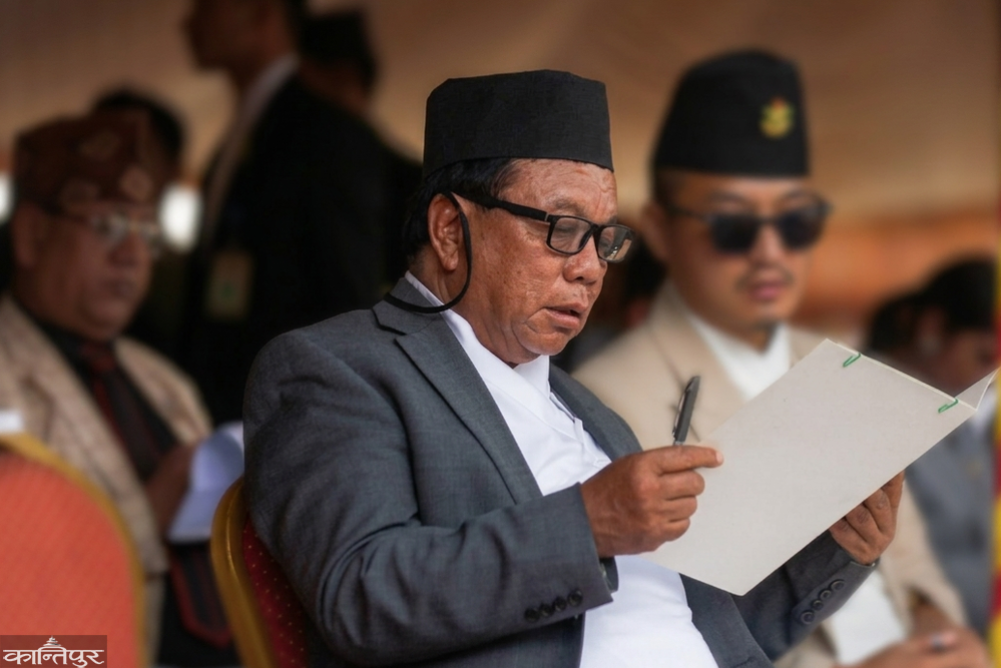
Independent MP Mahabir Pun has been entrusted with the leadership of the newly formed Ministry of Science, Technology and Innovation by Prime Minister Balen Shah.
We use Google Cloud Translation Services. Google requires we provide the following disclaimer relating to use of this service:
This service may contain translations powered by Google. Google disclaims all warranties related to the translations, expressed or implied, including any warranties of accuracy, reliability, and any implied warranties of merchantability, fitness for a particular purpose, and noninfringement.
Mahavir Pun, who was elected as an independent candidate in the election without being affiliated with any party, has become a minister. He took the oath of office and secrecy before the President on Tuesday evening and began his second term as a minister.
Prime Minister Balendra Shah (Balen) has given him the responsibility of the newly formed Ministry of Science, Technology and Innovation. Earlier, Pun had become the Minister of Education, Science and Technology in the cabinet of the then interim government, Prime Minister Sushila Karki.
Now, the government has reduced the number of ministries from 22 to 17 by reforming the federal administrative structure. The Ministry of Science, Technology and Innovation came into existence as a new ministry after the Cabinet meeting held on Baisakh 30, 2083 approved the ‘Government of Nepal (Division of Work) Regulations, 2083’ and implemented the decision.
Until Tuesday afternoon, Pun had said that he was completely unaware of becoming a minister. When the news of his appointment as Minister of Innovation spread, when he was surrounded by content creators, Pun had said, ‘Don’t ask me what I will do now after bringing a book seller here and making him a minister. The first thing I will do is go to the ministry and understand what is going on.’
The Rashtriya Swayamsevak Sangh (RSS) had supported Pun by not fielding a candidate in Myagdi. After becoming an MP, Pun has been heard to be soft on the ruling RSS. Pun is heard to have supported the Prime Minister even in Prime Minister Shah’s controversial statement that Nepal has encroached on India’s land. Pun had complained that the government had left the issue of science and innovation in the policy and program and budget. ‘You are trying to make a good car and a comfortable sofa by bringing good governance, but if you don’t put an engine in it, will that car run?’ He had said in Parliament, ‘What is an engine?’ Isn't science, technology and innovation the engine of the economy?'
He had been repeatedly saying that he needed a Ministry of Science, Technology and Innovation for the country and the economy, not to become a minister. Although he was hopeful that the technology-friendly youth government would understand this, he expressed surprise when it was not mentioned in the documents. Taking a dig at the creation of an Information Technology Authority under the Prime Minister's Office, he said, 'If science, research and innovation are developed by forming an authority, then urban development and physical development can be run by creating an authority, why is there a need for a ministry?'
Born in Nangi, Myagdi, Pun's father was in the British Army. He completed his SLC from Chitwan and his ISC from Amrit Science Campus in Kathmandu. At the age of 33, he went to the US on the advice of a friend for higher education. There, the University of Nebraska offered him a full scholarship to study science. In 1989, Pun earned a master's degree in science education from the University of Nebraska.
After returning from America, he taught math and science in Chitwan for about 13 years. After returning to his village, he expanded the school that taught up to grade 8 to grade 10. In 1997, he set up a computer lab at Himachal Secondary School with four old computers gifted by an Australian student. Since there was no electricity to run those computers, he started computer education in the school by connecting a small hydro-generator to a nearby river. Although there was a computer, there was no internet. In 2001, after sending an email to the BBC asking for help in connecting his village to the internet, Pun received support from all over the world. The BBC published a news story titled ‘Wooden Computer’ about Pun, who was looking for a way to bring internet to remote areas, and teaching students by assembling old computer parts.
Judging by Pun’s past statements and work, he seems to be a visionary in the field of technology. In the 2050s, he took the initiative to bring computers to remote areas and provide education and health communication through wireless internet services. He used wireless technology to bring internet to remote villages in Myagdi. He connected the village to the world by modifying a simple WiFi router and placing repeater towers on the hills.
For the same initiative, he was awarded the ‘Roman Magsaysay Award’, which is considered Asia’s Nobel Prize, in 2007. Later, he received various honors such as the ‘Internet Hall of Fame’, the Overall Social Innovation Award, and the Jonathan B. Postal Award. The University of Nebraska in the US also awarded him an honorary doctorate. ‘After returning from the US, I did not take a job, I did not do business, I have been doing social service,’ Pun has been saying, ‘Now everyone has a mobile phone. I did not build a tower, but I worked to bring internet to remote villages.’
Pun also operated a restaurant called ‘Nepal Connection’ in Thamel, Kathmandu around 2075 BS. He used to say that the restaurant was started to raise funds for the salaries of school teachers in Myagdi and that a portion of the income from it would be spent on the education and health of children in remote areas. The concept of the National Innovation Center was born within that restaurant.
To promote science and technology, he established the Innovation Center on the Tribhuvan University campus in Kirtipur in 2069 on his own initiative. The center made essential materials like PPE, swab collection booths, and robots during the Corona pandemic and delivered them to the district. Through the center, he repaired ventilators, dialysis, X-ray machines, anesthesia machines, video X-ray autoclave machines, blood pressure monitors, ECG machines, and patient monitors that were broken in various federal hospitals in the country. When Pradeep Poudel was the Health Minister, Pun repaired and managed the equipment of 17 federal hospitals. Pun is known for his simple lifestyle. He wears plain clothes. His style of asking for votes during election campaigns was famous. His straightforward and humorous style of speaking, dancing, singing and gestures have also been continuously becoming reels and memes on social media. Recently, he had made a statement that it is easy to make a rocket but there is no technology to drive away monkeys in the world, which has gone viral.
When he was the Education Minister last time, he had announced that he would sleep in a bed in the ministry and would not hire security personnel. At that time, he had prepared a draft of 3 laws and 4 regulations to eliminate irregularities, corruption and unrest in the education sector. According to his then advisor, he was preparing to amend the Unified Act on Higher Education, the Act on Research and Innovation, the Education Regulations and the rules on educational consultancy.
His style of working and walking is not predetermined or planned. His close associates say that he makes decisions quickly and immediately starts looking for other options if a plan does not work. He has been accused of not being completely transparent in the calculation of the amount collected publicly. Critics say that the process of collecting money through book sales and donations has been slow.
Some critics point out that it is rude to use rude language and sometimes resort to abusive language to those who criticize him on social media. Some comment on him as a person who fixes old things or repairs (jugaad) rather than a real 'inventor'.
Pun has been raising his voice in favor of replacing the system of the prime minister as the chancellor of the university and making an expert educationist the chancellor. He is of the opinion that the system of the prime minister or political figures as the chancellor of the university should be abolished to make universities free from politics. However, despite the RSPB government removing hundreds of officials who received political appointments through an ordinance at once, it has kept the arrangement regarding the university's chancellor intact. It remains to be seen how Prime Minister Balen and Pun will move forward on this.