Despite the expansion of online technology in public services, security weaknesses, along with problems such as server downs and power outages, have added to the frustration of citizens.
We use Google Cloud Translation Services. Google requires we provide the following disclaimer relating to use of this service:
This service may contain translations powered by Google. Google disclaims all warranties related to the translations, expressed or implied, including any warranties of accuracy, reliability, and any implied warranties of merchantability, fitness for a particular purpose, and noninfringement.
Sita Thapa of Thankot wanted to take a loan by mortgaging 5 aanas of land in her name in Bhaktapur. For this, she reached the Land Revenue Office in Chyamasing on Thursday to freeze the land. Normally, the process of freezing land purchase and sale should be completed in an hour, but it took her a whole day.
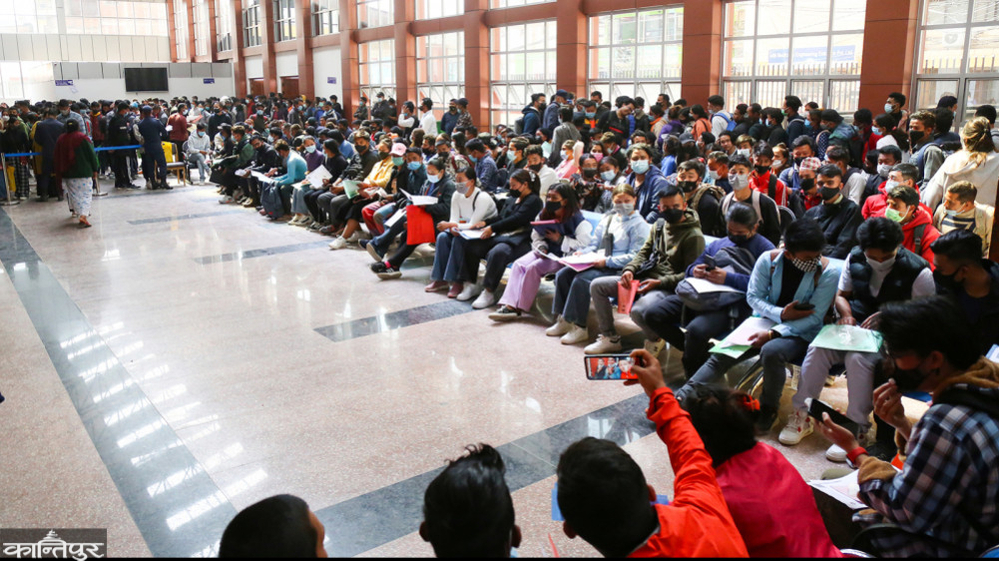
When she reached the Land Revenue Office at around 9:45 in the morning, a crowd of service recipients, scribes and others had gathered. The office opened in a few minutes. She entered carrying the red paper and other documents. However, before the work could start, the electricity went out, and there was no option but to wait. After an hour and a half, the electricity came back on, and she hurriedly stood in line again. However, after that, the employee said that the office's 'system was down' again and asked her to wait some more.
‘I had taken my daughter with me, thinking that the work would be completed in an hour or two at most. She had said that she would come to the office in two hours, but the work was completed only at 3:30,’ says Sita, ‘I had to go to the bank after completing the land tax work. Since the bank would close at 5:00, we took a taxi to Nepal Bank Ltd., thinking that we would be late. Now all that was left was to open an account at the bank. By the time we filled out the form, it was already 5:00. The bank employee had gone home. I only got the loan on Friday.’ Sita had taken the loan to repay the loan. She complained that she had to pay an additional interest of Rs. 25,000 for being late by just one day.
‘Two months ago, when my father underwent surgery, I was in a great need and took a loan from a friend for one month on interest. Now, I have taken a loan by mortgaging my land to pay for it.’ She said, ‘They said that the interest would double if the month exceeded.’ I have been requesting both the government bank and the land revenue for two months, but both sides were delayed, the system was broken. I suffered a lot due to this online system of the government, and I also had to pay a lot of interest.’
Many service recipients have been facing the same fate as Sita on a daily basis. The servers of government offices are down, the lights go out, the site does not work, it gets hacked, people have to be present in person even for services called online, and they have to print papers and pay through the window.
The security system of the government’s digital infrastructure is also very weak. Recently, the website of the Tribhuvan University Examination Controller's Office was hacked by students studying at the school. International flights are also affected when the server at the Immigration Office goes down repeatedly. Last Baisakh, the 'Kaju' hacker group had placed 8 GB of data on the dark web marketplace 'Dark Forum', claiming to have stolen the data of more than 2 million citizens from the Nepal Police website. In Baisakh 2080, the data of examinees was lost from the online system of the Public Service Commission. At that time, Nisha Dangi, a member of the Rashtriya Swayamsevak Party, had demanded action against those who did not keep the data safe in the parliament. MP Dangi is currently the chief whip of the ruling Rashtriya Swayamsevak Party. A few years ago, dozens of government websites were disrupted for a few days due to a 'D-DOS attack' on the Nepal government website from countries including France, Germany, Italy, and Israel. Such incidents highlight the vulnerability of government digital infrastructure. The recently formed Rashtriya Swayamsevak Sangh (RSS) government has prioritized digitization and increasing the use of information technology systems in government agencies in its 100-point action plan for good governance. It has an ambitious goal of making services like passports and citizenship ‘faceless’. However, Digital Rights Nepal’s ‘Policy Briefing’ states that some basic aspects are lacking in these plans. Accordingly, the government’s action plan does not include a clear and comprehensive strategy for cybersecurity. The briefing points out that integrating data without strong security mechanisms leaves government systems and citizens’ details vulnerable to cyber attacks and misuse. Digital Rights Nepal believes that the action plan also ignores internet access, rural-urban disparities, and gender and socio-economic inequalities. ‘There is a lack of a clear mechanism to consult and involve the general public, experts and stakeholders in the design and implementation of digital systems,’ says Santosh Sigdel, founding president of Digital Rights, ‘The new action plan does not seem to be in line with the previously prepared e-governance blueprint and draft personal data protection policy. This leads to duplication of resources for the same work and creates confusion in implementation.’ Sigdel informed that this policy briefing was submitted to Chief Secretary Sumanraj Aryal via email on Friday.
The ‘Report of the Advisory Committee on Systemic Reforms Related to Financial Management (Information Technology)’ recently released by the Ministry of Finance has also exposed the pathetic state of government information technology. The report states that most government agencies do not have a national policy or standard on digital data storage and security. ‘Most of the servers and equipment in use are old,’ it says, ‘some equipment was found to be running even after its expiration date.’ The report points out that the lack of timely renewal of licenses for cybersecurity systems such as firewalls and antiviruses and the lack of regular ‘health checks’ of the systems have led to high risks to data security. The report mentions that due to the lack of skilled technical manpower, government agencies have to rely solely on external private companies and consultants. ‘There are no clear ICT policies or guidelines for the operation, security, life management, compliance framework, data backup and data retention of software and hardware,’ the report states in point 3.1, ‘as a result, dependence on vendors for system operation and development has increased and challenges have arisen in institutional capacity development in the long term.’ The report also considers the lack of clear criteria for which work should be done by internal human resources and which should be outsourced as a weakness. Even from a global perspective, Nepal’s cybersecurity situation does not appear to be strong. In the latest
Global Cybersecurity Index (GCI) of the International Telecommunication Union (ITU) under the United Nations, Nepal has been ranked in the ‘Tier 3’ or ‘Establishing’ category. This means that Nepal is still struggling to establish a strong foundation for cybersecurity. Neighboring countries India and Bangladesh are in the ‘developed’ or fifth category. Although Nepal has made some improvements in the legal and structural sectors, it lags far behind in technical capacity and cooperation, according to the ITU analysis.
The effectiveness of various information technology systems used by government agencies for internal work and service delivery, procurement, maintenance, security assurance, dependence on third parties in system operation, and delays in the implementation of the latest technology have also been widely criticized year after year. However, these have not been addressed.
The government has decided to give two days off in government offices effective from Monday. There are problems such as server down, power outages, and service interruptions for 1 hour during lunchtime during a one-day holiday, and now complaints are being heard on social media that the extension of the holiday on Sunday will further harm the service recipients. However, The government has decided to declare Saturday and Sunday as holidays for government offices and educational institutions due to the inconvenience caused by the supply of petroleum products.

