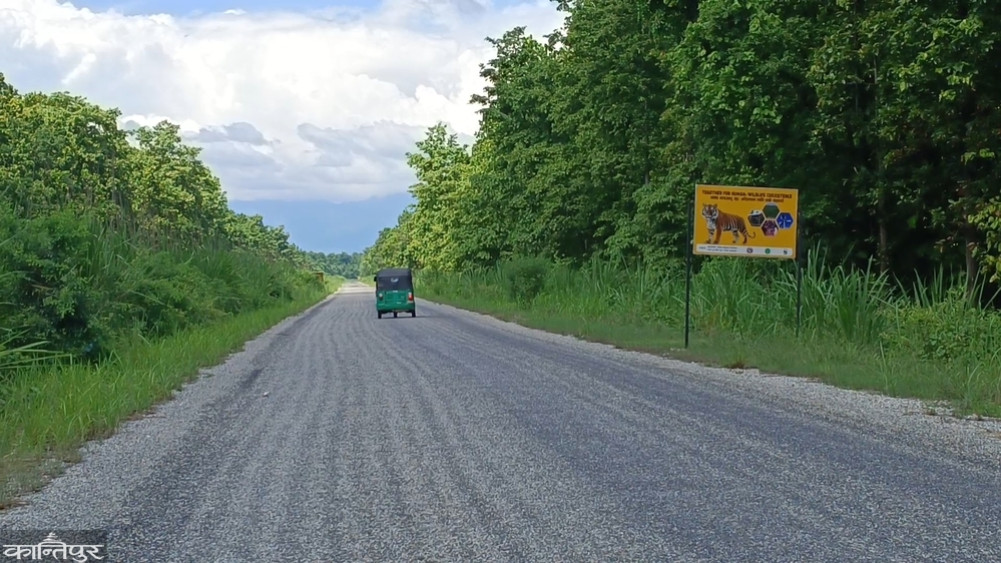
The absence of a mobile network on the road inside Shuklaphanta National Park, which sees hundreds of travelers daily, has made it difficult to seek help in cases of accidents, illness, or other emergencies.
We use Google Cloud Translation Services. Google requires we provide the following disclaimer relating to use of this service:
This service may contain translations powered by Google. Google disclaims all warranties related to the translations, expressed or implied, including any warranties of accuracy, reliability, and any implied warranties of merchantability, fitness for a particular purpose, and noninfringement.
Shuklaphanta National Park, which covers an area of 305 square kilometers, includes about 15 kilometers of the Daiji–Beldandi road section under the Hulaki Highway, about 4 kilometers of the East–West Mahendra Highway, and about 5 kilometers of the Belauri–Kaluapur road section. In addition, various rural roads are also in operation within the park and its buffer zone.
There is no mobile network available for about 15 kilometers of the Daiji–Beldandi Hulaki road section that passes through the middle of the park. Locals say that after entering this road section, which sees more than a thousand travelers daily, mobile phones do not work.
According to locals, if there is an accident or an encounter with wild animals during the day, information reaches the Nepal Army deployed for park security through other travelers. However, they say that information about accidents, vehicle breakdowns, or other emergencies that occur at night is delayed.
Traveler Krishnasingh Kunwar said that the lack of mobile network in the park area creates problems in emergencies. "Once inside the park, mobile phones do not work. If there is an accident or other problem, it is impossible to inform anyone," he said. Another traveler, Nakhuram Chaudhary, said that it is even more difficult to seek help if there is a problem at night. "When the phone doesn't work at all, the problem only gets worse. Communication services are necessary on such roads," he said.
The problem of mobile network is not limited to travelers. Both domestic and foreign tourists visiting the park face the same issue. Locals say that residents of the buffer zone who enter the forest to collect mushrooms, fiddlehead ferns, grass, and firewood cannot establish communication if they lose their way or encounter other problems.
The most recent example is the incident on the 4th of Saun. Seventeen people from Bhimdatta Municipality, Bedkot Municipality, and Beldandi Rural Municipality lost contact after entering the park to pick mushrooms. Nepal Police, Armed Police Force, Nepal Army, park administration, and local residents were mobilized to search for them. Drones and nine domesticated elephants from the park were also used in the search operation. They were rescued safely after 26 hours. Local Tejsingh Dhami said that the mobile network should be expanded in the park area. "Not only locals who enter the forest, but also travelers using the roads face problems. At the very least, there should be a system for making phone calls in emergencies," he said.
Stakeholders say that the lack of mobile network also affects the work of the park administration and the Nepal Army deployed for security. They say that during wildlife monitoring, rescue, and security management, the lack of communication makes coordination difficult.
After the incident in which 17 people lost contact, the District Administration Office, Kanchanpur has also shown concern about this issue. Chief District Officer Madan Koirala said that, considering the sensitivity of the park area, reliable communication services are necessary for the safety of citizens. He informed that coordination is ongoing with the Nepal Telecommunications Authority and service providers regarding this matter.
Chief District Officer Koirala said that although Shuklaphanta National Park is a sensitive area in terms of conservation, thousands of travelers pass through it daily, tourists visit, and the daily lives of buffer zone residents are connected to it, making reliable communication services indispensable. "The inability to make even a single phone call in an emergency is not just a basic infrastructure problem, but an issue directly linked to the safety of citizens. Therefore, it is necessary to expand communication access in coordination with the relevant agencies, maintaining a balance between park conservation and citizen safety," he said.
Administration orders not to enter the park without permission
As the trend of residents of the buffer zone of Shuklaphanta National Park entering the park without permission has been increasing, the District Administration Office, Kanchanpur has issued a strict order.
The administration has requested that no one enter the park unauthorized for any purpose, as the risk is high during the rainy season due to wild animals, rising rivers and streams, and dense thickets.
According to the decision of the District Security Committee, the District Administration Office has clarified through a notice that, according to Section 5 of the National Parks and Wildlife Conservation Act, 2029 (1973), no one may enter or carry out any activities within the national park area without written permission from an authorized official. The notice also states that, according to Section 9 of the Act, anyone entering the national park does so at their own risk, and the Government of Nepal will not be responsible for any death, injury, or other loss that may occur there.
Chief District Officer Koirala said that the practice of residents of the buffer zone entering the park without permission to collect mushrooms, grass, firewood, and other forest products has been increasing and needs to be stopped immediately. "Legal permission is required to enter the national park. During the rainy season, the thickets become dense, the flow of water in rivers and streams increases, and the risk from wild animals such as elephants, rhinos, tigers, leopards, and crocodiles is extremely high. Therefore, we urge all citizens not to enter the park unauthorized under any pretext," said Chief District Officer Koirala.
Reminding of the legal provisions, he said, "Entry into the national park is at one's own risk. The Government of Nepal cannot take responsibility for any accident, injury, or human loss that occurs there. Therefore, everyone should comply with the law and prioritize their own safety."
This warning from the administration comes after the recent incident in which 17 people who went to pick mushrooms inside the park lost contact. Seventeen women from Bhimdatta Municipality-19 Bagfanta, Bedkot Municipality-10 Chatahari, and Beldandi Rural Municipality-2 Chawanni lost their way in the forest and spent a night stranded inside the park. Nepal Police, Armed Police Force, Nepal Army, Shuklaphanta National Park administration, and local residents were jointly mobilized to search for them. The search operation included aerial surveillance by drone as well as the deployment of all nine domesticated elephants from the park. Ultimately, all 17 were rescued safely and handed over to their families.
Locals from settlements around Shuklaphanta National Park have long practiced entering the park during the rainy season to collect mushrooms, grass, firewood, and other forest products. However, in recent years, the administration has made a special request to stop such activities due to the increased risk from wild animals, weather-related disasters, and incidents of people losing their way. The administration has again requested the general public not to enter the park without permission, to stay away from risky activities, and, if necessary, to coordinate with the relevant agencies and obtain permission before entering the park area.