Even after 17 years, there has not been much difference in the life of Mukt Haliya of Dadeldhura. They are still landless, suffering from untouchability and waiting for rehabilitation.
We use Google Cloud Translation Services. Google requires we provide the following disclaimer relating to use of this service:
This service may contain translations powered by Google. Google disclaims all warranties related to the translations, expressed or implied, including any warranties of accuracy, reliability, and any implied warranties of merchantability, fitness for a particular purpose, and noninfringement.
The 65-year-old husband of Chandra Sarki of Dadeldhura Amargadhi Municipality-10 still goes to plough. Chandra complains that he has not been freed even though the government has said that Haliya is free. 'No land, no house. They have to live by ploughing,' she said.
Not only Chandra's family, hundreds of recent families of Dadeldhura are still in the same painful life. Narrating the bitter reality that her husband ended her life by plowing all her life, Bisnadevi Tamta complained that no government has seen the lack of land, unemployment, poverty and problems in her life.
'There is a house but no land . The roof leaks,' she said, 'the husband passed away. The son is also disabled.' As a single woman, on top of that, she expressed her pain that she had to face caste discrimination. He says that he does not even have the identity card of Haliya Mukti.
Tomta's husband spent his whole life ploughing. But he passed away in a house with a leaking roof. As my son is disabled, there is no one to work at home .
The government had announced the end of Haliya practice on 21st August 2065 . But even after 17 years, no change has been seen in the life of Muktu Haliya.
Manju Sarki of Amargadhi Municipality-3 Kande is still treated as 'untouchable' by the villagers. They don't let them drink water from the well, the discrimination in the society is still deep . How long will we endure injustice?' she asked. She said that since she has no land in her name, she had to stay in someone else's house until today.
Amargadhi-2's Radha Damai is also unhappy. He says that even if the government asks for 3 lakhs to build a house, that amount will not be enough. "It is only that we have been freed, we have not got the real freedom yet," she said. She said that despite being declared free by the Act, she has not been freed. 'No one has land, no one has no house,' she says, 'even if the government declared Halia Mukt and gave three lakhs, the budget is not enough for rehabilitation.'
He said that the people who built a house by taking out an additional loan of three lakhs have to go abroad to pay the loan. She said that the government should make a procedure for rehabilitation and implement it.
Many families are still landless as rehabilitation has not been effective even after the recent declaration of independence. In Dadeldhura, out of 2,551 households that have been confiscated by the Nepal government, only 2,267 households have received the rehabilitation package. The federal government has authorized the local government for rehabilitation. 331 recent families of 7 local levels have not been able to receive the rehabilitation package yet. 313 families are now awaiting rehabilitation.
Sahara Community Forest
A village of Ganyapadhura rural municipality-1 Veta has been living in the community forest for 16 years. In the year 2065, the government liberated Haliya. The citizens of the area, who had to make a living by plowing the plows of the owners from their ancestors, got relief from the recent times, but there was a problem of gansabash. The settlement, which has 10 Dalit families, has not yet been liberated.
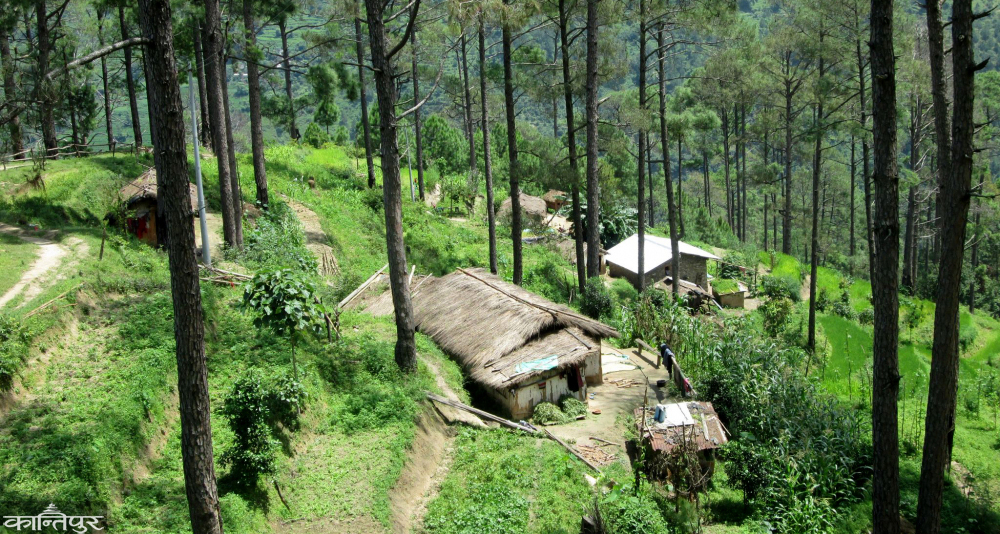
Chhabilal Damai remembers that he was liberated 17 years ago and he still lives in the community forest because he has no home. After the big landslide in 2066 washed away the village, the settlement was relocated. Out of 10 families, 4 families are now living in the forest. Chabilal says, "He has no land, no house in his name." It's been 16 years since I became landless . It has been 17 years since we got rid of Halia, but we have not been freed from suffering and poverty.' Tularam Sarki, the former president of District Halia Mukti Samaj Dadeldhura, remembers the moment he fasted in front of the district administration office for 24 days in 2064. "The government listened only when 40-50 people gathered together and made a demand," he says. He also said that he has been in the campaign for Haliya Mukti since two decades.
In the year 2057, when the Kamaiya Mukti movement was raging in the Terai, Halia also started a movement in the hill communities of Far West. Then, in 2065, when the agitation raged in Maitighar in Kathmandu, the government was forced to announce the end of Haliya practice. He said that in the year 2057, during the movement for the liberation of workers, they started the movement for the liberation of Haliya by following the same law for the liberation of workers. According to him, at that time, the Haliyas filed a lawsuit in the name of more than 60 owners and the decision was made in favor of the Haliyas.
Dalit rights activist Sunita Gayre says, 'Halia is associated with the life of landless Dalits. They still have to live on someone else's land. Education, health, nutrition are all affected. She said that this should become a common issue for all. "Since ancient times, they have not received their value for plowing someone else's land," she said. Because of this, education, health and nutrition have also been seriously affected. He said that even if they fight for their rights, the relevant bodies should be interested. The five-point consensus and 10-point recommendations made by the recent
free society and the government have not yet been fully implemented. Because of this, issues like education, health, employment, sustainable livelihood and social empowerment have been overshadowed. Even after 17 years, the state has not prioritized the restoration work. There is slowness from the federal to the local level,' says Gayre, a rights activist. Even after 17 years, there has not been a big difference in the lives of the free youths of Dadeldhura. They are still landless, suffering from untouchability, and awaiting rehabilitation .
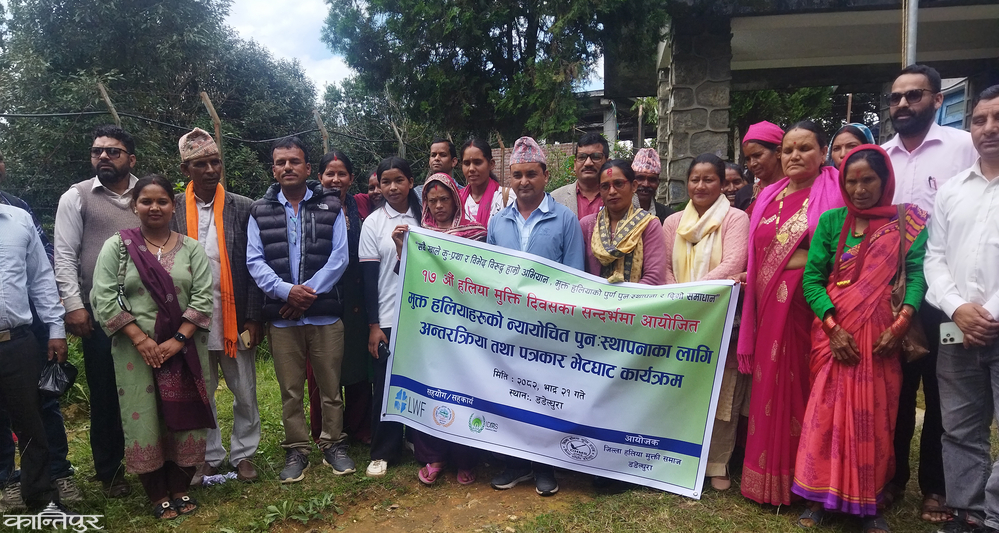
District Haliya Mukti Samaj Dadeldhura President Bharat Sarki estimates that there are still around 5,000 families in Khut Haliya. Out of the seven municipalities, only five made procedures, but there was no implementation. The municipality only gives assurances,' he says.
He said that they are coordinating in the collection of data on exempted haliya in all the seven municipalities. He says that even the municipalities that have made the procedures will give assurances but in practice the local levels have failed. He said that he has been drawing the attention of the government for the past 17 years to fulfill his demands and despite submitting a memorandum to the federal government, there has been no hearing. He says that he feels that the government is neglecting the rehabilitation work.
Even after 7 years have passed since the federal government gave the responsibility of restoration to the local level, the work is not effective . Ajaymeru Rural Municipality, Ganyapadhura Rural Municipality, Navadurga Rural Municipality, Alital Rural Municipality and Parashuram Municipality have made procedures but have not been able to implement them in practice . Amargadhi Municipality and Bhageshwar Rural Municipality have not made any procedures yet. Because of this, many families are still deprived of identity cards, land, houses, jobs and basic services.
Haliya community's umbrella mass organization National Free Haliya Samaj Federation of Nepal and the government of Nepal and the 5-point agreement and 10-point recommendations between the Nepalese government and the spirit and spirit of the emancipation declaration, rights activists say that the free Haliya is forced to live a difficult and painful life even for a long time. According to rights activists, as the period of resettlement lengthens, issues related to proper management, education, health, employment, income generation, sustainable livelihood, social empowerment and inclusion of the missing freed people are getting overshadowed.

