We use Google Cloud Translation Services. Google requires we provide the following disclaimer relating to use of this service:
This service may contain translations powered by Google. Google disclaims all warranties related to the translations, expressed or implied, including any warranties of accuracy, reliability, and any implied warranties of merchantability, fitness for a particular purpose, and noninfringement.
Last Sunday before 7 am, a Bolero jeep numbered SE1J 1517 was waiting for passengers in front of Dan Bahadur Bohra's shop. Some people were heating the fire in the shop while others were buying goods. Dan Bahadur, the owner of the shop, had no time to speak because of the hustle and bustle in the shop since morning.
At this time, a crowd of people from the Dalit slum rushed towards the shop. Children, old people and women were running behind the 8 youths with red tattoos on their foreheads . They were - young people who had traveled to India in search of work from Garaju-2 Garaju, which is only reached after a 9-hour motor journey from Doti headquarters.
As soon as he saw Laskar, the Bolero driver ordered the co-driver, "Put the man inside quickly". Put the one who doesn't stick on the bag at the back.' When the driver was about to start the car by ordering the co-driver, the noise and crying started in front of the shop. The sight did not leave the eyes of anyone present there. Some young people could not bear the pain of separation and bought Rahar (alcohol) from the moneylender. Some hands started to cover the dirty face and tears . Some were comforting their wives, children and mothers by hugging them. Everyone's face and eyes were red with tears. 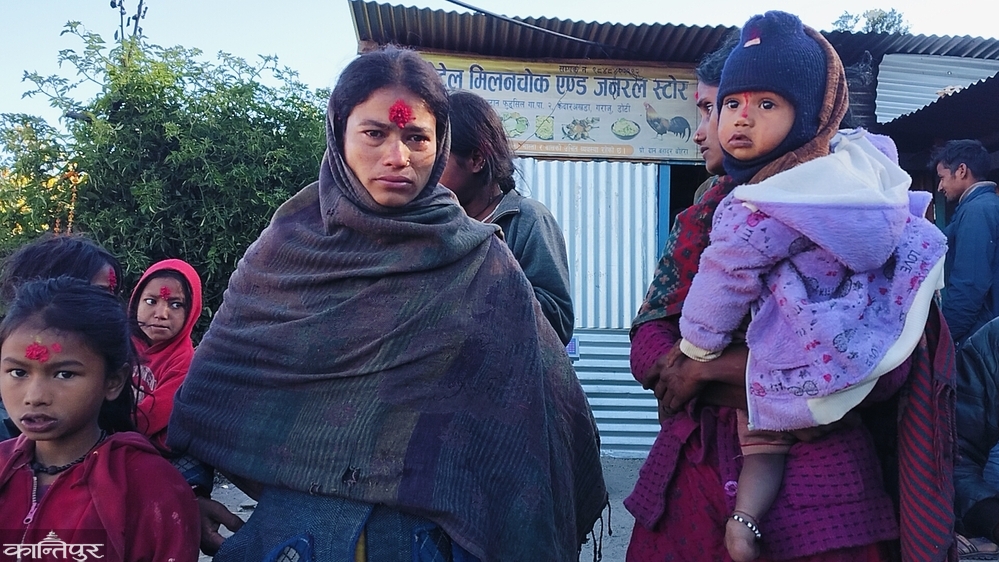
In front of the shop, 30-year-old Vimala Nepali was holding her one-and-a-half-year-old son in her arms and was sighing. Vimala, a mother of five children, who was married at the age of 14, had completely lost her face.
Vimala from Garaj has the stress of taking care of 5 children along with the pain of having to send her husband to India. She was crying that her husband Krishna, who came home three months ago, had to go to India again. ``The loan taken from the moneylender's shop is yet to be paid, there is no grain at home,'' she said after a long sigh, wiping away the stream of tears, ``when my husband was with me, I didn't worry about eating in the village, now how can I take care of my children ? A weak body is not strong enough to harvest other people's land and grow food.
17-year-old Janu Vishwakarma, who has 11 sisters and 4 brothers, could not bear the separation from her brother Ganesh. While at home, his brother encouraged him to read and write. Gana has felt the pain of parents who are facing difficulties in taking care of their children from all over the house.
Ganesh's dream is to teach his sister, but due to poor economic conditions, the marriage is going on at home. "Brothers who understand the pain have to go to India for our own happiness," she said. 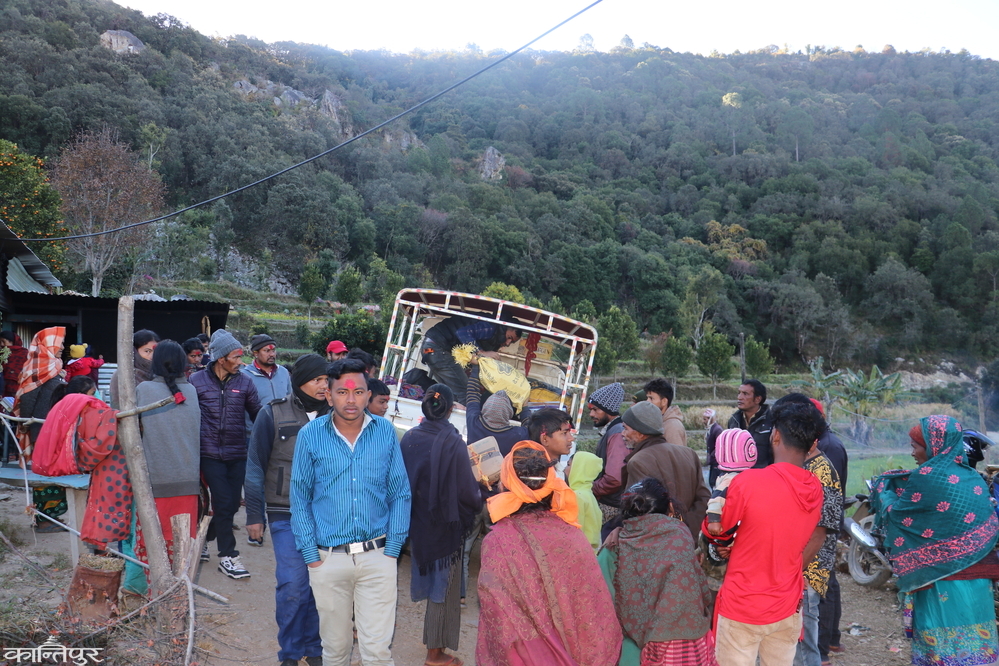
On the other hand, the jeep driver was indicating that the vehicle was about to leave by pressing the accelerator. The sailor started yelling to sit inside the car quickly. The young people who did not get to live with their family happily were getting upset because they did not even get a chance to say goodbye to their relatives until they died. Amidst the silence and crying, the bolero drove away with the young people. The women who were sobbing until the
put their children on the ground and started crying. After the car crossed the hill, the people who were crying slowed down . Some went home, some went to the garden . Some of the remaining men started making plans to play Tas, some of them cut the straw and got ready to have fun . Dan Bahadur's shop started to get busy again.
'This scene may seem new to you, but young people are migrating here day by day,' teacher Lok Bahadur Bithari said, 'Within a month, 107 young people from 60 households in Garaju village have entered India, probably this team is the last one today According to teacher Bithari, only the elderly, women and children have been in Garaju since Sunday.
Dhanadevi Bohra, a leading member of the Changeable Women's Group, said that when women enter India due to poverty, tears flow from their eyes like Ghate Khola (the name of a local river). She said that although the level of awareness is gradually increasing, most of the women are forced to drown in tears due to poverty and lack. Since there is no land for farming in the village and there is no alternative for income, some people go from here with their children to cities like Champawat, Tanakpur, Delhi, Punjab, Mumbai, Beglour and other bordering cities of India in search of work . After the festival, they usually return home on the anniversary.
Every year in the hilly areas of the Far West including Doti, after the end of festivals and fairs, the rush to India in search of work begins. Most of the young people will enter India by the last week of November, says Bishnadevi Bam, vice president of Bogtan Foodsil Rural Municipality. "The youth of the entire village has become destitute due to the migration to India," Vice President Bam said, "Only a few people who are old and stopped for jobs are found in the village. It is becoming a challenge for us." He says that he is making fun of himself . 'The main thing is unemployment, I am trying to create jobs in agriculture as a ward president,' said Bam, 'There is no attraction for the youth in agriculture, politicization and manipulation have brought distortions to the government's agricultural subsidy.' Ward president Bam says that even when young people are offered for farming, they prefer to go to India.
According to the National Planning Commission's Multidimensional Poverty Index of 2075, the poverty rate in Far West is 45.5 percent. This rate is much higher than the national average of 28.6 percent. The number of people traveling from the Far West in search of work in India is significant.
According to the preliminary results of National Census 2078 (year 2021), more than three lakh people of this province have gone to India for employment. This number is about 10 percent of the total population of the province. These figures show that migration to India in search of work is high due to poverty and lack of employment in the Far West.

