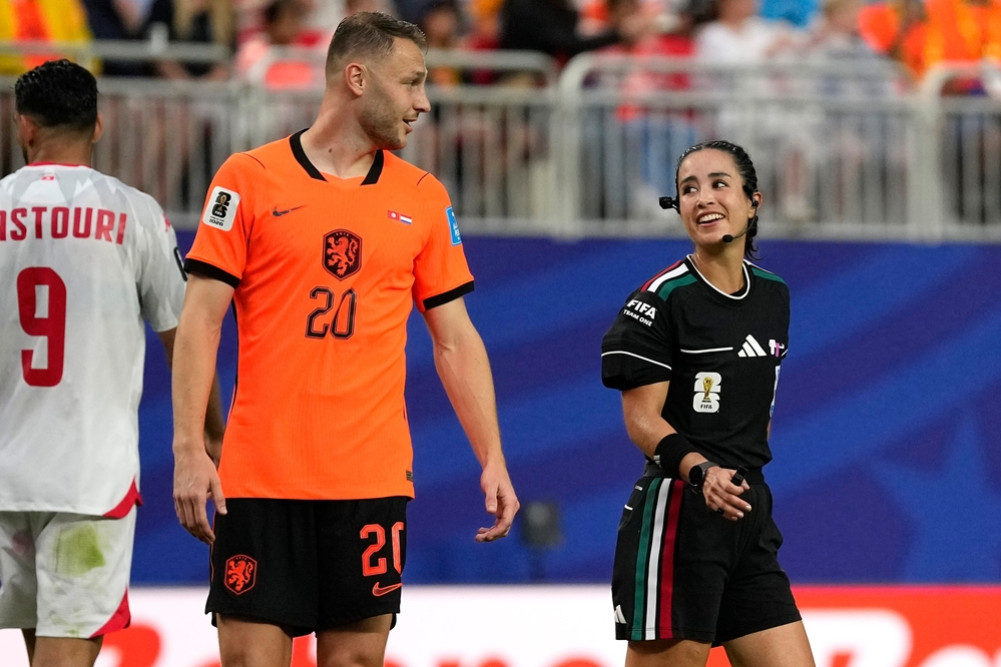
Referees are encouraged not to blow the whistle for minor 'fouls' and to maintain the pace of the game.
We use Google Cloud Translation Services. Google requires we provide the following disclaimer relating to use of this service:
This service may contain translations powered by Google. Google disclaims all warranties related to the translations, expressed or implied, including any warranties of accuracy, reliability, and any implied warranties of merchantability, fitness for a particular purpose, and noninfringement.
One of the features of the World Cup is a slightly more lenient referee. This has not only increased the speed of the game, but will also become a feature of future football. This time, referees have been encouraged not to blow the whistle on minor ‘fouls’ and to maintain the order of the game. This has not only reduced the ‘injury’ time of the game, but also increased the time of games with the ball.
This is also why the number of goals has increased. According to the statistics released at the end of the league stage, there is a greater chance that such players will shine more in this World Cup, whose physical ability is slightly higher than others. What this also means is that players will have to work a little harder physically. Many have welcomed this change in football.
There will also be a fear of this, especially for injured players. Players with minor injuries will now find it more difficult to play football. Not only that, but players who are trying to return to the field after recovering from injury can also be troubled by today's highly dynamic football. Chris West, a football statistician, says, “The distance players cover so far has not increased, but their speed has increased.”
Now most teams are trying to play at a faster pace when the opposing team has the ball. Similarly, they are also trying to increase their speed to disrupt the rhythm of the opposing team. For this reason, the possibility of any team continuing to attack even when they do not have control of the ball has increased. West adds, “Football has now become a game of high speed.”
One concrete reason behind the increased attacks in football is the generosity of the referee. Brazilian football expert Lendio Carmon says, “Referees are now stopping the game for most common tackles. Now common tackles will be part of the game.”
FIFA, the world football’s highest organization, also has a policy of not disrupting the game as much as possible. Pierluigi Collina, the head of FIFA’s refereeing department, has been giving similar instructions. The aim is that the more dynamic the game is, the better. Statistics show that fouls have decreased by 29.3 percent in this World Cup compared to the 2018 edition and 27.7 percent compared to the 2022 edition. For this reason, the number of yellow cards has also decreased, but the number of red cards has increased.
Fast-paced football has made players extremely tired. If football is played at this speed, the number of injuries to players may increase. For this reason, while players like Argentina's Lionel Messi and France's Kylian Mbappe have been seen in rhythm, Brazil's Neymar has also needed more time to return to the field.