The Wankhede Stadium was filled to capacity in every match Nepal played in the Cricket World Cup.
We use Google Cloud Translation Services. Google requires we provide the following disclaimer relating to use of this service:
This service may contain translations powered by Google. Google disclaims all warranties related to the translations, expressed or implied, including any warranties of accuracy, reliability, and any implied warranties of merchantability, fitness for a particular purpose, and noninfringement.
Spontaneous Deuda dance at Marine Drive in Mumbai. Can you imagine? Cricket is also making this possible. When we look back at the year 2082 from the perspective of Nepali sports, we will
remember exactly the same Marine Drive that is so famous in Nepal and the famous historical cricket ground Wankhede Stadium. The occasion was, the ICC Twenty-20 World Cup. How far can Nepali sports go at most? The answer is that it will be made possible by such a cricket atmosphere. This was the year when Nepal played the biggest Twenty-20 cricket tournament, the World Cup, for the third time. The memories associated with it will remain vivid for a long time.
Wankhede, which is associated with the historic success of Indian cricket, was truly like a second home for Nepal. The stadium was full in all the matches that Nepal played. Thousands of Nepali cricket fans reached Mumbai and wore Nepali jerseys and Dhaka caps and carried the country's flag. While Nepal's World Cup journey was like that of a great champion, there was no shortage of performances in the World Cup. A brave game against England, a decent performance against the West Indies, a forgettable result against Italy and a resounding victory against Scotland. This was the essence of Nepal's performance in the tournament, satisfactory in many ways.
Meanwhile, foreign media did not hesitate to praise Nepal's performance. Taking advantage of this opportunity, Nepal's captain Rohit Poudel did not forget to request the big Test playing countries India, England and Australia to come to Nepal. And West Indies coach Darren Sammy publicly said that it is the duty of all Test playing countries to support a cricketing country like Nepal. Having said this, Nepali coach Stuart Law made a sharp point. He said that Nepali cricket will not progress very much in this way. If it is to really progress, it needs investment and this investment is for first-class cricket, that is, two or more days of cricket.
Twenty20 cricket is all about the economy and discussion these days. But if cricket is to be developed, then a red ball game is needed, white ball is not enough. In the year 2026, the second edition of the Nepal Premier League (NPL) was also held. It was more successful than the first. The main thing is that the spectators bought tickets and reached the Tribhuvan University Cricket Stadium in Kirtipur. Everyone enjoyed the cricket played under the floodlights of the renovated Tribhuvan University Stadium. It was also discussed equally in the foreign media. Everyone was amazed to see the influx of Nepali cricket supporters. While saying this, a commentary has started to form in Nepali sports. This is that cricket is moving forward, while football is falling behind.
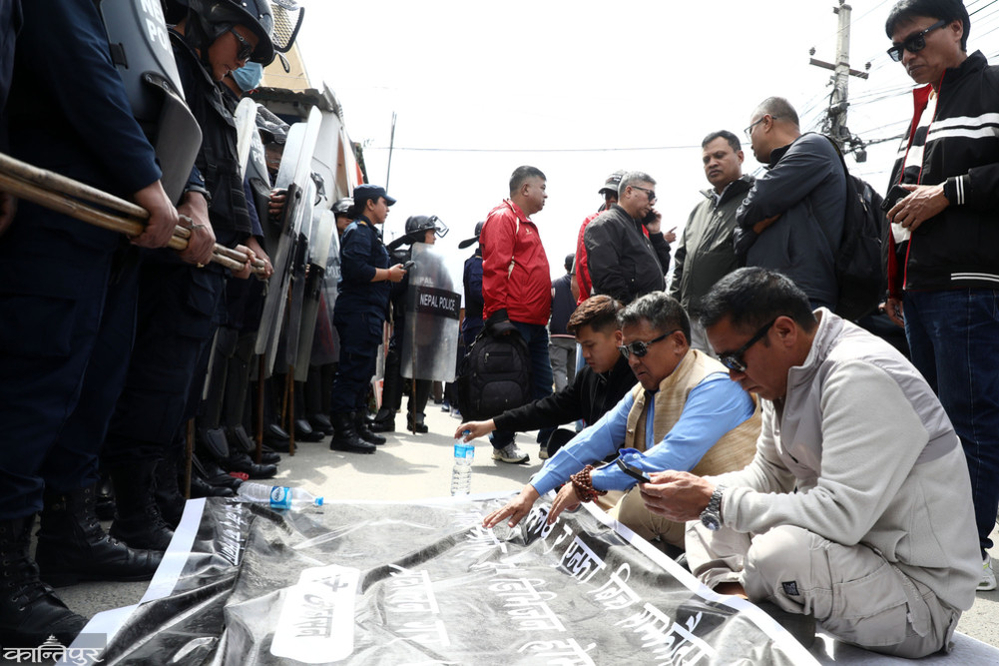
The year 2082 Nepali football was extremely disappointing. In the current situation, Nepali football is at zero. No one can say what will happen tomorrow. For now, the National Sports Council (NSC) has suspended the All Nepal Football Association (ANFA) for three months. The International Football Federation (FIFA) and the Asian Football Confederation (AFC) have considered this as direct third-party interference. The deadline for these two organizations to lift the suspension imposed on ANFA and hold elections has also passed. Sooner or later, such news will come. Its title may be, ‘FIFA bans Nepal.’
When is there no controversy in Nepali football? But this time, if a serious controversy has started, it is the early election announced by the founding party of ANFA. For those who have said to hold this early election, it is okay according to their statute. However, this was not possible after the suspension of the Nakhep. The opponents of the founding party think that early elections are okay, but for this, elections must be held at the level. From the outside, it may seem like this, but the real root of all these disputes, disagreements, and rebellions is the unrest within ANFA that is more than two decades old. Whatever happens, the problem caused by the situation has finally taken its current form.
FIFA thinks that the way the elections are being held is right. A big problem in Nepali football is that whenever someone is in the leadership of ANFA, FIFA thinks it is right, but if the country's laws and regulations interfere, then there is interference from a third party. And then the threat of ban from FIFA and AFC starts to be heard. If he has to step down from the leadership of ANFA, he will again think that FIFA is wrong and the country's laws and regulations are right. And going to court seems equally justified. This is a cycle that has been going on for more than two decades. Only the characters and tendencies have changed.
At this very moment, Nepali football has truly collapsed on the field. Moreover, field football is now at zero. The men's national league has been halted in the middle of the two major tournaments, while the women's Martyr's Memorial League, which had just begun, has also been postponed. The work permits required to play foreign players have complicated the situation. The national team's performance has also been equally poor. Nepal finished last in the four-team group in the third round of the Asia Cup qualifiers. Falling behind Vietnam and Malaysia is acceptable, but losing to a team as strong as Laos is completely unacceptable.
Meanwhile, Nepali football did not want to learn anything from the controversy and confusion of the Nepal Olympic Committee. The way the Olympic Committee led by Jeevan Ram Shrestha amended the statute and held elections, the entire government disagreed with it. The government did not stop there, it not only occupied the Olympic building in Satdobato, but also formed another parallel committee under the leadership of Dhruv Bahadur Pradhan. While that committee was making big talk, it also talked about bringing international support, but that did not happen. It was not even a possibility. No one knows where that committee is now. In the end, the support of the International Olympic Committee was the official one.
That's what happens in football, that's what happens. Now, whatever FIFA and AFC say, that's what happens. No, if we don't want these two big organizations, then domestic football will do whatever it wants. Another form of commentary that has been prepared in the meantime is that Nepali football is really going downhill, now it will be difficult to get up from here and move forward, otherwise it may take a long time. At least according to player Anjan Bista, Nepali football will never die. But all this is education for Nepali sports. Education is for Nepali cricket. As successful as this game is on the field, it is equally weak off the field. Disagreements, disputes and conflicts are rife in the Nepal Cricket Association (CAN).
There is a big allegation that there is no financial transparency within Nepali cricket. On the contrary, ANFA is far ahead in this. Nepali cricket and its leadership should understand that the more the problems start piling up, the more it will spoil the game over time. Nepali cricket must not forget democratic values and must continue in this manner. If Nepali cricket is only more organized, this game will move forward with joy on its path. Isn't this the lesson that the year 2082 has given to Nepali sports? As long as disputes and conflicts continue, not only in football and cricket, but also outside the field, what will happen is the same as in football, it is better not to let this disease remain in cricket.


