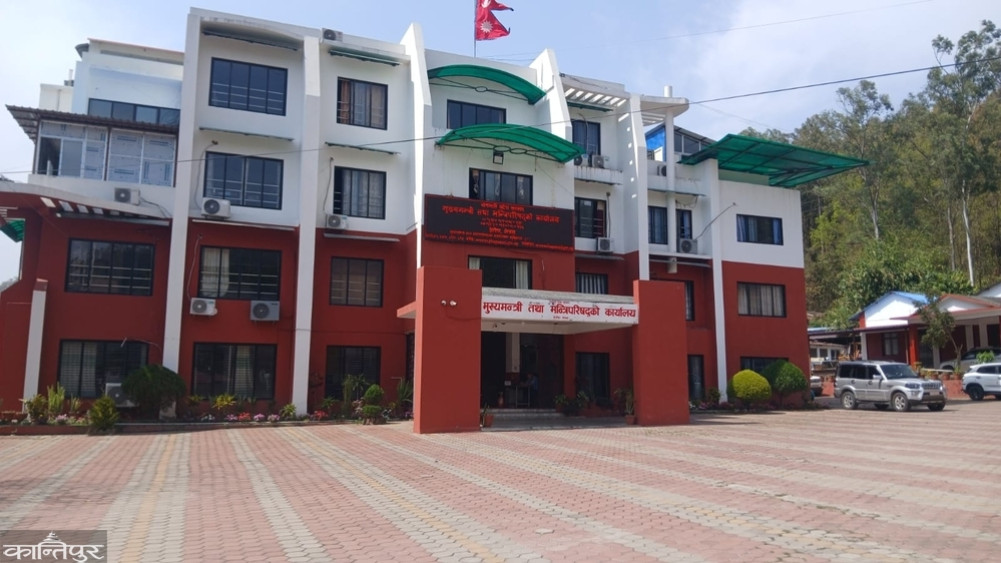
After the agreement between UML and NCP, two UML leaders are being discussed as potential Chief Ministers of Bagmati.
We use Google Cloud Translation Services. Google requires we provide the following disclaimer relating to use of this service:
This service may contain translations powered by Google. Google disclaims all warranties related to the translations, expressed or implied, including any warranties of accuracy, reliability, and any implied warranties of merchantability, fitness for a particular purpose, and noninfringement.
According to the power-sharing agreement between UML and NCP regarding the leadership of provincial governments, UML has secured the leadership of the Bagmati government. After it was decided which party would lead the Bagmati government, two aspirants for the position of Chief Minister have emerged within UML. Both aspirants are actively campaigning for the post of Chief Minister.
According to the written agreement reached on Saturday between UML Chair KP Sharma Oli and NCP Coordinator Pushpa Kamal Dahal, UML will lead the governments of Koshi, Bagmati, and Lumbini provinces, while NCP will lead the governments of Karnali and Sudurpaschim provinces.
With this agreement at the center, UML and NCP’s provincial-level leaders are busy forming a new government in Bagmati. From UML, Jagannath Thapaliya, leader of the Bagmati Provincial Parliamentary Party from Chitwan, and Kiran Thapa, outgoing Health Minister from Bhaktapur, have emerged as the main contenders for Chief Minister.
Both leaders have intensified internal lobbying with the party leadership to secure a decision in their favor. Thapaliya and Thapa have been staying in Kathmandu for the past two weeks to lobby for the position.
UML has not yet made a formal decision on who will be appointed Chief Minister. Both leaders are currently awaiting the leadership’s decision. “Party leader Thapaliya is naturally a contender for Chief Minister. Kiran Thapa, who claims to have fulfilled his responsibilities as Provincial Health Minister well, has also staked his claim to the post,” said a central UML official. “It is natural for both to be contenders for Chief Minister; the party will decide soon.”
Thapaliya, who has also served as Provincial Minister for Economic Affairs, was considered a future Chief Minister when a joint government was formed with the Congress on 9 Saun 2080 (July 25, 2023), based on an agreement to share the leadership for half the term each.
The agreement was between Thapaliya and then Congress Parliamentary Party leader and Chief Minister Bahadur Singh Lama. Another UML leader, Thapa, is also seen as a strong contender for Chief Minister due to his influential image within the party. Thapa, who is close to Party Chair Oli and Party Secretary Mahesh Basnet, has served as Health Minister in the province twice. Thapaliya is also considered close to Oli. Both Thapaliya and Thapa have declared themselves contenders for Chief Minister.
According to the provision that the leader of the parliamentary party becomes Chief Minister, Thapaliya’s claim is straightforward, while if Thapa is to become Chief Minister, he must first be selected as party leader. UML, which had 27 provincial assembly members, now has only 25. After former provincial ministers Prakash Shrestha and Aman Kumar Maske resigned to run as candidates in the last House of Representatives election, UML lost two seats in the provincial assembly.
After the Congress-led government in Bagmati Province fell into a minority, the process of forming a new government has begun. Leaders say that efforts are underway to secure the support of NCP and other parties to form a government under UML leadership. UML and NCP have also been in talks with the Rastriya Prajatantra Party (RPP) regarding government formation.
Of the 110 elected members of the Bagmati Provincial Assembly, six resigned to run as candidates in the last House of Representatives election, so the assembly currently has 104 members. According to this arithmetic, a majority of 53 provincial assembly members is required to form a new government in Bagmati.
In the Bagmati Provincial Assembly, Congress is the largest party with 36 seats. NCP has 26 seats, UML has 25 seats (including the Deputy Speaker). Among other parties, RPP has 12, Nepal Workers and Peasants Party has 3, and Hamro Nepali Party has 2 seats.
If UML and NCP form a government together (51 members), they will still be two seats short. Since UML’s Apsara Chapagain is the Deputy Speaker, support from other small parties is essential to secure a majority during the government formation process. RPP is seen as decisive in this regard. RPP’s provincial parliamentary party leader Uddhav Thapa said the party will decide soon on how to proceed regarding the formation of the provincial government.
Six Chief Ministers, 95 Ministers in Eight Years in Bagmati
The provincial government, which began with seven ministries in Magh 2074 (January 2018), expanded to 14 ministries and has now returned to eight. During this period, there have been six Chief Ministers. So far, 83 different individuals have had the opportunity to serve as Chief Minister, Minister, or State Minister, and with repeated appointments, the total number of ministers has reached 95.
After the first provincial assembly election, on 28 Magh 2074 (February 11, 2018), UML’s Dormani Poudel became the first Chief Minister of Bagmati Province, then known as Province No. 3. UML had a single majority, and the left alliance with the Maoist Centre made the government even stronger.
Poudel ran the government with seven ministries, including the Office of the Chief Minister and Council of Ministers. The number of ministries was not increased during his tenure, but ministers were changed. Keshav Sthapit was dismissed, Rameshwar Phuyal later became a minister, and after the NCP dispute intensified, the Council of Ministers was reshuffled in Baisakh 2078 (April/May 2021).
Poudel, who led the government for about 43 months, remains the longest-serving Chief Minister of Bagmati to date. Disputes within the then NCP, the return of UML and Maoist Centre to their previous status, and power struggles within UML forced him to step down.
On 2 Bhadra 2078 (August 18, 2021), UML’s Astalaxmi Shakya became Chief Minister. Shakya, Nepal’s first female Chief Minister, separated the health sector from the Ministry of Social Development to create a separate Health Ministry. With this, the number of ministries in Bagmati increased from seven to eight. This decision is considered the formal beginning of the trend of splitting ministries in the province.
After Shakya, on 11 Kartik 2078 (October 28, 2021), Rajendra Prasad Pandey of Unified Socialist became Chief Minister through an alliance with Congress, Maoist Centre, and Unified Socialist. There were many coalition partners and many MPs aspiring to become ministers. To manage this, the Pandey government increased the number of ministries from eight to fourteen at once. The province had 14 ministries and an 18-member Council of Ministers, including ministers and state ministers.
After the second provincial assembly election in 2079 (2022/23), Maoist Centre’s Shalikram Jamkattel became Chief Minister on 25 Poush 2079 (January 9, 2023). The government, formed with the support of UML, Maoist Centre, RPP, Unified Socialist, and Hamro Nepali Party, concluded that the 14 ministries during Pandey’s tenure were excessive. A task force led by the Chief Secretary recommended having 9 or 11 ministries, so the Jamkattel government reduced the number from 14 to 11. However, this decision did not last long. After the coalition changed at the center, UML and RPP left the government, and Congress and Unified Socialist joined. Even with 11 ministries, 12 ministers were appointed in the province.
Congress’s Ram Krishna Chitrakar remained a minister without portfolio for about three months due to the lack of a department. To assign him responsibilities, the Ministry of Tourism, Industry, and Cooperatives was split to create the Ministry of Industry, Commerce, Land, and Administration. The number of ministries thus increased from 11 to 12.
During Jamkattel’s roughly one-and-a-half-year tenure, the coalition changed three times. Initially, it was UML–Maoist–RPP, then Congress–Maoist–Unified Socialist, and finally UML–Maoist–Unified Socialist–Hamro Nepali Party. He took a vote of confidence three times and appointed 21 people as ministers at various stages. Although the Chief Minister remained the same, the faces of coalition partners changed repeatedly during this period.
On 8 Saun 2081 (July 23, 2024), Bahadur Singh Lama became Chief Minister through a Congress–UML coalition. At that time, there were 13 ministries in the province. Although Congress and UML agreed on the division of ministries including the Chief Minister, more ministers than ministries were appointed due to internal faction management within Congress.
Congress’s Madhu Kumar Shrestha remained a minister without portfolio for 112 days. To assign him responsibilities, the Ministry of Cooperatives and Poverty Alleviation was separated from the Ministry of Culture, Tourism, and Cooperatives, creating the fourteenth ministry. Thus, Bagmati again had 14 ministries. During his tenure, Lama appointed 18 people as ministers, including himself.
However, Lama’s government was not toppled by the opposition. After the Indra Bahadur Baniya faction secured a majority within the Congress parliamentary party, Lama was removed as party leader. The coalition remained Congress–UML, but only the Chief Minister changed. On 20 Saun 2082 (August 4, 2025), Baniya became the province’s sixth Chief Minister. After Poudel, Shakya, Pandey, Jamkattel, and Lama, Baniya took over the leadership of the provincial government. He is still in office. Baniya formed a 14-member Council of Ministers including himself. In Baisakh 2083 (April/May 2026), the government decided to reduce the number of ministries and merged the 14 ministries into eight from the first day of the new fiscal year, Saun 1 (July 17, 2026).
Six UML ministers resigned on 6 Saun (July 22, 2026). After UML withdrew, the Baniya government was left with the direct support of only 36 Congress MPs and fell into a minority. In eight years of the provincial government, the coalition has changed eight times. “The main reasons for changes in the provincial government are not provincial policies, programs, or public demands, but rather central coalitions, party splits, parliamentary party factions, ministerial power-sharing, and the lust for power,” says advocate Madan Dahal. “Here, power equations are not made for the people or principles; it is the lust for power that keeps changing the equations.”