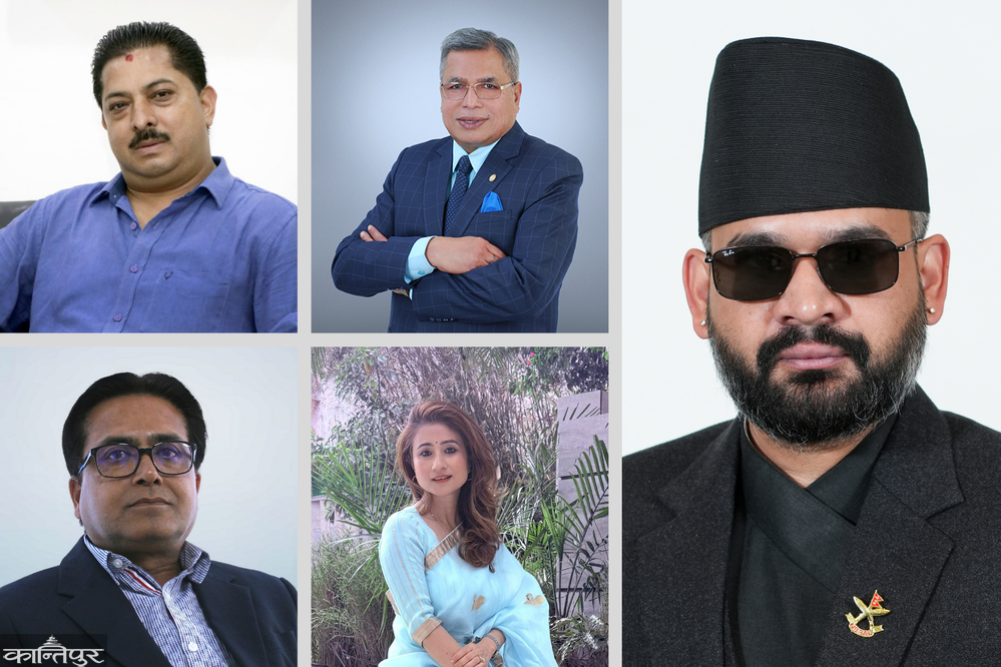
Prime Minister Shah, who met with private sector entrepreneurs on Wednesday, will also hold discussions with construction entrepreneurs on Thursday.
We use Google Cloud Translation Services. Google requires we provide the following disclaimer relating to use of this service:
This service may contain translations powered by Google. Google disclaims all warranties related to the translations, expressed or implied, including any warranties of accuracy, reliability, and any implied warranties of merchantability, fitness for a particular purpose, and noninfringement.
After crossing the hundred-day mark of leading the government, Prime Minister Balendra Shah has finally begun dialogue with the private sector. Until the hundredth day of forming the government, Prime Minister Shah had not engaged in significant dialogue with stakeholders from the country’s private sector, political, or diplomatic spheres, but he is now preparing to initiate regular discussions and consultations.
Previously, he had held talks twice with ambassadors from various countries, and on Tuesday, he met with Masatsugu Asakawa, President of the Asian Development Bank (ADB), at the Office of the Prime Minister and Council of Ministers. Immediately afterward, on Wednesday, he held talks with businesspeople from Nepal’s private sector. Similarly, discussions with construction entrepreneurs have been scheduled for Thursday.
The meeting between the private sector and the Prime Minister was coordinated by Member of Parliament Bidushi Rana. Rana stated that, in line with the government’s and the Prime Minister’s priority on economic prosperity, she coordinated with representatives of umbrella organizations from the private sector.
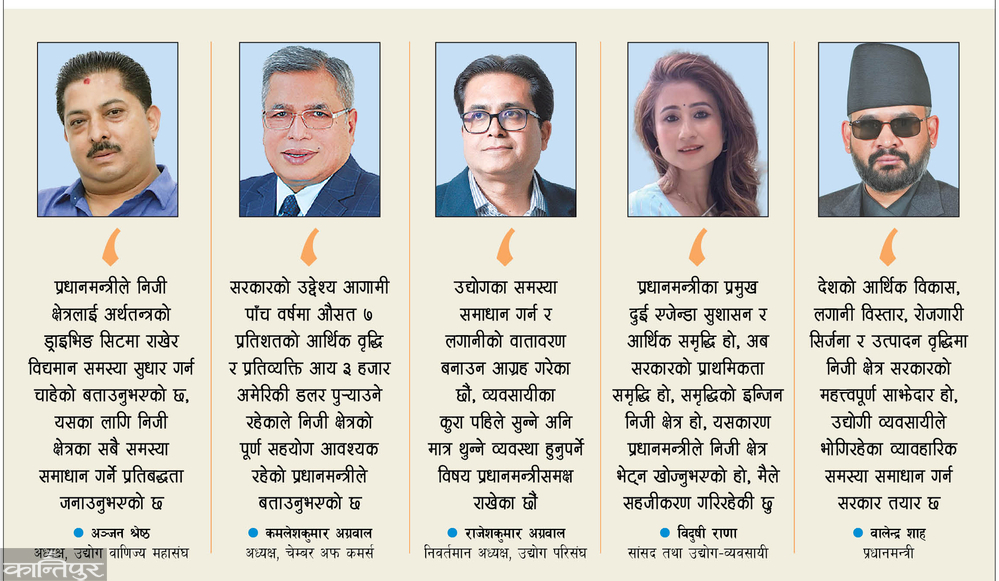
“The Prime Minister’s two main agendas are good governance and economic prosperity. In the first hundred days, the groundwork for good governance has been laid. During this period, individuals involved in corruption and irregularities have been investigated, arrested, and prosecuted,” she said. “Now, the government’s priority is prosperity. The engine of prosperity is the private sector. That is why the Prime Minister sought to meet with the private sector. I only facilitated the process.”
Although the first day’s meeting was with umbrella organizations of the private sector, she informed that this process would become regular and that the Prime Minister also plans to meet representatives from other sectors. “In the coming days, the Prime Minister has scheduled regular meetings with various organizations from the private sector. He will meet people from all sectors, including construction, hotel and tourism, information technology, and manufacturing,” she said.
Rana said that the meeting, initially scheduled for half an hour, lasted about two hours. “The Prime Minister listened with great interest and asked many questions in between,” she said. “He told the private sector not to bring only problems but also solutions.” The Prime Minister has stated that he will continue meetings with the private sector. Since he may not always be available for regular meetings, the Prime Minister has instructed the formation of an informal committee comprising representatives from his secretariat and the private sector, according to Rana. “At least once a month, this committee will meet to discuss the problems and solutions of the private sector and report back to him,” Rana said.
The Prime Minister’s secretariat also informed that Prime Minister Shah has now begun dialogue not only with diplomats but also with individuals and institutions from various sectors in Nepal. In this context, the Prime Minister’s Office stated that discussions with construction entrepreneurs have been scheduled for Thursday. According to a member of the Prime Minister’s secretariat, the purpose of meeting with the private sector and construction entrepreneurs is to accelerate development works and discuss the implementation status of economic reform plans.
Regarding the discussions with the private sector and construction entrepreneurs, the secretariat member said, “The Prime Minister is holding dialogue with representatives of the private sector to boost their morale, and tomorrow there is a meeting with construction entrepreneurs to discuss how to work in the field of development.” Nicholas Pandey, President of the Federation of Contractors’ Associations of Nepal, said he was very enthusiastic about the discussion with the Prime Minister. “We have received an invitation from the Prime Minister’s Office, and we are very excited to have the opportunity to present our issues directly to the Prime Minister,” he said.
Anjan Shrestha, President of the Federation of Nepalese Chambers of Commerce and Industry, said that Wednesday’s meeting with the Prime Minister included open discussions on the problems of the private sector, the current state of the economy, and possible solutions. “The Prime Minister said he wants to put the private sector in the driver’s seat of the economy to address existing problems, and he has expressed his commitment to resolving all issues of the private sector,” he said.
During the meeting, businesspeople raised issues such as some industrialists being held in custody, the private sector being in fear, and a lack of confidence. In response, President Shrestha said that Prime Minister Shah stated that although some industrialists are under investigation based on allegations of wrongdoing, the government’s overall stance toward the private sector is positive and that the government’s policy is to encourage the private sector for further investment.
Quoting the Prime Minister, President Shrestha said, “It is not the government’s intention to arrest entrepreneurs and businesspeople, and our economy cannot move forward by arresting them; we are clear on this.” He said he requested the Prime Minister to introduce an “anticipatory law.” “If crimes are seen in any economy, until they are proven, there should be a provision for anticipatory bail,” he said. “If the court provides for advance bail, entrepreneurs and businesspeople can work in a dignified environment. We have suggested that there should be an investigation first, and only after guilt is proven should there be prosecution.”
He said the Prime Minister was positive on this matter. “It is neither our intention, policy, nor motive to treat entrepreneurs and businesspeople in an undignified manner by arresting them,” Shrestha said. “The Prime Minister said that you are already aware of the charges against the industrialists under investigation, those who make mistakes will not be spared, and the innocent need not fear.” According to Shrestha, the Prime Minister said the government is positive about amending legal provisions as needed to boost the private sector’s confidence.
Kamlesh Kumar Agrawal, President of the Chamber of Commerce, said the government is ready to solve all existing economic problems. “We raised issues such as the inability to increase credit flow, declining confidence in the private sector, stagnant investment, money piling up in banks, industries operating at less than half capacity, and the continuous decline of the stock market,” he said. “The Prime Minister listened to all our concerns attentively and sought suggestions for solutions to each issue. The Prime Minister is very positive toward the private sector.”
Agrawal, President of the Chamber, said that this was the first time since the formation of the new government that a lengthy discussion was held with the Prime Minister, including the presidents and officials of three private sector organizations. “The discussion covered how to move Nepal’s economy forward, how to end the current economic stagnation, how to boost the morale of the private sector, and what factors have caused the decline in morale, and how to address them,” he said. “The Prime Minister listened carefully to all the issues raised by the private sector.”
After hearing the private sector’s concerns, the Prime Minister stated that the government’s objective is to improve the economy by promoting the private sector and that such interactions will be continued in the future. “Past shortcomings have prevented the economy from moving forward. Nepal is a country with immense potential. Our goal should be to become the country with the highest per capita income in South Asia, but the economy is currently sluggish. Natural resources have not been utilized, jobs have not been created, and productive industries have not reached capacity. Now, the government is working to solve the problems seen in all sectors,” Agrawal said.
According to him, Prime Minister Shah said the government’s goal is to achieve an average economic growth of 7 percent and per capita income of 3,000 US dollars in the next five years, and that full cooperation from the private sector is necessary to achieve this. The Prime Minister also urged the private sector to openly present the problems they face in achieving these goals. Rajesh Kumar Agrawal, immediate past president of the Confederation of Nepalese Industries, said they requested the Prime Minister to solve industrial problems and create an investment-friendly environment. “We raised issues such as controlling unauthorized trade, constructing and operating industrial zones under public, private, and partnership (PPP) models, decriminalizing commercial laws, and ensuring that there is a provision to hear cases before detaining anyone,” he said.
Similarly, Agrawal said they raised issues with the Prime Minister such as timely government payments, equivalence of quality standards and imports, prohibiting customs facilities for importing goods produced in Nepal, various taxes imposed on industries, and coordination among all three levels of government. He said the positive response from the Prime Minister has boosted the private sector’s enthusiasm.
Before the budget was drafted, Prime Minister Shah had held collective meetings with Members of Parliament from the House of Representatives by province and, on 3 Baisakh, held discussions with provincial chief ministers. After that, the program of collective or individual meetings had stopped, but the Prime Minister has now resumed them. According to a notice issued by the Prime Minister’s secretariat, in Wednesday’s meeting with businesspeople from the private sector, Prime Minister Shah discussed issues related to industry and business, the investment climate, and economic reforms.
The secretariat stated that Prime Minister Shah has begun dialogue with the private sector to make the country’s economic activities dynamic and robust, facilitate the operation of industry and business, create an investment-friendly environment, remove policy and procedural obstacles, boost the morale of the private sector, and create jobs and increase production. During the discussion, representatives of the private sector suggested the need for promoting industry and business, expanding investment, ensuring policy stability, simplifying service delivery, and establishing regular and result-oriented dialogue between the government and the private sector.
The discussion was attended by Anjan Shrestha, President of the Federation of Nepalese Chambers of Commerce and Industry; Ujjwal Kumar Shrestha, Chair of the Industry Committee; Rajesh Kumar Agrawal, immediate past president of the Confederation of Nepalese Industries, and Director General Dr. Ghanshyam Ojha; Kamlesh Kumar Agrawal, President of the Nepal Chamber of Commerce; and Senior Vice President Deepak Malhotra.