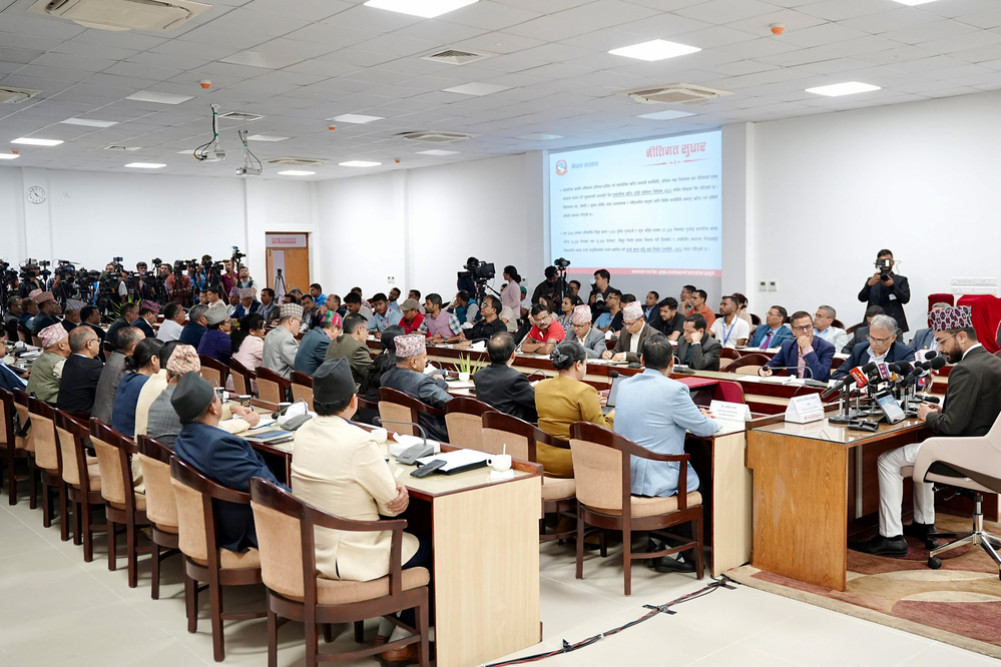
The government on Saturday made public the achievements of its first 100 days, covering everything from the recommendation for the appointment of the Chief Justice to corruption control, governance reforms, digital governance, and changes in public service delivery.
We use Google Cloud Translation Services. Google requires we provide the following disclaimer relating to use of this service:
This service may contain translations powered by Google. Google disclaims all warranties related to the translations, expressed or implied, including any warranties of accuracy, reliability, and any implied warranties of merchantability, fitness for a particular purpose, and noninfringement.
The government has presented the protection of public land, the decision to move forward with the implementation of past high-level investigation reports, the recommendations of the Chief Justice and Chief Election Commissioner by accelerating the work of the Constitutional Council, and the intensification of investigations against corruption and financial crimes as the main achievements of the first 100 days. However, since there are high public expectations for the government formed with a parliamentary majority of nearly two-thirds, it is being commented that most of these works are limited to policy announcements and processes, and results are yet to come.
At a press conference organized at the Office of the Prime Minister and Council of Ministers on Saturday to mark the completion of 100 days, government spokesperson and Minister for Education Sasmit Pokharel claimed that significant achievements have been made in administrative reform, good governance, corruption control, public service delivery, legal reform, and the economic sector.
The first cabinet meeting held on Chaitra 13, 2082 immediately after the formation of the government, had made public the 100 agendas for governance reforms. The government had declared the first year as the 'base year for governance reforms' and pledged to prioritize administrative, political, and institutional reforms.
According to the same agenda, the government has stated that the trade union-related system has been abolished to make public administration effective, regular monitoring of government offices has been increased, and 6,145 employees have been recommended for action after inspecting 787 offices. The government has also presented the distribution of driving licenses as an achievement, stating that 2.375 million licenses have been printed and 2.9 million will be issued by mid-Ashar.
The government had made public 100 agendas for governance reforms in the first meeting of the Council of Ministers on 13 Chaitra 2082. With the aim of building the basis for long-term governance transformation, there was a commitment to move the first year forward as the base year for governance reforms.
The government has stated that the work has been done by prioritizing corruption control and good governance. Minister Pokharel said that the commission, formed to investigate the assets of political office-bearers and high-ranking employees who held public positions from 062/63 to 2082/83, has so far collected more than 11,000 asset details and complaints.
Similarly, it is mentioned that the investigation into financial crimes and illicit wealth has been intensified through the Money Laundering Investigation Department. Minister Pokharel said that the Money Laundering Department has filed seven cases and made 101 natural and legal persons defendants, claiming a sum of Rs 118 billion.
The government has mentioned the decision to implement the reports of various high-level investigation commissions and committees formed in the past as an achievement in the 100 days. The government's achievements include the Central Investigation Bureau (CIB) of Nepal Police investigating allegations of misuse of property of Nepal Children's Organization and Children's Temple, renting out land, embezzlement of government property, and sending children abroad illegally as adopted sons and daughters.
Similarly, the process of implementing the report of the high-level committee on the Ncell share purchase-sale and ownership transfer dispute has been taken forward, and the government claims that the CIB is continuing to investigate the fraud, criminal, and breach of trust cases in the said case.
The government has described the issuance of the National Ethics Policy as another important achievement to promote good governance. The issues of ethics, code of conduct, transparency, accountability and conflict of interest control in public bodies have been covered. The government is confident that institutional good governance will be promoted in government, private and non-government sector organizations with the implementation of the policy. Accordingly, it has been mentioned that the Ministry of Home Affairs, Finance, Culture, Land, Women, Youth and Labor have issued the Employee Code of Conduct-2083 and have started strict implementation and monitoring. Minister Pokharel said that the government has adopted a policy of keeping a close watch on activities that seek to gain personal benefits by misusing their positions and bringing those involved in such activities to justice.
The government has also linked structural reforms with corruption control to maintain austerity in public expenditure. The government says that the process of abolishing, merging and restructuring boards, committees and bodies that are unproductive, have dual functions and create unnecessary financial burdens has been started.
The government has also linked structural reforms to corruption control to maintain austerity in public expenditure. Minister Pokharel said that the work of abolishing, merging and restructuring unproductive, dual-purpose boards, committees and bodies that create unnecessary financial burdens has been done in the meantime. According to him, so far, 31 bodies have been abolished, 6 departments have been merged, 6 bodies have been transferred and 18 bodies have been restructured.
The reduction of 22 ministries to 18 has saved 20 billion rupees annually, and the submission of the Public Procurement (Second Amendment) Bill in Parliament to ensure good governance by ensuring more competition and transparency in public procurement procedures, processes and decisions has also been taken as a significant achievement in the first 100 days.
It has been claimed that 672 government vehicles and motorcycles that were being used illegally have been brought back to control the misuse of government vehicles.
Claim that public service delivery is becoming citizen-friendly
To make public service delivery citizen-friendly, a campaign has been launched to deliver services such as citizenship, passport, driving license and others to the doorstep, citizenship and passport-related services have been expanded through post in 75 districts, a system has been started to deliver driving licenses to homes, and the 'Quality Assurance Standards for Services Provided by Local Levels-2083' has been issued for the first time to ensure the quality of services provided by the local level, Minister Pokharel mentioned.
The government has stated that it has taken forward many reforms with the goal of making public services completely digital. An online pre-enrollment and appointment system has been implemented for passports, online mortgage withdrawal and redemption from banks and financial institutions has been made mandatory, arrangements have been made to download certificates including police character certificates, permanent account numbers through the Nagarik app, and company registration, tax administration, immigration, surveying and land revenue services have also been gradually linked to the online system.
The government has made Hello Government more effective by expanding the grievance management system to the federal, provincial and local levels. 3,770 offices of all three levels have been integrated into an integrated system and arrangements have been made to monitor the progress of grievance resolution of all ministries in real-time. The Ministry of Home Affairs has announced the launch of a 24-hour national citizen assistance and grievance management system.
The government has also claimed that preparations are being made to bring bank accounts, digital wallets, share investments, etc. into an integrated digital asset monitoring system and that more than 200,000 illegal betting websites and domains have been closed.
The government has mentioned that it has collected 1.233 million applications in the informal land information system for the management of landless Dalits, landless squatters and unorganized settlers and prepared digital details. While there is criticism that it has evicted squatters, the government has said that it has started distributing land titles to landless citizens, covering up this.
The government has stated that 29 landless citizens have received land titles so far, and 388 families removed from risky settlements in Kathmandu have been accommodated in 7 different holding centers and provided with food and shelter. 193 displaced families have been provided with a lump sum rehabilitation allowance of Rs 25,000 per family, and families of up to 4 members who were removed from 12 Baisakh to 20 Baisakh have been provided with relief of Rs 15,000 per month and an additional Rs 2,000 per member for 3 months if they have more members.
Preparations to submit a report on the constitutional amendment
The task force formed by the government in connection with the constitutional amendment is preparing to submit a report to Prime Minister Balendra Shah within the month of Ashar. The government had formed a constitutional amendment task force under the coordination of the Prime Minister's political advisor Asim Shah on 16 Chaitra.
The task force is responsible for preparing a discussion paper on the constitutional amendment. The first cabinet meeting held on Chaitra 13, immediately after Balendra Shah was appointed as the Prime Minister, had made public 100 agendas related to governance reforms. It mentioned that a 'Constitutional Amendment Debate Paper' would be prepared to build a national consensus on constitutional amendment on issues including the country's long-term political and institutional reforms, electoral system, etc. The agenda stated that the debate process for constitutional amendment would be participatory, transparent and fact-based.
Coordinator Shah had answered questions about constitutional amendment at the press conference. He said that the task force is working and will submit a report by mid-Ashar.
'We have discussed with various stakeholders, constitutional experts and political parties,' he said. 'We are now almost at the stage of writing the report. We will submit a report to the Prime Minister by mid-Ashar.'
The task force has taken suggestions from various parties regarding constitutional amendment. However, the task force has not sought political consensus on which articles of the constitution should be amended or what topics should be included.
Government spokesperson Minister Pokharel said that 17 working procedures have been approved and implemented for policy reforms, 87 action plans, 1 work framework, 1 order, and 14 study reports have been brought.
Similarly, 14 bills have been drafted or agreed to be drafted, and 4 laws and 6 regulations have been brought. An ordinance has been issued to organize the work, duties and powers of the Constitutional Council, and it has been said that the work of the council has become effective after the issuance of the ordinance. The appointment of the Chief Justice on the recommendation of the council, as well as the recommendation for the appointment of the Chief Election Commissioner and commissioners, are mentioned in the 100-day achievements.
Minister Pokharel mentioned that the process of appointing officials on the basis of competition has been started by removing more than 1,500 officials who received political appointments during the previous government. 'The appointments being made in the ministries are being made transparently through open competition. The manner in which applications are submitted is transparent.' Further, if there is any problem in the appointment process, the concerned ministry will make it clear,' he said, 'It has been done in a manner that is as inclusive as possible . However, since it was done through open call and competition, it has more of a meritocracy than inclusiveness .'
A press conference was held at the Office of the Prime Minister and Council of Ministers at 3 pm on Saturday to inform about the achievements made by the government in the last 100 days . The secretaries of the ministry and media personnel had reached the meeting room by 3 pm . However, Minister Pokharel, who was given the responsibility of making the government's achievements public, arrived an hour late .
The main work done in the last 100 days