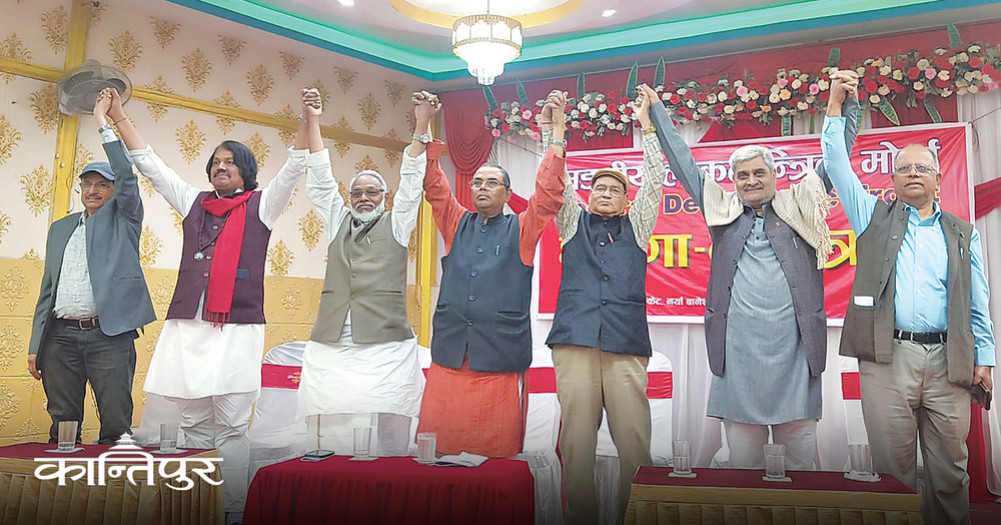
After the Rashtriya Swayamsevak Sangh (RSS) proposed to dissolve the provincial assembly at the Chitwan general convention, Madhesh-centric parties have expressed objections and demanded a formal statement.
We use Google Cloud Translation Services. Google requires we provide the following disclaimer relating to use of this service:
This service may contain translations powered by Google. Google disclaims all warranties related to the translations, expressed or implied, including any warranties of accuracy, reliability, and any implied warranties of merchantability, fitness for a particular purpose, and noninfringement.
After the Rashtriya Swatantra Party (RSP) put forward the debate on abolishing the provincial assembly at the Chitwan general convention, Madhesh-centric parties have taken notice. They have formally demanded the opinion of the National Independent Party and the government.
The parties that have been conducting major agitations in the Madhesh Terai for federalism have objected and urged the RSP to postpone the proposal. They say that they will protest if the government formally moves forward the proposal to abolish the provincial assembly. Although the Janata Samajwadi Party, Nepal, Janmat, and Nagarik Unmukti Party have agreed in principle on the restructuring of the provinces, they have said that abolishing the provincial assembly will weaken federalism.
JSP Nepal Chairman Upendra Yadav has said that he will protest if there is an attack on the federal democratic republic, provincial system, and inclusiveness. He said that ‘federalism is an achievement achieved through the sacrifices of hundreds of Madheshi people’ and that federalism cannot happen without a provincial assembly. Chairman Yadav said that the proposal made at the RSVP general convention is not the government's, so the government's decision is important. 'We will discuss the constitutional amendment after the government brings a concrete proposal,' he said.
Janmat Party Chairman CK Raut said that it was political dishonesty to bring a proposal at the general convention against Prime Minister Shah's statement made in Janakpur during the election rally. 'The people of Madhesh won the RSVP with the expectation of strengthening federalism.' He said, 'We are spreading information that the proposal to abolish the provincial assembly is wrong because federalism is necessary for rights, development, and equality.' He argued that since the provincial assembly is an integral part of the federal democratic republic, democracy would cease to exist if it is abolished. 'Other parties (Congress, UML, NCP) should understand that democracy cannot exist without the provincial assembly,' he told Kantipur.
Laxman Lal Karna, a member of the 2072 constitution drafting committee and leader of JSP Nepal, said that provinces without provincial assemblies would be meaningless. ‘While the government task force is discussing the constitution amendment debate paper, the proposal to abolish the provincial assembly is serious. Provinces without provincial assemblies cannot function. It kills the essence of the province,’ he said, ‘The provincial assembly can be remodeled. We can think about the difficulties of the province.’ He said that he would discuss the proposal to abolish the provincial assembly with the government task force. ‘We will discuss this with the government task force,’ he said, ‘If a proposal to abolish the provincial assembly comes, there will be a movement rejecting it,’ he added. The constitution amendment task force, coordinated by Prime Minister Shah’s political advisor Asim Shah, is also scheduled to discuss with party leaders from the Congress, UML, CPN, JSP Nepal and other parties on Thursday itself.
Madhesh-centric parties say that the proposal to abolish the provincial assembly, thereby weakening the federalism achieved through people's movements, armed struggles, Madhesh, Tharu, and tribal movements, has raised suspicions about the intentions of the Rashtriya Swayamsevak Sangh (RSS). They are preparing to discuss the RSSS's proposal internally and form a common opinion as much as possible.
At an election rally held in Janakpur on Magh 5, Balendra Shah had said that the provinces do not have to go to Kathmandu to seek rights. He had said that the provinces will be empowered. 'You do not have to go to Kathmandu to demand rights, go visit Pashupati and Swayambhu,' he had said in Maithili. But in order to disrupt this, a proposal to abolish the provincial assembly was presented at the RSSS general convention.
RSSS Vice President Swarnim Wagle had submitted a proposal to restructure federalism including abolishing the provincial assembly. His proposal was passed by the general convention as a supplementary proposal to President Ravi Lamichhane. ‘The RSVP has already put forward the agenda of governance reforms such as a directly elected Prime Minister, a system where MPs do not become ministers, a one-third reduction in the number of non-party local levels and 753, restructuring of federalism including the abolition of the Provincial Assembly, radical reforms of other constitutional bodies including the Judicial Council, and transparent funding of recognized political parties,’ Wagle’s report said.
But President Lamichhane’s political report mentions restructuring the Provincial Assembly and the provincial government. ‘We are in favor of restructuring the Provincial Assembly and the provincial government,’ the report said.
RSVP General Secretary Bipin Acharya had said that there should be a broad debate on restructuring the provinces. ‘After intensive discussions on what its courses are and what the terms are, let’s finally move on to the next decision. There should be a broad debate on the issue of system change,' he said in an interview given to Kantipur in the second week of Ashad. 'There is no mention anywhere in the document presented by the chairman that the provinces should be abolished. There was some 'confusion' on the issues presented in the vice-chairman's report. It should be understood that whatever issues have come up in the chairman's report is the party's final line.'
JSP Nepal leader Jitendra Sonal, who is also a member of the Madhesh Provincial Assembly, said that since federalism was established through the movement, struggle and sacrifice of the oppressed Madhesi, Janajati, Muslim and Tharu communities, he would oppose any action to weaken it. 'Provinces have an identity, rights and responsibilities of the people have been protected,' he said, 'Abolishing the provincial assembly will lead to another conflict.'
Stating that there were weaknesses in the past to strengthen the provinces, he said that the upcoming constitutional amendment should make it even stronger. ‘The people of Madhesh-Terai won the election to strengthen the provinces,’ he said. ‘The RSVP should play a role in strengthening the provincial assembly, but it should not weaken it. In the past, parties have failed to strengthen the provinces.’
Resham Chaudhary, patron of the Civil Liberation Party Nepal, also says that abolishing federalism, which came about through a great movement, sacrifice and renunciation, is unthinkable. ‘Discussions are being held about the model of provinces. To strengthen it, the number of provincial assembly members can be reduced,’ he said. ‘The proposal to abolish the provincial assembly will cause problems.’
He said that the path of constitutional amendment can be taken to make the functioning of the union, provinces and local governments more effective. ‘No one should be against federalism now,’ he said. ‘A proposal to abolish the provincial assembly was made in the RSVP general convention, but the government has not officially moved forward. It is not appropriate to move forward with the proposal.’