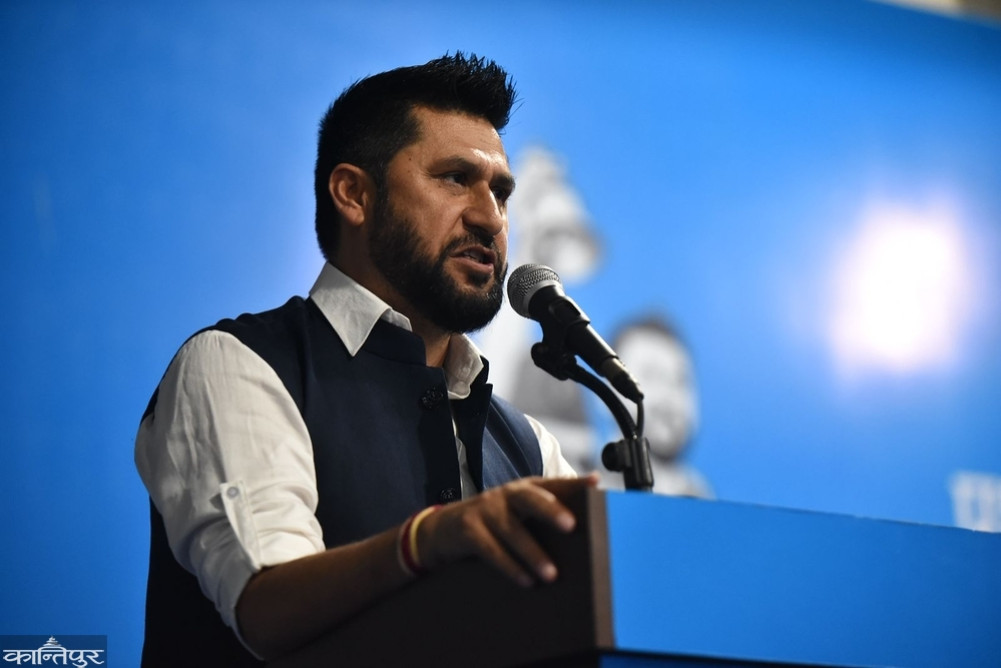
Leaders say that while there is an option to improve the mixed electoral system, the Congress and UML are not in favor of fully proportional representation.
We use Google Cloud Translation Services. Google requires we provide the following disclaimer relating to use of this service:
This service may contain translations powered by Google. Google disclaims all warranties related to the translations, expressed or implied, including any warranties of accuracy, reliability, and any implied warranties of merchantability, fitness for a particular purpose, and noninfringement.
The debate on this issue has started in political circles after President Ravi Lamichhane proposed a directly elected executive as the country's form of government at the first general convention of the National Independent Party (NISP). Lamichhane formally proposed this proposal through the general convention at a time when the government was discussing with political parties and other stakeholders regarding the amendment of the constitution.
Earlier, the then CPN (Maoist) and the Madhesi Janadhikar Forum had a heated debate in the Constituent Assembly on whether to elect a directly elected head of state or a prime minister from the parliament. When the constitution was promulgated in 2072, the Maoists had a different opinion after the parliament agreed to elect the prime minister, while the forum boycotted the parliament.
In the general convention, Lamichhane also proposed a fully proportional electoral system along with the form of government. Previously, the Maoists and the Janata Samajwadi Party (JSP) Nepal have also been proposing a similar proposal. However, the major parties, Congress and UML, have stood in favor of a modified or improved parliamentary system while maintaining the basic provisions of the constitution. With these two issues formally entering the general convention of the Rashtriya Swayamsevak Sangh (RSS), it is expected that further debate will focus on the agenda of constitutional amendment.
The Rashtriya Swayamsevak Sangh (RSS) has adopted a policy of standing in favor of a directly elected chief executive despite securing a two-thirds majority under the current electoral system. ‘We have some different views on the constitution, which we have been holding since the party’s inception.’ Lamichhane’s political report states, ‘Instead of the current extremely expensive electoral system, we are in favor of a fully proportional electoral system, which ensures representation of all communities.’
In addition, the Rashtriya Swayamsevak Sangh (RSS) has also put forward a proposal to make the National Assembly non-partisan. ‘We are in favor of making the current National Assembly a non-partisan expert assembly and making the Vice President the Speaker,’ Lamichhane’s report states.
Former RSP joint general secretary Bipin Acharya said that the political proposal presented by newly elected President Lamichhane at the general convention will be discussed extensively and taken forward. ‘We will discuss this proposal of the president in detail and make it more prosperous,’ he told Kantipur. ‘A comprehensive discussion is necessary on whether the president will be directly elected or the prime minister when amending the constitution.’
Although the RSP has a strong presence in the House of Representatives, it does not have any MPs in the National Assembly, where the NCP has 17 seats. It is expected that the RSP MPs will contest the National Assembly elections to be held after the results of the local level elections in Baisakh. The RSP did not participate in the last local level and provincial elections, so it was not in a position to be a candidate in the National Assembly.’
The main opposition party, the Nepali Congress, is in favor of amending the constitution in a way that does not compromise on democracy, the characteristics of the Nepali state, republic, federalism, citizen supremacy, a multi-party parliamentary system based on multi-ethnic, multi-religious, multi-cultural and pluralism, separation of powers and an independent judiciary. It has stated that the constitution can be strengthened only by basing itself on basic values such as freedom of expression and press, rule of law, proportional inclusive principle, open society and human rights. 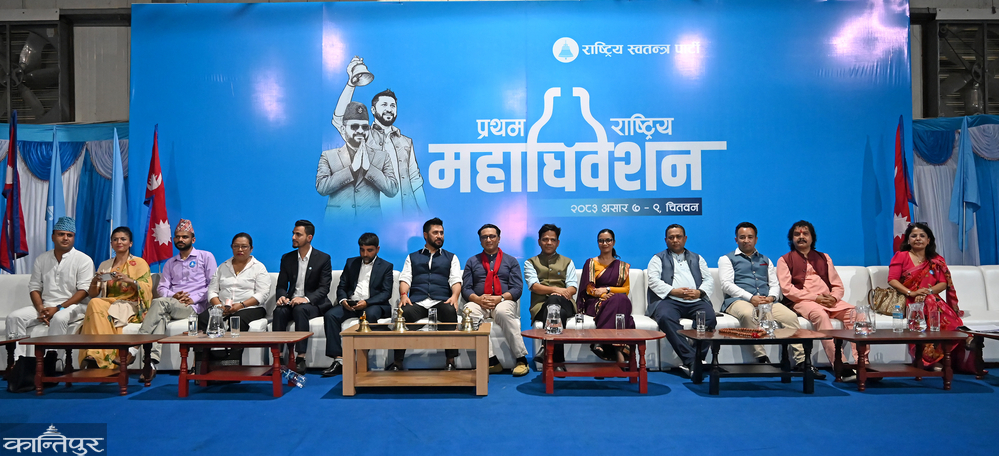
Pushpa Bhusal, Vice President of the Nepali Congress and Coordinator of the Constitution Amendment Task Force, said that the current parliamentary system of electing the Prime Minister would be appropriate. She argues that the system would be institutionalized if the elected MPs from the people elect the Prime Minister. 'The parliamentary system has been established according to our social structure and the governance system should be in accordance with that.' Therefore, this parliamentary system is the most appropriate,' she said, 'After forming a government based on this constitution, it is necessary to institutionalize the parliamentary system in a way that makes it stronger.'
She mentioned that since the issue of the direct executive head has been widely debated during the constitution-making process by the Constituent Assembly, it is not relevant now. 'There was a discussion when the Constituent Assembly made the direct executive, it is not relevant now. It is necessary to institutionalize this constitution in a strong way,' she added, 'We have not thought of such an amendment now. The parliamentary system is the one that gets closest to the people.' She made it clear that the Congress is in favor of strengthening the constitution to increase the inclusive ratio, provide good governance in the country, and prepare the basis for prosperity.
Congress and UML are in favor of a reformed parliamentary system. There was even a discussion during the coalition government to raise the 'threshold' required for a national party to 5 percent in the electoral system for political stability. UML Secretary Padma Aryal said that the discussion on constitutional amendment will be based only on the basic issues of the constitution. She claimed that political stability is possible with the current form of government and electoral system. She reiterated that political stability can be brought about by reforming the parliamentary system itself. 'The electoral system can be further enriched, but the current system is not weak, we are in discussions to strengthen it,' she said.
Although there is an option to reform the mixed electoral system, the leaders say that the Congress and the UML are not in favor of full proportional representation. 'The threshold can be discussed under the mixed electoral system. The current electoral system can be made more proportional,' added Congress leader Bhusal, 'Trying to change the parliamentary system itself means weakening the constitution.' She clarified that the Constitution Amendment Task Force will prepare a report on this basis.
RSP proposal: Directly elected executive, non-partisan national assembly
Wishing the Rashtriya Swayamsevak Sangh (RSS) general convention held in Chitwan on Sunday, NCP coordinator Dahal had stated that there are similarities between the NCP and the RSS on several issues. 'We have broken the continuity and set a political path. We are getting closer on the agenda of social transformation,' Dahal's congratulatory letter said. Our political culture has not become strong. Therefore, there is a risk that the direct executive chief will misuse his power and become autocratic. -Professor Bhimnath Baral
JSP Nepal leader Manish Suman said that while amending the constitution, he would be in favor of a directly elected executive prime minister and a fully proportional electoral system. 'The people should be able to elect the directly elected executive chief themselves.' Due to the division of the party, sometimes the government is formed from the parliament against the wishes of the people,' he said. 'Political stability is maintained only if there is a directly elected head of state or head of government.'
He believes that a fully proportional system is more appropriate as the mixed electoral system is expensive. 'The current electoral system has become very expensive.' If there is a fully proportional system, it will be free from 'money and muscle' (money and muscle),' he said, 'it will be more inclusive and healthy.'
Former Prime Minister Baburam Bhattarai, who has been advocating for a directly elected executive president and a fully proportional system since the Constituent Assembly period, said that if the constitution is amended, there will be political stability and the government will be effective. 'It is most appropriate to have a directly elected executive president.' A directly elected head (prime minister) alone, as the Rashtriya Swayamsevak Sangh (RSS) has said, does not provide a complete solution,' he said, 'a directly elected presidential system provides political stability.'
He argues that the government can work effectively if the fully proportional electoral system further enriches inclusivity, discourages expensive electoral systems, and has a system for non-parliamentary ministers. 'Parliament becomes functional only to make necessary laws.' "If there is a system of non-parliamentary ministers, the government can focus on its work," Bhattarai added, "The current election system is very expensive and unhealthy, and full proportional representation discourages it."
Bhimnath Baral, a professor of political science at PN Campus Pokhara, said that there is a risk of a directly elected chief executive abusing his power and authority and becoming autocratic. He said, "The political culture is not strong here. Therefore, there is a risk of a direct chief executive abusing his power and authority and becoming autocratic."