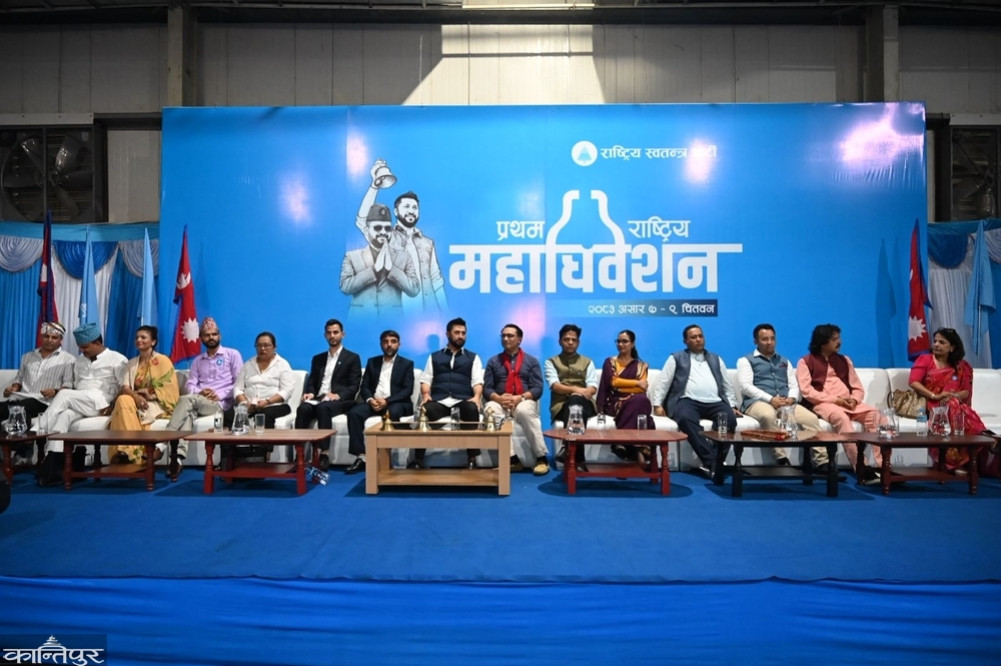
In the proposal presented by party Vice President Swarnim Wagle, the agenda for debate includes restructuring of federalism including the abolition of provinces, party-less local levels, and reducing the number of local levels by one-third.
We use Google Cloud Translation Services. Google requires we provide the following disclaimer relating to use of this service:
This service may contain translations powered by Google. Google disclaims all warranties related to the translations, expressed or implied, including any warranties of accuracy, reliability, and any implied warranties of merchantability, fitness for a particular purpose, and noninfringement.
The National Independent Party (NIP) has made it clear that it is in favor of a democratic republican system of governance and does not consider any alternative to it. Stating that the democratic republican system of governance is intertwined with both Nepal's original political experience and the historical development of world politics, the NIP has emphasized its strengthening.
In addition, the agenda for debate has made the restructuring of federalism including the abolition of the provincial assembly, party-free local levels, and a one-third reduction in the number of local levels.
Vice President and Finance Minister Swarnim Wagle has presented an economic and political proposal at the party's first general convention in Bharatpur, Chitwan. The proposal states that the policy of a liberal economy with social justice will be pursued while remaining committed to the equitable progress of all Nepalis.
The proposal states that the NIP is a pluralist democratic party that believes in a liberal economy. The Rashtriya Swayamsevak Sangh (RSS) has positioned itself in favor of good governance based on law and accountability within a fully democratic republican system of governance that guarantees individual freedom and fundamental rights. The party has also stated that its objective is to build an equitable and inclusive society.
It has emphasized the amendment or rewriting of the Constitution of Nepal 2072 BS. ‘We will amend the current constitution on the day we reach our numbers and strength,’ Wagle said in the preamble. ‘The RSSS has already put forward the agenda for debate on the restructuring of federalism including a directly elected Prime Minister, a system where MPs do not become ministers, a party-free local level, and the abolition of the provincial assembly.’
Key points of the economic-political preamble
- Committed to an enterprise-friendly, investment-friendly and competitive social market by sustainably mobilizing public, private and community resources to ensure a public welfare state.
-Increase in social capital dedicated to labor and commitment to climate-environmental balance.
-Coexistence and mutual respect based on Nepal's history, ancient civilization, religious-cultural diversity.
-Emphasis on strengthening the democratic republican governance system.
-Constitutional amendment includes a directly elected Prime Minister, a system where MPs do not become ministers, non-partisan local levels, federal restructuring with the abolition of the Provincial Assembly, and radical reform of other constitutional organs including the Judicial Council.
-Governance reform agenda such as transparent funding of recognized political parties.
-Generous incentive policies and technology-friendly structures to mobilize all legitimate sources of investment for national capital creation.
-Utilization of Nepal's soft power.