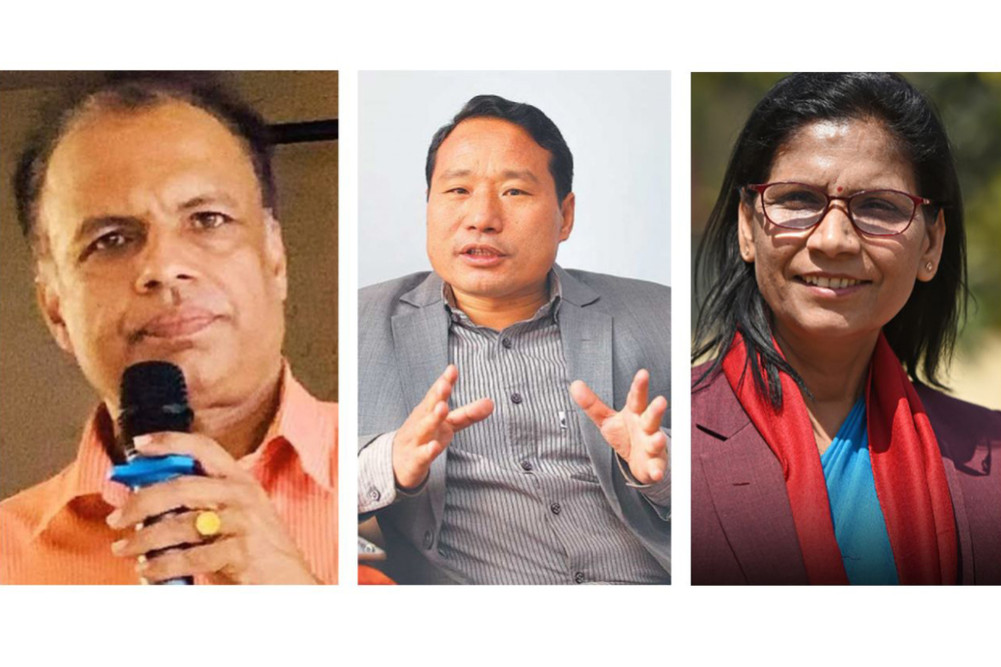
Congress, UML, CPN (Maoist), and RPP are working to forge a common position on issues of national importance inside and outside the parliament.
We use Google Cloud Translation Services. Google requires we provide the following disclaimer relating to use of this service:
This service may contain translations powered by Google. Google disclaims all warranties related to the translations, expressed or implied, including any warranties of accuracy, reliability, and any implied warranties of merchantability, fitness for a particular purpose, and noninfringement.
The opposition parties are engaged in a frontal attack on the government's governance style and the behavior presented by Prime Minister Balendra Shah in the parliament. They are also preparing to cooperate on the issue of constitutional amendment.
The opposition parties have been alleging that there has been insufficient discussion on policies and programs in the parliament and that an attempt has been made to limit the sovereign parliament to formalities. They are also dissatisfied with Prime Minister Shah for leaving the parliament on 28 Baisakh while President Ram Chandra Poudel was reading the policies and programs and not answering the questions raised by the lawmakers. Similarly, they have also been protesting the government's move to remove squatter settlements without alternative arrangements.
The opposition Congress, UML, CPN and RPP have jointly signed the issue of promulgating eight ordinances and amending about a dozen laws by suspending the already called parliament session. They are preparing to reject the ordinance from the National Assembly. If the ordinance is rejected by either house of the federal parliament, it becomes ineffective. The ruling party is not present in the National Assembly.
NCP coordinator Pushpa Kamal Dahal has indicated that there may be a blockade on both the streets and the House. 'We had said that we would support the government in a constructive manner to amend the constitution or protect democracy,' he said at a press conference held in Surkhet on Sunday, 'but the latest government steps have created a situation where we have to protest rather than support.' Dahal says that the government is moving towards undemocratic practices due to events such as adjourning the already-called parliament session and bringing an ordinance, the Prime Minister not being accountable to the parliament, and dissolving trade unions.
.....................................
We form a common opinion on issues inside and outside the parliament, and we try to hold discussions with all parties to create a document of general acceptance even in the amendment of the constitution. - Gururaj Ghimire, Congress General Secretary
00
Cooperation between opposition parties is necessary against issues related to nationality, the interests of the general public and the wrongdoings of the government. If the government becomes arbitrary, we will stand together. - Barshaman Pun, NCP leader
.....................................
Congress, UML, NCP and RPP have been seen together in the activities inside the parliament. Despite not joining the front, the Shram Sanskriti Party has also been seen as aggressive towards some of the government's activities. Hark Sampang, Chairman of Shram Sanskriti, has demanded his resignation, saying that Prime Minister Shah was not present in the discussion on policies and programs and did not answer the questions raised by the MPs. The party boycotted the parliament meeting on April 30.
Opposition parties had demanded that the Speaker rule to make the Prime Minister present in Parliament to answer questions raised on the government's policies and programs. Opposition parties have criticized Speaker DP Aryal for not ruling. Finance Minister Swarnim Wagle answered the questions raised in Parliament on the policies and programs on behalf of the Prime Minister. The policies and programs were passed amid obstruction and boycott by opposition parties.
Congress Parliamentary Party Whip Niskal Rai commented that the Speaker has become indifferent to 'ruling' the Prime Minister. 'The Speaker is the head of the legislature. He could have ruled the Prime Minister on policies and programs. But he became indifferent,' he said.
Whip Rai says that the opposition had to come together because the ruling Rashtriya Swayamsevak Sangh (RSS) tried to run the state through ordinances despite having a strong majority in the House of Representatives. ‘We are concerned that this is not the development of a mindset in the Prime Minister to ignore the House and become an autocrat. Rather than answering questions, he seems to be trying to evade Parliament and questions,’ he added.
The opposition parties are also trying to stand together on issues outside Parliament. They are especially trying to form a common position on issues related to constitutional amendment and people’s livelihood. The government has formed a task force under the leadership of the Prime Minister’s political advisor Asim Shah to prepare a debate paper on constitutional amendment. The opposition UML, NCP and RPP have sent representatives to the task force.
The Congress has not sent a representative demanding the government’s formal opinion on the basic features of the constitution. The Congress has formed a separate committee led by Vice President Pushpa Bhusal, including constitutional experts. It is holding discussions on the issues of amendment.
Congress General Secretary Gururaj Ghimire said that the opposition will form a common position on issues inside and outside Parliament by observing the government’s activities. He informed that discussions are underway among the opposition parties to form a common opinion on the issue of constitutional amendment. ‘All the parties that were in the Constituent Assembly during the constitution-making process are not in the parliament now. Their support is also needed. Constitutional amendment is not only the concern of the parliament, but should be a matter of concern to the general public,’ said Congress General Secretary Ghimire. ‘Wherever there was disagreement yesterday, where there was no universal acceptance when the constitution was promulgated, we are holding discussions to make it a document of general acceptance. We are trying to form a common opinion on it.’
The Rashtriya Swayamsevak Sangh (RSS) had formed a new government on Chaitra after winning almost two-thirds of the seats in the House of Representatives elections on 21 Falgun. Immediately after that, the government had taken aggressive steps against corruption and abuse of power. The first cabinet meeting on Chaitra had decided to implement the report of the Commission of Inquiry into the Incidents of 23-24 Bhadra. According to the commission's report, former Prime Minister UML Chairman KP Sharma Oli and former Home Minister Congress leader Ramesh Lekhak were arrested the next morning for investigation. A section of UML and Congress had termed the move as 'political revenge'. The establishment wing of Congress, however, had raised the issue of method and procedure rather than revenge.
Four opposition parties had formally blocked the election of the parliamentary committee chairman. When the ruling Rashtriya Swayamsevak Sangh (RSS) wanted to appoint itself as the chairman of the Public Accounts Committee, the four opposition parties had held a joint meeting and protested. After that, Congress got the chairman of the Accounts Committee.
The opposition parties, who have been protesting against the government's amendment of the Constitutional Council Act through an ordinance, have also been criticizing the Council's recommendation of a fourth-rank judge as the Chief Justice, contrary to judicial tradition. They also object to the removal of about 1,500 positions by amending 110 acts through a single ordinance.
The opposition parties also have a policy of collaborating in the provincial government. Apart from Madhesh Province, there is a joint government of Congress and UML in 6 provinces. Apart from UML, there is a government in Madhesh under the leadership of Congress including CPN, JSP, and LOSP. Congress has also led the Bagmati, Gandaki, and Sudurpaschim governments. UML is leading the Koshi, Lumbini, and Karnali governments. Discussions have also begun between Congress and UML regarding a change in leadership as per the old agreement.
While reaching an agreement between Congress and UML on 17 Ashad 2081, there was an understanding to change the leadership of the provincial government along with the Sangh in Ashad 2083. In the Sangh, the Gen-G movement changed the political landscape.
Congress General Secretary Ghimire says that collaboration with UML in 6 provinces and with Madhesh-centric parties including CPN in Madhesh Province will continue. 'Discussions are underway to take this collaboration to the next election.' "As for the leadership change, the Congress and the UML have not yet decided whether to hold it before or after the budget speech," he said. "We will reach a decision by consensus."
UML Parliamentary Party Deputy Leader Padma Aryal said that the opposition parties are in agreement on some issues in parliament. "We have agreed on some issues of national importance. But there has been no concrete discussion on how to proceed in the coming days," she said.
NCP leader Barshaman Pun said that there would be cooperation between the opposition parties on necessary issues. "Cooperation between the opposition parties is necessary against issues related to nationality, the interests of the general public and the wrongdoings of the government," he said. "If the government moves forward on an arbitrary path, we will stand together."