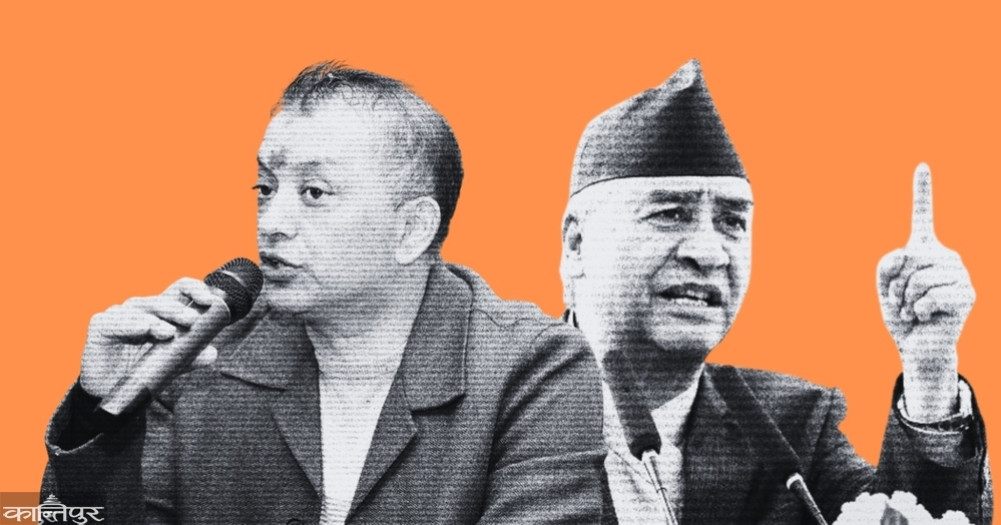
In its 80-year history, the Congress has continuously undergone cycles of division and unity in leadership, power, and ideology, and the current controversy is a continuation of that.
We use Google Cloud Translation Services. Google requires we provide the following disclaimer relating to use of this service:
This service may contain translations powered by Google. Google disclaims all warranties related to the translations, expressed or implied, including any warranties of accuracy, reliability, and any implied warranties of merchantability, fitness for a particular purpose, and noninfringement.
The Supreme Court has resolved the dispute over the legitimacy of the Nepali Congress. But the internal dispute within the Nepali Congress remains the same.
Former President Sher Bahadur Deuba, who went to Singapore on March 13, has not yet returned home. Leaders in the race to succeed him in the party are currently engaged in a debate on whether to form a separate party or return to the mainstream.
Despite responding on social media about the investigation into money laundering and the arrest warrant, they have not even disclosed their whereabouts. According to a leader close to Deuba, Deuba had recently asked leaders close to him within his group for advice on what would happen if he returned. Most leaders suggested that he return home and face the charges against him. Since then, it is not certain whether Deuba will return immediately. However, Deuba has not given any response about the future of the Nepali Congress after the Supreme Court's decision.
Leader close to Deuba, Prakash Sharan Mahat, says he has no contact with former President Deuba. ‘I don’t know if he has had any contact with Purnaji, but I suspect that whatever has been discussed between friends, he will also have the same opinion.’
After the Election Commission gave legitimacy to the Gagan Thapa-led Central Working Committee that emerged from the special general convention on 2 Magh, Deuba himself and the then acting President Purna Bahadur Khadka were the ones who filed a writ in the Supreme Court against it.
Even after the Supreme Court dismissed the writ on 4 Baisakh and upheld the Commission’s decision, the Deuba group, especially the second-tier leaders, are not ready to easily accept Thapa as the president. Instead, they are focused on the debate of forming a separate party to protect their political relevance.
After the court's verdict, President Thapa has spoken to Khadka, who led the Deuba group to preserve unity. According to Mahat, Khadka had sought Thapa's opinion on what the model of participation and unity would be.
'Gaganji has said that he will come after consulting with friends, but further discussions have not been held,' he said. According to Mahat, he says that going to the Central Working Committee at the individual level will not resolve the dispute. For that, he says that a separate mechanism should be formed, not the current Central Working Committee, to hold the upcoming 15th General Convention.
'To make the General Convention fair and free, it is the responsibility of both parties, but rather those who are not contesting the election, to form a common mechanism. That will create an atmosphere where both parties will be included and go to the General Convention. The General Convention will establish unity,' says Mahat.
While the dialogue between the two parties is ongoing, the leaders of the Deuba faction are busy preparing for a national and provincial-level gathering in seven provinces. A gathering with the district presidents of their group has been called in Kathmandu on April 14.
‘Our priority is still to start the process of participating in the general convention in a respectful manner, and not to form a separate party.’ Mahat says, ‘Gaganji should also prioritize the party.’
Gagan came to the leadership after throwing out the 81-year-old Deuba due to the impact of the Gen-G ‘movement’ of 23-24 Bhadau. The Gagan-Bishwaprakash Sharma duo had concluded that Deuba, who had failed on both the fronts of party transformation and good governance, should not go to the elections with him.’
Deuba and his group were not in favor of the special general convention. Another leader Shekhar Koirala and his group were also in the same place with Deuba in the belief that the special general convention would lead to a split in the party. Deuba, along with Koirala, stood against the special general convention for his own happy political exit. At the same time, Gagan-Bishwa ignored the mandatory provision of Article 17 (2) of the party constitution and rebelled against it.
Thapa Gagan-Bishwa concluded that carrying Deuba's face would cause great damage to the Congress in the elections, and even changed the leadership and some policies within the party. The changed face of the Congress from the special general convention did not bring good results. Thapa himself lost the election in the 21 Falgun elections. The party shrank and was limited to 38 seats. Thapa, who has been on the defensive since the election, has been challenged to handle the internal strife within the party. Even after the court gave the final verdict in Thapa's favor, unity has not been achieved. Shekhar and his group, who are in the same camp as Deuba in the special general convention issue, have stood in favor of party unity. In fact, most of the leaders within the Deuba-Khadka group are also in favor of merging with the mainstream. However, the leaders at the leadership level of the group have started focusing more on the plan to form a separate party.
Those who are imagining the formation of a separate party are all leaders who have brought the family legacy of the founding leaders. Among the leaders in this camp, Prakashman Singh is the son of the 'Sarvamanya' late leader Ganeshman Singh. Another leader, Shashank Koirala, is the son of BP Koirala and Bimalendra Nidhi is the son of Mahendra Narayan Nidhi. Despite not having family ties, the then acting president Khadka always presents himself as a disciple of Krishna Prasad Bhattarai.
Leader Krishna Prasad Sitaula is a key member of the then president Girija Prasad Koirala's 'kitchen cabinet'. After the 062/063 Jana Andolan, Sitaula had joined Koirala's 'kitchen cabinet' by leaving aside his predecessors. Carrying Koirala's legacy, he had gained influence within the party. Shashank has indicated that he will not stand in favor of forming a separate party. He was even absent from the last meeting. Apart from that, all the other leaders have been standing together.
Born in controversy, raised amidst controversy
The current controversy within the Congress is not the first and not new. It has been affected by the dual trend of unity and division since its birth. Sometimes there has been a clash of ideas, sometimes of leadership and sometimes of power. Leader Arjun Narsingh KC says that in the 80-year long political history, a long series of disunity, unity and disputes has become the culture of the party. Therefore, Gagan Thapa is no exception to this.
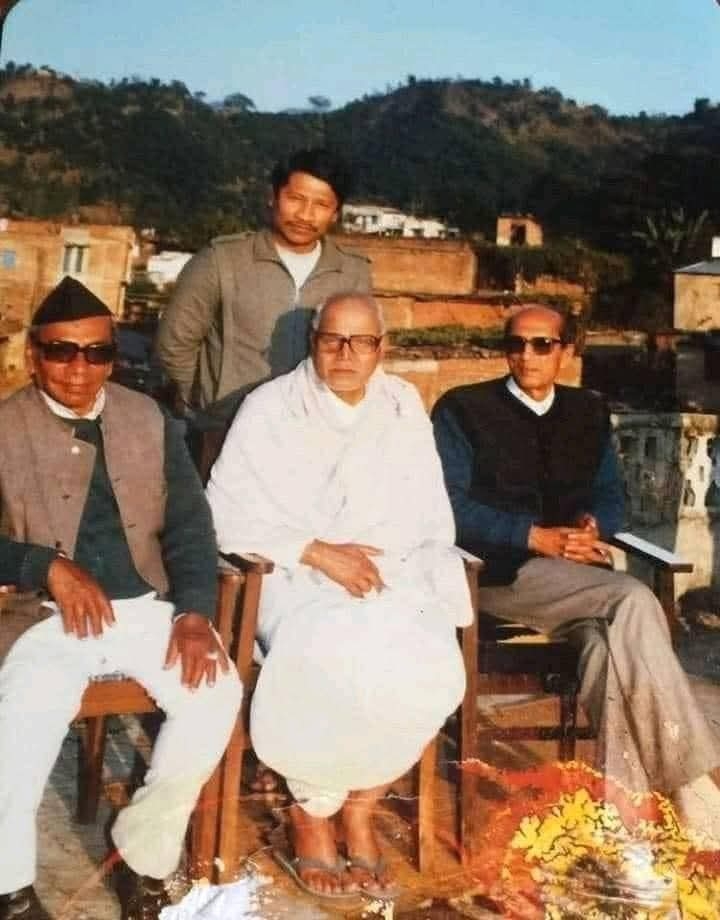
BP Koirala, Suvarna Shamsher Rana, Krishna Prasad Bhattarai, Girija Prasad Koirala and Sher Bahadur Deuba have all faced struggles, conflicts and disputes in the internal life of the party. In some cases, the party has split. After the split, the series of unity has also been linked to it.
The seeds of controversy were sown on 15 Kartik 2003 when Nepali students studying in Banaras, India, established the ‘Akhil Bharatiya Nepali Congress’ under the presidency of Devi Prasad Sapkota. Which soon transformed into the ‘Nepali National Congress’. From that time on, there was a leadership conflict between BP Koirala and Dilliraman Regmi. Although the first general convention held in Calcutta (Kolkata) on 12–13 Magh 2003 elected Tanka Prasad Acharya as the president, BP Koirala took over as the acting leader because he was in jail.
BP was in jail at the convention held in Banaras on 20 Magh 2004. Dilliraman Regmi was made the acting president of the party while he was in jail. After his release from jail, Regmi did not want to give up the position of acting president. BP then called a meeting. In Falgun 2005, Matrika Prasad Koirala was again given the responsibility of acting president at the third general convention.
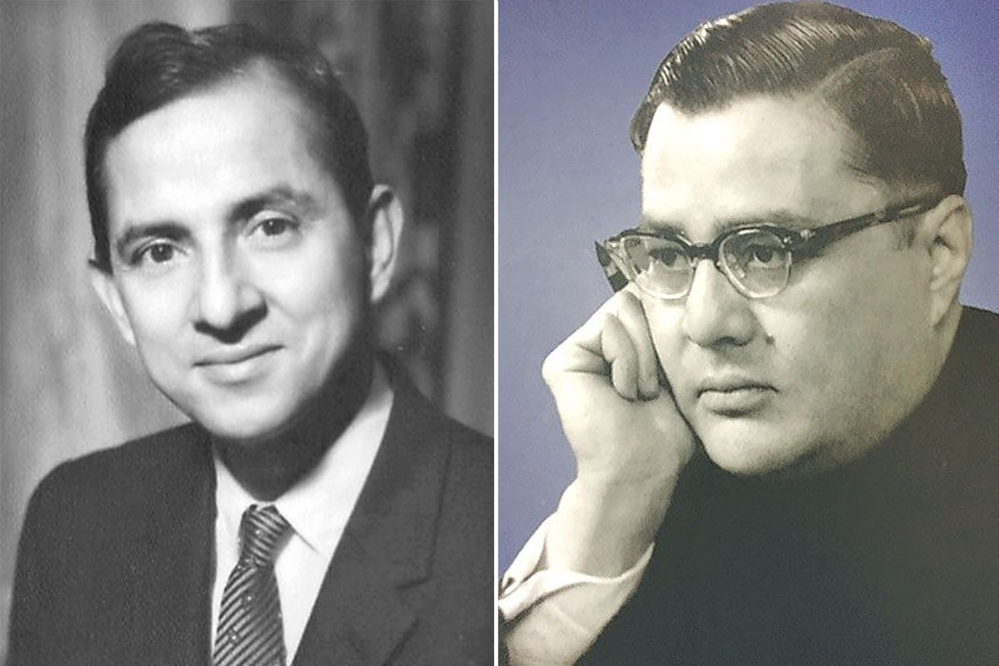
Meanwhile, on 31 Shrawan 2005, the ‘Nepal Democratic Congress’ was formed under the coordination of Suvarna Shamsher. After 5 months, Mahendra Bikram Shah took over its leadership. Finally, on Chaitra 27, 2006, the Nepali Congress was formally established with an agreement between these two congresses that one would abandon ‘national’ and the other ‘democracy’. Which strengthened the movement against the Rana regime.
But even after the unity, the leadership struggle did not stop. Even though the fourth general convention elected Matrika Prasad Koirala as the president, the differences with BP Koirala continued to grow. There was already an ideological and leadership dispute between BP and Dilliraman Regmi. ‘Even when the two congresses were united, Regmi did not want to unite.’ He remained the leader of the ‘Nepali National Congress’ for a long time,’ says leader KC.
KC, who is also the author of the book ‘A Brief History of the Nepali Congress’, has mentioned that there was a heated dispute between BP and Dilliraman in 2004. The book mentions that the leaders who could not be integrated into the National Congress due to the conflict between the two were together to establish the 'Nepal Democracy Congress'. The 'Big Four' included Suvarna Shamsher, Surya Prasad Upadhyay, Mahavir Shamsher Rana and Mahendra Bikram Shah.
There was also a ideological difference between BP and Suvarna Shamsher. Suvarna Shamsher was in favor of an armed movement against the Rana regime, while BP was in favor of non-violence and Satyagraha. The same ideological dispute between these two leaders was also seen during the movement against the Panchayat after 2017. But at that time, BP stood in favor of an armed movement. However, Suvarna Shamsher was in favor of a peaceful movement.
'There was an ideological conflict since the establishment.' Within that, conflicts of personality and leadership were also seen from time to time. Sometimes between BP and Dilli Raman, sometimes between Matrikaka's father and BP, sometimes between BP and Subarna Shamsher,' said leader KC in an interview with Kantipur, 'These conflicts and competitions are not unnatural for a party that believes in democracy.'
The Congress has taken a leading role in three major transformational movements in Nepal's modern political history, from the end of the Rana regime to the establishment of the republic. The 104-year-old Rana regime was ended by the people's revolution led by the Congress. It was then that the Rana-Congress joint cabinet was formed. During that interim period, Mohan Shamsher Rana was the Prime Minister and BP Koirala was the Home Minister. BP resigned from the post of Home Minister in protest against the assassination of Chiniya Kazi. Then Prime Minister Mohan Shumsher also resigned. On 1 Mangsir 2008, BP's brother Matrika Koirala became Prime Minister.
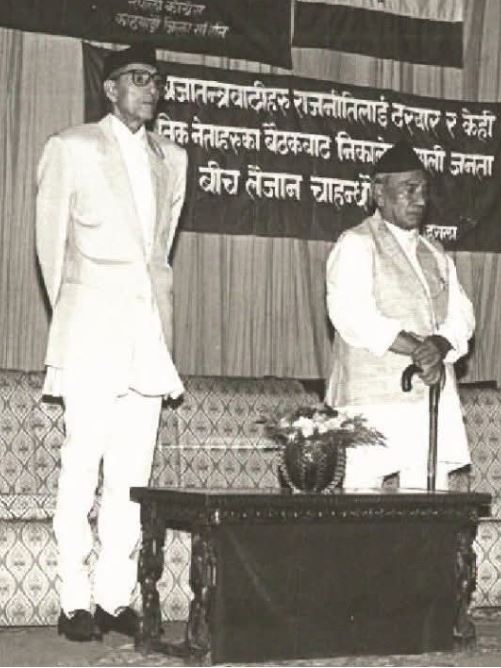 Within 7 months of Matrika becoming Prime Minister, BP was elected President of the party at the fifth general convention. After that, a rift began between BP and Matrika. On 10th Shrawan 2009, BP expelled Matrika from the party membership on charges of running the state against the party's principles and the interim constitution. Then, on 14 Kartik 2010, Matrika called a meeting in Birgunj and launched a new party - the National Praja Party. There have been many minor splits and divisions in the history of the Nepali Congress. However, this was the first major split. On 2 Chaitra 2011, the cabinet led by Matrika Prasad Koirala was dissolved. Subarna Shumsher became the President of the party at the sixth general convention of the Nepali Congress on 9-12 Magh 2012. After that, the Rashtriya Praja Party led by Matrika merged with the Congress again.
When the representatives who elected them demanded a special general convention, former President Deuba tried to stop it by saying that the party would split. However, in history, the special general convention was called by the party president on Jestha 14, 2014. As the political situation in the country deteriorated, President Suvarna Shamsher called a special general convention and handed over the leadership to BP. Deuba was disgracefully removed for not understanding the changing situation in the country.
After BP's death, the collective leadership of Ganeshman Singh, Krishna Prasad Bhattarai and Girija Prasad Koirala began. These three leaders were called the 'Trinity' in the Congress. After the 2048 elections, Girija Prasad Koirala became the Prime Minister. After that, the 'quarrel' between these three leaders began. Koirala removed six ministers from the Bhattarai faction on 15 Mangsir 048. After that, ‘36’ and ‘74’ were born within the Congress. The power struggle between Ganeshman Singh and Krishna Prasad Bhattarai on one side and Girija Prasad on the other side lasted for a long time.
In the by-election of Kathmandu Constituency No. 1 on 24 Magh 050, the then party president Krishna Prasad Bhattarai was defeated. Koirala and his group were accused of collusion and lost.
In the meantime, Binod Bhattarai, nephew of leader Krishna Prasad Bhattarai, says that once the Congress came close to splitting but survived. The power struggle between Girija Prasad Koirala and Krishna Prasad Bhattarai had led to the party splitting several times. When the dispute between Koirala and Bhattarai reached its peak, the two leaders even signed the Godavari Accord on 3 Poush 2054. Koirala and Bhattarai had reached a three-point agreement on party unification at Godavari Resort. On 24 Ashad 051, the Koirala faction organized a gathering at the Nepal Royal Academy in Kamaladi. There were rumors that a separate party would be announced from the gathering. At that time, it is said that the Koirala faction had even prepared the party's flag, name and draft statute. The gathering was chaired by Bhuvikram Nembang.
'Kisnuji was not invited to the gathering. As soon as he heard that the gathering was being organized, he took a taxi and reached there secretly in his slippers. He went straight to the stage and sat next to Girija Prasad. Kisnuji was also insulted there,' says Binod. 'When I reached the gathering, Kisnuji sent a message saying that I had come to my own house even though I had not been invited.' Then the workers became emotional. The division was stopped.'
The party was saved from an immediate split by the Kamaladi gathering, but within a few days, 36 MPs of his own party were absent from the government's policies and programs, making the government a failure. Koirala then dissolved the parliament and went into mid-term elections. Even after that, internal power struggles continued in government formation, dissolution, assassinations, and assassinations. Ganeshman Singh and Krishna Prasad Bhattarai left the party at the end of their lives. However, the party did not allow a split.
Another Congress leader, Shyam Ghimire, says that despite such disputes and problems being seen in the party many times, the party has been saved due to the understanding, patience, and maturity of the leaders.
'There are still leaders who carry the legacy of BP Koirala, Ganeshman Singh, Krishna Prasad Bhattarai, and Mahendra Narayan Nidhi.' Ganeshman and Krishna Prasad Bhattarai have saved the party many times even after drinking poison, now their followers have the responsibility to remember that and save the party,' said the then acting president Khadka Nikat Ghimire.
Another leader Lokesh Dhakal says that the trend of internal disputes and struggles in the Congress has been the same since the BP era. 'Even yesterday, there was no big fight between ideas and principles. The leadership was for power. The difference is that even when there was a fight between leadership and power yesterday, there was cordiality between the leaders, but not today,' says Dhakal. 'After Gaganji came, there was some ideological debate. But, the focus was more on power than ideas. The main goal of the election campaigners saying 'again Gagan government' is power. In the past, Pradeep Giri and Narahari Acharya used to debate ideas. Today, it is not the same.’
The second major split in the Nepali Congress took place in 2059 BS. At that time, Deuba was the Prime Minister. The government, led by Deuba, had declared a state of emergency on 2058 BS against the armed Maoists. According to the constitution, the state of emergency imposed in this way could not be extended for more than 6 months. Another decision had to be made. Deuba wanted to extend the state of emergency, but the then party president Girija Prasad Koirala did not allow it to be extended.
After the state of emergency was not extended, Deuba dissolved the House of Representatives on 8 Jestha 059 BS. After that, the party asked Deuba for an explanation within 24 hours. The party did not accept the explanation and expelled him from the party for three years, not even as an ordinary member. After that, Deuba split the party on 5 Asad 059 BS and established the Nepali Congress (Democratic). The party that was divided in this way was reunified on 8 Asoj 2064 .
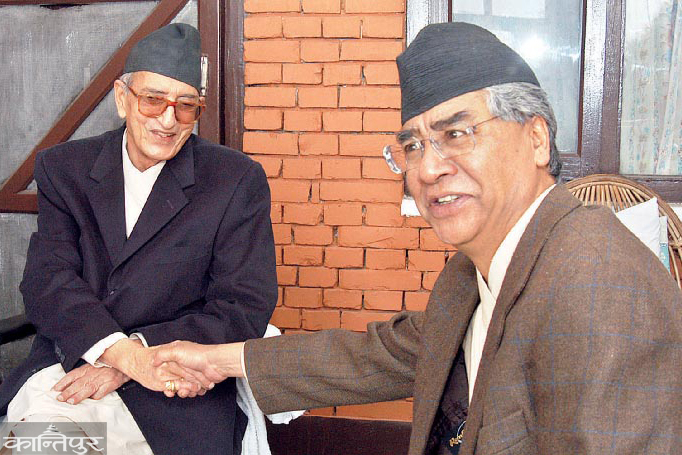
According to Ghimire, the latest dispute within the Congress is a dispute between the grandfather and the leader generation . ‘The grandson generation has usurped the leadership because it could not keep up with the times and circumstances,’ he said, ‘The tendency to try to remain in leadership for a long time will be a hindrance not only for the country but also for oneself . If Gaganji, who has come to the leadership, tries to be an executive for twenty years like Sher Bahadur Deuba, the same will happen .’
After the 21 Falgun elections, the National Independent Party, as an alternative political democratic force, is running the government with a nearly two-thirds majority . For the Congress, which has been competing with leftist parties in the past, the biggest challenge now has become the Rashtriya Swatantra Party . The local and provincial assembly elections to be held a year later will be another test for the Congress, which suffered a heavy defeat in the House of Representatives elections.
Political analyst Geja Sharma Wagle says that although the defeat of the Congress and the victory of the Rashtriya Swayamsevak Sangh (RSS) in the elections created some challenges for the Congress from a theoretical, ideological and class perspective, if the party is transformed and moved forward, the Congress and Gagan can make a 'comeback'.
'If the Congress is fundamentally transformed and restructured, the Congress will also make a 'comeback' and Gaganji will also make a 'comeback'. Otherwise, the status quo has no future for the Congress,' he said.
The biggest challenge for Gagan Thapa, who has reached a 'defensive' state due to the results of the House of Representatives elections, is to build broad unity within the party. If unity is not achieved, even a few percent of the impact it will have could hurt the Congress in the upcoming local and provincial assembly elections. If the results are like the current ones, all-round questions will be raised on party president Thapa.
Wagle says that the challenge has increased as the intellectual and professional community, middle and lower middle class, and democratic voters, who are considered traditional base areas, have started choosing the Rashtriya Swayamsevak Sangh (RSS) as an alternative to the Congress.