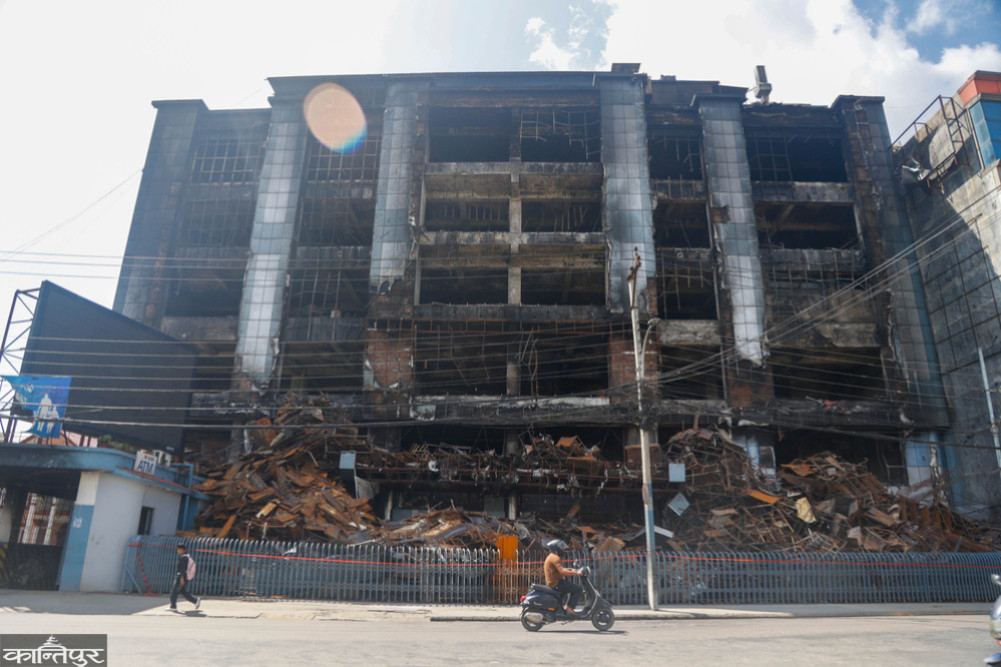
The victim's family has still not been able to identify their relatives and get justice because forensic tests were unable to extract DNA samples from the charred remains.
We use Google Cloud Translation Services. Google requires we provide the following disclaimer relating to use of this service:
This service may contain translations powered by Google. Google disclaims all warranties related to the translations, expressed or implied, including any warranties of accuracy, reliability, and any implied warranties of merchantability, fitness for a particular purpose, and noninfringement.
It has been difficult to hand over the bodies of 7 of the deceased on 24 Bhadra to their families due to difficulties in conducting DNA profiling. It has not been possible to collect samples for DNA testing from the bodies found burnt in the Bhatbhateni Supermarket in Chuchepati.
According to SSP Ramesh Thapa, Chief of the District Police Range, Kathmandu, efforts are being made to trace the families of the missing persons during the Gen-G movement based on reports. However, he says that the problem arose due to difficulties in even extracting DNA.
‘We conducted the investigation based on the complaints received during that period regarding the disappearance of relatives,’ Thapa said, ‘In the meantime, we are separately looking at 7-8 files that may be related to this incident.’
The police had collected the bodies a few days after the incident and handed them over to the Forensic Department of Tribhuvan University Teaching Hospital. However, the doctors had replied that it was not possible to conduct a post-mortem examination of the bodies.
‘We conducted the investigation based on the complaints received during that period about missing relatives,’ Thapa said, ‘In the meantime, we are separately looking at 7-8 files that may be related to this incident.’ According to a doctor from the forensic department, the police had brought the charred remains of the body in different bags at that time, with nothing left to test. ‘The body brought by the police was almost completely charred, so we had given the opinion that the process could be carried out through DNA testing,’ he said, ‘We had kept the remaining remains here.’
According to the Kathmandu Police, on 29 Bhadau, an employee and some others who entered Bhatbhateni called ‘100’ saying they had seen the body. Then a team from the Police Circle, Gaushala, reached. ‘The shape of the ashes was the only indication that it was the body,’ said an officer from the Kathmandu Police, ‘There were some small bones in the remains.’ There was a food warehouse next to the room where the body was found. And, eyewitnesses had told the police that smoke was coming from there for a long time.
According to Kathmandu Police SP Pawan Bhattarai, the last option for the process of handing over the body is DNA testing. For that, the sample was sent to the police's central forensic laboratory.
'However, since they said that the sample could not be prepared, we are discussing other options,' he told Kantipur, 'We had heard that it could be tested in Europe, that option is also being discussed.' According to him, it has been learned that there is a technology in Vienna that can extract DNA samples from samples in this condition. 'However, that is only a matter of initial discussions, what to do has not been decided.'
In Nepal, there is a national forensic laboratory in Khumaltar along with the police forensic laboratory for DNA testing. In this case, the sample has only been sent to the police laboratory for testing. Former Executive Director of the National Forensic Science Laboratory, Jeevan Prasad Rijal, says, “In such cases, the police should also send the sample to the government laboratory for testing.” According to him, one of the bones or teeth is needed to collect DNA samples from a burnt body.
“DNA remains in these two even at very high temperatures, but I do not know what condition it was in in this case,” he told Kantipur, “But, even a small sample can help.” Even if it is not possible to test, he says, it would be easier to determine what can be done by sitting with experts from both sides.
“In a previous incident in Shivpuri, only a fragment of bone was found, and that too was completely black,” Rijal recalled, “But, we tried to extract a DNA sample even based on the small part that was lumpy.”
However, he recalls that the sample was sent to Finland for testing when it was not ready to be tested with another sample. ‘Such incidents are very rare, although some countries in the world have such technology,’ he added, ‘if it is really to be tested, a solution can be found by holding discussions between experts from both laboratories.’
Read this also
The report states that it was not possible to thoroughly investigate the incidents across the country and prove anyone guilty at the time due to lack of time and manpower. In the Gen-G Movement on 23 Bhadra, 21 people were killed in one day due to excessive force by the police, 19 in Kathmandu and 2 in Koshi. After the protesters broke through the weak police barricade and reached the Parliament building, the administration imposed a curfew at 12:30 pm. Then the shooting continued until the evening.
The next day, a protest was held in protest with even more people present, forcing the then Prime Minister KP Sharma Oli to resign. In the ensuing situation, structures including the Parliament Building, Singha Durbar, Supreme Court and Bhatbhateni Supermarket were vandalized, looted and set on fire.
The report of the High-Level Inquiry Commission led by Gauri Bahadur Karki states that of the 76 deaths in the incidents of 23 and 24 Bhadra, 42 were killed by security personnel. The report states that 3 policemen were killed in the attack by protesters and the rest during the looting.
These incidents injured 2,522 people and caused damage of more than 85 billion rupees. According to the details included in the commission's report, only 2,192 SIM cards were active in the Tangal branch of Bhatbhateni on 23 and 24 Bhadra.
The commission had recommended criminal action against the then Prime Minister Oli and Home Minister Ramesh Lekhak, among others, who were involved in the use of force on 23 Bhadra. However, in the case of Bhadra 24, it was said that further investigation was required, saying that ‘the mandate received by the commission is definite but for a short period’.
The report states that it was not possible to thoroughly investigate the incidents across the country and prove anyone guilty at that time due to lack of time and manpower.
‘Now, a detailed investigation is required by the government to form an investigation team with experts and compare it with other available evidence, video clips obtained from victims and other sources, to immediately reach the accused,’ the report says. Accordingly, the government has said that it will form a committee to investigate the incident of Bhadra 24. However, that investigation has not gained momentum.