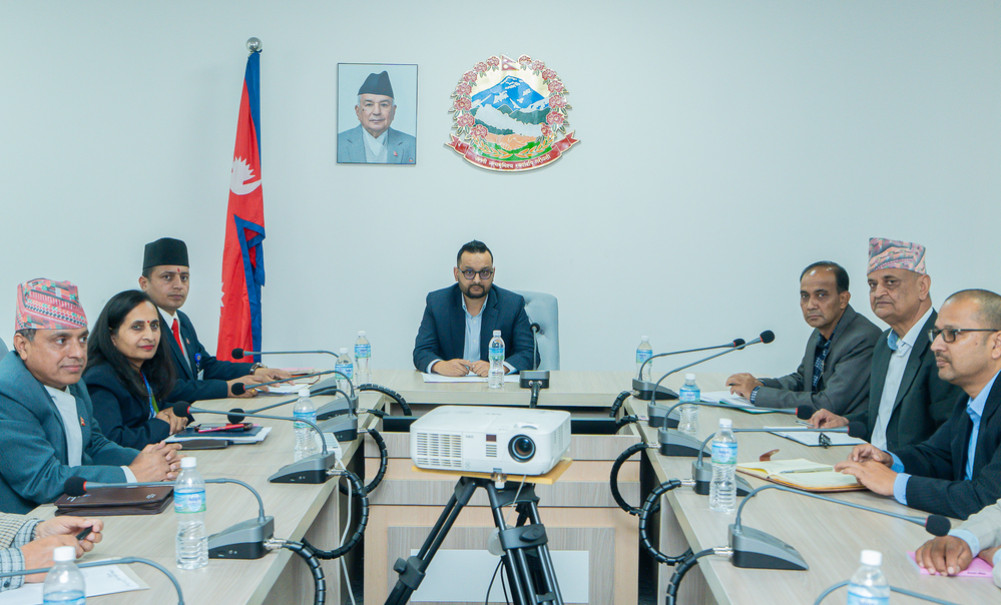
Task Force Coordinator Asim Shah says that the work of dispelling suspicions between the parties has been done.
We use Google Cloud Translation Services. Google requires we provide the following disclaimer relating to use of this service:
This service may contain translations powered by Google. Google disclaims all warranties related to the translations, expressed or implied, including any warranties of accuracy, reliability, and any implied warranties of merchantability, fitness for a particular purpose, and noninfringement.
The government-formed Constitution Amendment Task Force has started its work. The first meeting of the task force held at the Prime Minister's Office on Wednesday decided to seek opinions from all political parties on the constitutional amendment.
The government had formed the 'Constitution Amendment Task Force 2082' on 16 Chaitra under the leadership of the Prime Minister's Political Advisor Asim Shah. Task force coordinator Shah said that the issues of the constitution amendment were presented in the first meeting. He informed that the drafts of the constitution amendment will be prepared by holding consecutive meetings.
Task force member secretary Leeladhar Subedi said that the meeting on Wednesday took three decisions. It was decided to give member secretary Subedi the responsibility to identify the issues of the constitution amendment by taking into account the written opinions of the political parties, including the issues raised in the meeting, give member secretary Subedi the responsibility to propose an action plan on how to proceed with the future work of the task force, and thank the government.
The opposition party Congress was absent from Wednesday's meeting. Other parties had sent their representatives. The meeting mainly discussed the issues to be amended in the constitution. During the discussion, presentations were given by the employees on how to amend the electoral system, form of governance, independent judiciary and federalism.
Earlier, the Law Commission had also prepared some drafts and the issues of the drafts were also presented in the discussion, said RPP leader Gyan Bahadur Shahi, who participated in the meeting. Similarly, since the constitution states that other commissions will be reviewed in 10 years, there has been discussion to include them as well.
The task force includes Mohan Acharya of the Congress, Dr. Bhishmanath Adhikari of the UML, Dev Prasad Gurung of the NCP, Shahi of the RPP and Manoj Bhatta of the Janamorcha. The Congress, Shram Sanskriti, JSP Nepal and LOSPA have not yet sent representatives to the task force. The task force includes Pushkar Sapkota, Law Secretary of the Office of the Prime Minister and Council of Ministers, and Indira Dahal, Secretary of the Nepal Law Commission. The task force has been formed as member secretary of the task force, with Leeladhar Subedi, head of the Law and Decision Implementation Division of the Office of the Prime Minister and Council of Ministers, being appointed.
The task force has been formed as per point number 4 of the '100 Agendas on Governance Reforms' made public by the Office of the Prime Minister and Council of Ministers on Chaitra 13. The Rashtriya Swayamsevak Sangh (RSS) had said in its pledge to prepare a 'discussion paper' on the proposals for constitutional amendment within three months of assuming power in order to establish a national consensus. Similarly, the issues to be submitted for initial discussion by the RSS were a directly elected executive, a fully proportional parliament, a system where MPs do not become ministers, non-partisan local government and a reformed provincial structure. In addition to the UML, the Congress, the NCP, the Labor Culture Party and the RPP have mentioned the issue of constitutional amendment in their election manifestos.
What should be done to amend the constitution?
Experts have been saying that constitutional amendment is a 'risky but necessary step' and that we should proceed with caution. Constitutional scholars and former judges have commented that the review of the constitution has been delayed and that the Gen-G movement on 23-24 Bhadra also demanded it, so now is the right time. They say that this is the right time because the government has received strong public opinion in history and all political parties have accepted the amendment to the constitution.
Former Supreme Court judge Anand Mohan Bhattarai says that the shortcomings seen in the constitution promulgated in Asoj 2072 during the 10-year practice can be addressed with the upcoming amendment. He suggested that the amendment should be framed with good governance in mind.
‘The structures demanded by this constitution are costly. The state has to invest a lot of money to implement fundamental rights and many articles of the constitution,’ Bhattarai said, ‘The time has come to debate the issue of provincial structures and the expenditure of commissions. For now, we need to identify what amendments can only be made by the House of Representatives and the National Assembly.' He suggested that amendments should be made now regarding inclusiveness, making the Vice President the Speaker of the National Assembly, and the number of proportional MPs from directly elected to directly elected. He said that issues that do not require consultation with the provinces should be amended in the first phase, and amendments can be made in the case of the provinces and local levels in the second phase.
Senior advocate Bipin Adhikari recommended 10 points that should be included when amending the constitution. He said that the constitution should be edited properly first. Adhikari suggested that the structure of the provinces should be changed and a system should be established for directly electing the Chief Minister. He believes that it would be appropriate to create or eliminate a constitutional court in place of the constitutional bench.
Similarly, Adhikari said that the number of MPs in the provinces and the House of Representatives should be reduced and inclusion should be increased, elections should be made more proportional, the Election Commission should be strengthened, problems seen during 10 years of practice should be addressed, and the powers of the President should also be clarified.
Advocate Dipendra Jha has seen nine points that need to be amended immediately. ‘The demand for an executive presidential system was also raised in the Gen-G movement. Since the majority party, the Rashtriya Swayamsevak Sangh (RSS), also mentioned this in its manifesto, this can be included in the current amendment,’ he said. He suggested that all elections to the House of Representatives should be fully proportional, that MPs should do the work of the legislature and form a cabinet of experts, and that the formation of the government should be amended in accordance with past practices and the Supreme Court’s decisions.
‘The National Assembly could not prove its legitimacy. It was seen that an amendment should be made to remove it,’ Jha said, ‘It was seen that only ward chairmen should be appointed in municipalities, ward members should be removed.’ Jha suggested that the Chief Minister should be directly elected in the provinces, and that the number of MPs in the center and provinces should be amended.
The Congress has made public its stance that the scope of work, process, and the government’s opinion should be clear before sending representatives to the government task force to prepare a debate paper on the constitutional amendment. The Congress sent a letter to the Office of the Prime Minister and Council of Ministers on Tuesday, saying that clarity is needed on four main issues. The Congress presented its formal view after the government formed a task force to prepare a discussion paper on the constitutional amendment and requested the nomination of a representative from the Congress. Although the party welcomed the initiative to amend the constitution, it has indicated that it will be difficult to decide on sending a representative until the process and objectives are clear.
The Congress has first raised questions, saying that there is no clear description of the authority, role and limits of the task force. Although the letter received from the government mentions 'preparing a discussion paper', it has asked for clarification as it is not clear what issues the task force will work on, what its scope will be and what its role will be in the decision-making process. The Congress has emphasized that since the constitutional amendment is a sensitive issue, its debate should be participatory, inclusive and fair from the beginning, and the government should move forward, especially keeping in mind the movements related to identity, rights and representation and past agreements with the state.
Work has been done to dispel doubts among the parties: Asim Shah
Coordinator, Constitution Amendment Discussion Paper Preparation Task Force
What was discussed on the first day of the Constitution Amendment Task Force?
Discussions were held with representatives of parties other than the Congress on Wednesday. The Congress has also said that it will give its name after discussion. In today's meeting, everyone's views were heard. They had doubts that the debate paper would be prepared within 7 days and submitted to Parliament and that the rest of the parties would simply bypass and keep witnesses while amending the constitution. That doubt was dispelled.
How does this task force work?
The government is not rushing to amend the constitution, the government has formed a task force in accordance with the RSVP's pledge. Its starting point is today's meeting. It is to prepare a universally acceptable debate paper. I am the coordinator, I will do the coordination work, and I have told the party representatives that you will prepare the debate paper.
What issues will be amended in the constitution?
It was explained what will be touched and what will not be touched during the constitution amendment. For this, the views of constitutional experts, the judiciary, party leaders, Gen-G, and the general public will be understood. We will listen to everyone. We will understand the views of the people online. We will prepare a debate paper and submit it to the Prime Minister.
What decisions did today's meeting make?
Today's meeting has taken three decisions. To thank the government for forming the task force, to seek opinions from all parties on the constitutional amendment, and to appoint a member secretary, who has been given the responsibility of preparing a TOR.