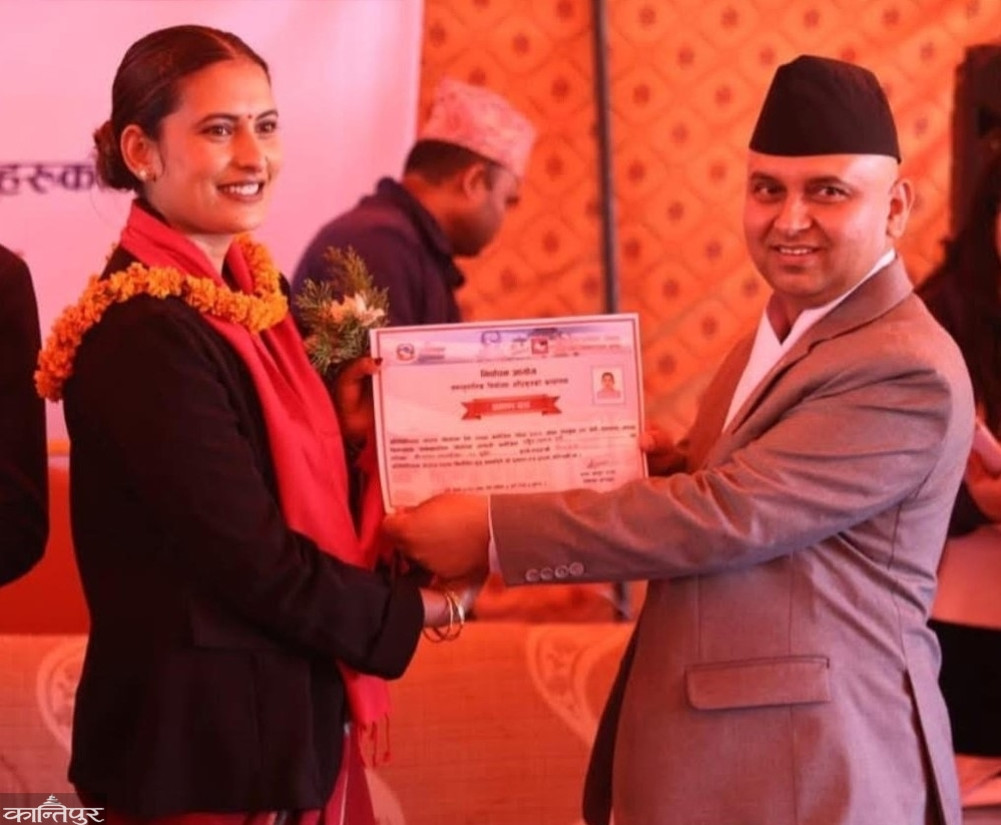
”Now the voices of the marginalized will also be heard in the federal parliament,” said Hikmat Badi, a leader of the Badi community. ”This is a matter of pride for us. The Rashtriya Swayamsevak Sangh (RSS) has given a great opportunity to Sita Badi, a woman from the Badi community. We should utilize this as an opportunity.”
We use Google Cloud Translation Services. Google requires we provide the following disclaimer relating to use of this service:
This service may contain translations powered by Google. Google disclaims all warranties related to the translations, expressed or implied, including any warranties of accuracy, reliability, and any implied warranties of merchantability, fitness for a particular purpose, and noninfringement.
The name of a struggling girl born in the Badi community living in Karnali, the western region of Nepal, is Sita Badi. The Badi community is also considered one of the most backward communities among the Dalit community. The citizens of this community, who mostly live on river banks, open land or in temporary settlements, do not own land. They have been facing many social and economic problems.
A girl from this community will now be seen in the country's parliament building. The National Independent Party has elected her to the parliament through the proportional system from the Dalit Women's Cluster.
Born in Jhuprakhola of Birendranagar Municipality-11 in Surkhet in 2052 BS, she can never forget the bitter time she spent in poverty, untouchability, exclusion and humiliation during her childhood. She shared her experience of growing up considering poverty as fate and humiliation as normal behavior.
Education: Not a right, but a struggle
Being born in the Badi community, Sita could not get education as a right. She says that education was not a privilege for her and the children of the Badi community, but a struggle, saying, ‘I grew up in a situation where I had to choose between my stomach and education.’
After getting the foundation to study and live with self-respect, she continued her studies up to the master’s level. After completing her bachelor’s degree in social studies, she has a master’s degree in political science. Speaking to Kantipur, she said, ‘It is not a coincidence that I studied politics. I wanted to know why our community is always left behind?’ Why is the equality written in the constitution not seen in practice in our lives?'
Not only the Badi community, but also the entire women, Dalit community and marginalized communities are happy to see Sita, who was born/brought up in the Jhupra stream near the Bheri River and reached the parliament. Now, they say, she will raise their issues in the parliament.
Badi community leader Hikmat Badi says that Sita is the first person to become an MP from the Badi community of Karnali. 'Now the voices of the backward classes will be heard in the federal parliament,' he said, 'This is a matter of pride for us. The Rashtriya Swayamsevak Sangh (RSS) has given a great opportunity to a woman from the Badi community. We should utilize this as an opportunity.'
Hikmat, who has known Sita since childhood, says that she is a source of struggle for her. He emphasized that Sita, who has turned suffering into an opportunity, should now speak out for the backward classes. He says that Sita should raise her voice in Parliament and draw the government's attention to the problems of the Badi community, including not having land in her name and being left behind in education. Gehendra Prasad Dahal, the then principal of Janasewa Secondary School Ghusra in Surkhet, says that Sita has reached this point due to hard work and struggle. Sita studied in this school from grades 4 to 9.
Sita's family still lives in the village of Jhupra. She has been earning a living by mining sand. It was not an ordinary thing for her to become a member of the House of Representatives. She says that she has reached this point after facing a lot of insults and distrust. She joined the politics of the Rashtriya Swayamsevak Sangh (RSS) while doing social work and said that she has heard the question, "Where are you, where is the parliament?" many times.
‘In a country where the caste system has structured society, capital is concentrated in the hands of a few, justice is biased in favor of those with access, and politics revolves around the powerful,’ she said. ‘It is a big deal for me to be a woman who has been marginalized even within the Dalit community, and moreover, a daughter of the Badi community, to become a member of the House of Representatives today. It is both an opportunity and a challenge.’
Sita has gone to Parliament with a long experience in social work. She is still providing education to children from disadvantaged communities in remote areas and vocational training to women. She has started a business in the Chunikhel area to produce and sell handicraft materials. This enterprise has made her financially capable and also provided an opportunity to create employment for other women. Her efforts to make women self-reliant through small enterprises have become exemplary for society.
She regretted not being able to reach the decision-making position after seeing problems and suffering while working. Therefore, she said that she joined the party thinking that change is possible not from outside but from politics. She said that making her a member of the House of Representatives by trusting the National Independent Party is not only a personal success but also the identity and presence of the entire women, Dalit, and Badi communities.
‘The Constitution of Nepal states that everyone is equal, but in practice, all citizens of this country are not equal. Some get respect because of their surname, while others are humiliated because of their birth,’ she said, ‘We wanted education, health, employment. We also wanted to live with respect. But even now, opportunities have always been reserved for those above us. That is why now I have joined politics saying that I should come forward and speak. The Rashtriya Swatantra Party has given me that opportunity.’
She said that she is not under the illusion that all the problems of her community will be solved at once after reaching the parliament. However, she said that she planned to appear in parliament with the belief that a representative from the same community can speak for the women, Dalits, and Badi communities with truth and courage. ‘When policies are made, we become invisible. When laws are written, our problems are being solved,’ she said. ‘Now, when the budget is made, our basic needs are prioritized and the silence that has been there so far is what I am going to go to parliament to break.’
She said that her political objective is to build a society where the children of any community do not have to suffer the same sufferings that she experienced when she was born in the Badi community - education, health, employment, caste-based governance, social humiliation and boycott. In our country, where the constitution is on one side and society is on the other, she has experienced that there is no respect for it in practice. She says that she feels that she is also represented in parliament to give a political outlet to this inequality, this injustice, and this old system.
Now the true voice of the grassroots should reach the parliament, let's make this journey not just mine, but our common journey, says Sita, who has moved forward, 'I will not be limited to being a representative of the Badi community, I want to be the voice of all those whose issues are still on the sidelines.' She said that she wants to do politics of rights, not mercy. She said, 'I am not asking for mercy. I am asking for support, trust and opportunity for our common future. Everyone needs to support this.'