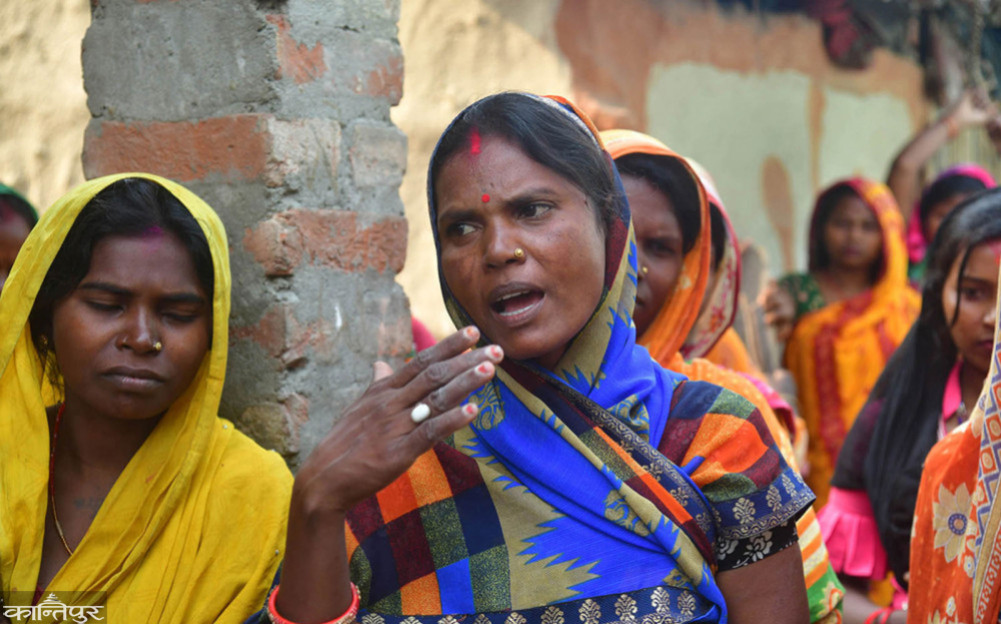
Senior advocate Chandra Kumar Mainali says it is sad that those for whom the constitution made provisions such as proportional representation and inclusion are being deprived are being deprived.
We use Google Cloud Translation Services. Google requires we provide the following disclaimer relating to use of this service:
This service may contain translations powered by Google. Google disclaims all warranties related to the translations, expressed or implied, including any warranties of accuracy, reliability, and any implied warranties of merchantability, fitness for a particular purpose, and noninfringement.
Even after more than a decade of the implementation of the federal democratic republican constitutional system, the representation of the Madhesi Dalit community in the House of Representatives is zero. In the three elections to the House of Representatives held in the meantime, more than 800 members of parliament were elected to the parliament through direct and proportional representation. However, only two Madhesi Dalits have become members of parliament.
Out of the 19 Dalit members represented in the House of Representatives in the 2074 BS elections, only one was a Madhesi Dalit. The then RJPN Nepal had made Dulari Devi Khatveni an MP from Saptari through the proportional representation system. Similarly, in 2079 BS, only one out of 16 Dalits became a Madhesi Dalit MP. The CPN-UML had made Prabhu Hazara Dusadh of Parsa a member of the parliament.
Let's leave aside the Congress, Communists and Madhesh-centric parties. The pro-change party, which received an unimaginable public vote from Madhesh, is not participating this time, instead of increasing the representation of Madhesh Dalits. The National Independent Party (RSP), which became the largest party in the election, did not elect Arvind Kumar Ram from Siraha despite putting him on the closed list for proportional representation. This time, the RSP has won 30 seats out of 32 Madhesh seats.
Article 40, Clause 7 of the Constitution recognizes the Dalit community not as a single identity, but the internal diversity, geography, language, culture and oppression within Dalits. Clause 7 of the Constitution states that the facilities received by the Dalit community should be distributed fairly so that Dalits in all communities receive them proportionally.
In the recently concluded elections, 17 Dalit MPs from across the country have reached the House of Representatives. One was elected through the direct system (Khagendra Sunar from Banke-3) and the remaining 16 were elected through the proportional system. According to the census, Dalits constitute 13 percent of the country's population, but their share in the parliament is only 6.2 percent. This trend has been going on continuously for the last 3 decades. The old parties have not even tried to bridge this gap, and even the so-called new ones have not shown any interest.
Although 20 percent of Dalits in the 34-year presence in the House of Representatives were Madhesi Dalits, this number has come down to zero by 2082. It was negligible even before that. Senior advocate Chandra Kumar Mainali says that it is sad that those for whom proportional, inclusive and other provisions were made in the constitution are being deprived. He says, 'The class that needs transformation and mainstreaming of the state the most is the class that is being deprived. Overall, this is a conspiracy against the country, the rule of law, proportionality and inclusion.'
According to the National Census 2078, the total population of the Dalit community across the country is 3.898 million. Of this, Pahadi Dalits are about 8.6 percent and Madhesi Dalits are 4.8 percent. Dalits make up about 18 percent of the total population (more than 6.1 million) in Madhesh.
Despite such a large population, keeping one's relatives in the House of Representatives on the proportional side based on political access and keeping the presence of Madhesi Dalits zero is also a violation of constitutional provisions. ‘From ticket distribution to proportional representation, leaders who make lists first choose those from their own community,’ says researcher Bhola Paswan, ‘Madhesi Dalit parties do not get access to internal discussions. They are not allowed to enter the room where the decision on ticket distribution is made.’
Rights activist Ramji Ram also believes that the next step in policy reform should be to reserve certain constituencies for Dalits for direct elections in a cyclical manner.’ He said, ‘Only then will parties be forced to empower Dalits,’ he said.
Advocate Raksha Ram Harijan has approached the Supreme Court twice in 8 years over the issue of the ongoing game-changing situation over the presence of Madhesi Dalits in the House of Representatives. In the 2074 elections, he had approached the Supreme Court and argued, ‘Madhesi Dalits are not included in the proportional representation list of the party, this is a direct violation of the constitution.’ The court did not rule until the remaining term of parliament was over. After the end of the matter, it was said in Chaitra 2080 that since the parliament no longer existed, there was no justification for this case.
In the 2079 elections, Harijan also approached the Supreme Court with a similar petition. The argument was the same. The Supreme Court did not give an order. The hearing of the case has been scheduled for a month from now. However, the parliament in which Madhesi Dalit representation was demanded was dissolved after the Gen-G movement toppled the government. After that, elections for a new House of Representatives have also been held. Harijan knows that the same verdict will be given in this petition.