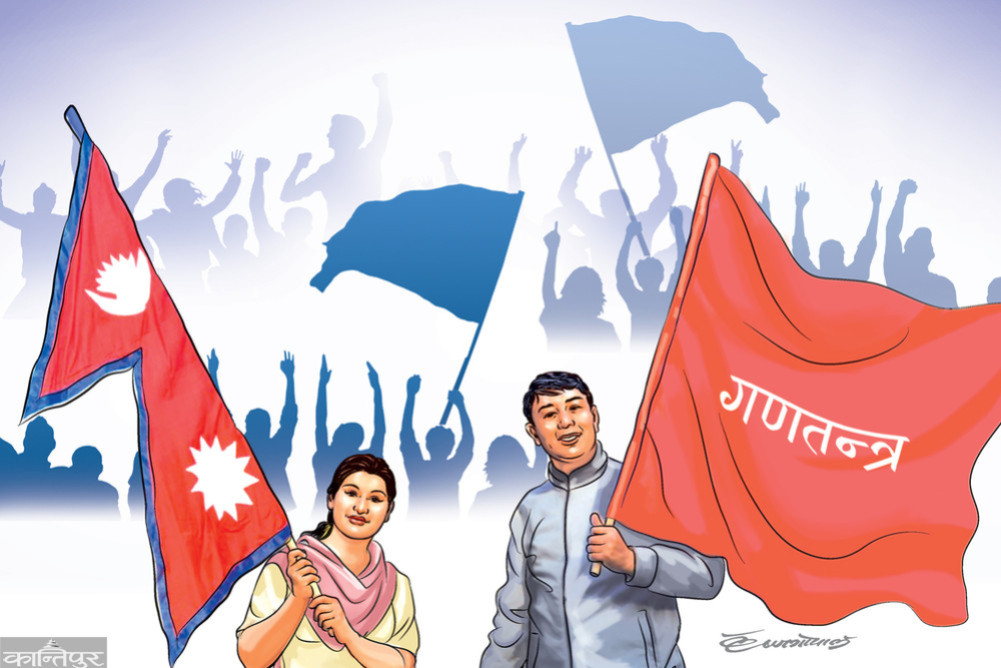
The representation of the Khas-Arya community in parliament has increased, while the presence of Dalits, Tharu, Madhesi and indigenous communities has decreased, says analyst Tulanarayan Sah, ”It is very difficult for Dalits and women to win elections. Madhesis, Tharu and indigenous communities have not won in areas other than their demographic majority.”
We use Google Cloud Translation Services. Google requires we provide the following disclaimer relating to use of this service:
This service may contain translations powered by Google. Google disclaims all warranties related to the translations, expressed or implied, including any warranties of accuracy, reliability, and any implied warranties of merchantability, fitness for a particular purpose, and noninfringement.
The representation of the Khas-Aryan community in the direct election is increasing, while the representation of the indigenous, Madhesi, and Tharu communities is also decreasing. It does not appear that even the proportional system can bridge the gap in representation created by the latest direct election results.
In 2074, 52.1 percent of those directly elected were Khas-Aryas. The representation of Khas-Aryas increased to 58.2 percent in 2079 and is now 60.6 percent. The representation of indigenous peoples has now remained at 15.8 percent, down from 21.2 percent in 2074 and 20.6 percent in 2079. Similarly, the directly elected Madhesis have now remained at 16.0 percent, down from 17.7 percent in 2074 and 16.4 percent in 2079.
Dalit representation was 1.8 percent in 2074. It has now remained at 0.6 percent, the same as in 2079. Muslim representation has now remained at 2.5 percent, down from 1.8 percent in 2074 and zero percent in 2079. This is the only marginalized community that has seen an improvement in representation.
The constitution states that proportional inclusive representation should be ensured in every body of the state, that is, it is a constitutional obligation to ensure representation in proportion to the population of all, including indigenous peoples, Madhesis, Tharus, Dalits, Muslims. But the data from the recently held elections shows that the House of Representatives is becoming increasingly unincorporated. In this election, the Khas-Arya population, which has 60.6 percent direct representation, is 30 percent.
In the previous election, there was only one directly elected MP from the Dalit community (Chabilal Bishwokarma of UML from Rupandehi-1), and this time there is only one - Khagendra Sunar. He was elected from Banke-3 of the Rashtriya Swayamsevak Sangh (RSS). The population of this community is about 13 percent.
In the election, all parties gave more tickets to the Khas-Aryas. The highest number of direct candidates of the Rashtriya Swayamsevak Sangh (RSS) was about 62 percent Khas-Aryas. When the Rashtriya Swayamsevak Sangh (RSS) won 76 percent of the seats in the direct elections with a nationwide wave, it also elected twice as many Khas-Aryans as the population. The Rashtriya Swayamsevak Sangh (RSS) had reduced the number of indigenous peoples, Dalits, Tharu and Muslims to give more representation to Khas-Aryan men, and the result is the same now.
Analyst Tulanarayan Sah says, “This result was predicted in advance.” He says that the marginalized communities have not been able to get elected because the major parties have given more tickets to Khas-Aryans. “Looking at Nepal’s electoral history, it seems that the Brahmins and Chhetris of the hills have a higher chance of winning,” he says. “It is very difficult for Dalits and women to win elections. Madhesis, Tharus and Janajatis have not won in areas other than their demographic majority.”
Analyst Sah says that the issue of the identity of marginalized communities has been overlooked during the dominance of ‘grand narratives’. Giving an example of the marginalization of the issues of marginalized communities within Hinduism in the political discourse of Hindutva in India, he says, ‘It is a long-standing trend to say that we want to see all Nepalis laughing, but to take political advantage, it is a continuation of the trend of pushing the upper classes of society forward.’
In the 275-member House of Representatives, 40 percent, or 110 seats, are reserved for proportional representation. But even of that, the highest share, about 31 percent, is reserved for the Khas-Arya community. Even through proportional representation, the highest share, about one-third of the MPs, is reserved for the Khas-Arya community. Moreover, the reserved share that the remaining communities will get is only from 110 seats. That does not have the power to change the structure of the 275-member parliament in a way that makes it inclusive.
For example, only 14 people will come from 110 out of 13 percent of the seats reserved for Dalits. Since only one Dalit is directly elected, 15 Dalits will be in the parliament through proportional representation, which is only 5.5 percent of the 275-member House of Representatives. This narrowing of representation will continue for other communities as well. ‘The law has been made to reserve proportional seats for the class that already has more representation,’ says former MP Anjana Bishankhe. ‘Such a practice of reserving seats for the ruling class probably does not exist anywhere else.’
Legal experts have been suggesting ways to amend the law to improve this by not giving proportional reservation to communities elected through the direct system in proportion to their population and to elect communities that are not sufficiently elected through the direct system to the extent that they are not enough.
Even for the minimum 33 percent representation of women guaranteed by the constitution, we have to depend on the proportional system. Of those elected through direct systems, 3.6 percent were women in 2074 and 5.5 percent in 2079. Currently, women's representation has reached 8.5 percent. Despite gradual improvements, the number of women elected directly is far from the limit guaranteed by the constitution.